


AS Janet Jackson fans gear up for her Taipei concert tonight, US media have been airing “exclusive” interviews with the pop diva to promote True You: A Journey to Finding and Loving Yourself, a memoir-cum-self-help guide-cum-diet manual that documents her struggles with self-confidence.
“There was a lot of pain in my life,” she said in an interview on NBC’s Dateline and Today shows that aired this week.
In an interview with CNN broadcast on Tuesday, the day of the book’s release, the 44-year-old Jackson said she “felt so unattractive … I used to bang my head against the wall.”

Photo courtesy of Universal Music Taiwan
Jackson will perform Janet Number Ones: Up Close and Personal at the Taipei World Trade Center Nangang Exhibition Hall (台北世界貿易中心南港展覽館) beginning tonight at 8pm, and according to Very Aspect Culture Group (有象文化), 95 percent of tickets had been sold by press time.
As with other stops on her 35-city world tour, Jackson will dedicate one of her No. 1 hits to Taipei.
“Because of Love is the No. 1 I’m dedicating to Taipei,” she was quoted as saying on her official Web site. “I dedicated this song to each of you and want you all to know I’m coming to Taipei because of love.”
While here, she’ll stay in the same Zhongshan District hotel room that her brother Michael did when he visited in 1993 and 1996. On the topic of Michael, Jackson told Today: “There’s still not a day that goes by that I don’t think about him. Not one day.”
But her thoughts aren’t always positive. According to the New York Post, Janet said the King of Pop contributed to her self-esteem problems.
“A lot of his pet names had to do with my backside,” she was quoted as writing.
“There were a lot of names,” she confessed on the Today show. “‘Horse, pig, cow, slut or hog.’ I guess some people could say, ‘Oh that’s, you know, brothers and sisters joking, it’s all affection, it’s all, you know, it’s in a loving way.’ But not everybody can brush it off, and I was one of those.”
And though Janet says she has rebounded from these childhood taunts and found love, some feel she isn’t spreading enough of it. Her recent Manila concert attracted the attention of animal rights activists, who rallied outside the venue to protest against her endorsement of fur coats.
Others have said her Up Close and Personal Tour, is, well, less than up close and personal, a problem the 10,000-seat Taipei venue could exacerbate.
Commenting on her Feb. 7 Singapore performance, a report in AsiaOne said that aside from the song lyrics, she barely mouthed a “meaningful word” while on stage, “aside from the obligatory, ‘I love Singapore.’”
A reporter with the Jakarta Globe made similar comments after watching her Feb. 9 concert.
“Jackson’s show was hardly a living room performance and the distance from the performer — physically and emotionally — was palpable. Communication with the audience mainly consisted of Jackson shouting, ‘Jakarta!’ and ‘I love you, Jakarta!’”
Mind you, had she said more it might have been something like, “I’m just Janet. I have strengths, weaknesses, fears, happiness, sadness. I experience joy and I experience pain,” or “I’m highly emotional. I’m very vulnerable. And, as anyone who knows me well will testify, I’m extremely sensitive,” according to excerpts from her book, which seems intended to show that, like everyone else, Jackson is human.
The star, who has sold more than 100 million albums over her 35-year career, evidently wants readers to understand that growing up, like fame and much else in life, is fraught with confusion and pain.
“Had there been a book that addressed issues like body image, I would have read it immediately. Had there been a book that told me I wasn’t alone — that millions of men, women, and children are confused about self-image — I would have been grateful. That kind of book could have made a difference in my life,” she wrote.
In the end, people will read her book for the same reason they will go to her concert: it’s entertainment, a spectacle. And to enter Jackson’s world, like that of most entertainers of her caliber, the price of admission is worth paying.

Taiwan’s English education system is being pulled apart by three opposing forces. Bilingual Nation 2030 pulls students toward English and global communication. Artificial Intelligence (AI) readiness pulls them toward digital judgment, verification and AI-mediated work. But Taiwan’s old exam culture pulls them back toward memorization, grammar drills, timed reading and correct answers. If the education system keeps using old exams to define success, it risks producing graduates who are neither genuinely bilingual nor genuinely AI-ready, but trained for tasks machines can already perform. The first force is Bilingual Nation 2030. Launched in 2018, the policy aimed to “help Taiwan’s workforce connect

It seems every few days one bumps into one of those “real man” comments in which Taiwan is urged to “face reality” or similar, and “make a deal,” with the speaker implying that soon it will be too late. “Deal” advocates always present themselves as having a superior grip on reality, and the manly ability to make the “hard choice.” Their testosterone-laden language often echoes that of Taiwan sellout advocates. Note that such commentary always specifies a process (“make a deal, work with, make progress”), never the end state of what occupation by a violent authoritarian colonialist state will entail. In

“Taiwan’s Opposition Leader Comes to US With a Message Straight Out of Beijing” read a May 31 headline in the Wall Street Journal. Top US administration officials and members of Congress almost certainly read the WSJ, and if there was a bullet point takeaway that people in Washington should absorb ahead of Chinese Nationalist Party (KMT) Chair Cheng Li-wun’s (鄭麗文) arrival in DC on June 9, that headline is it. The last few columns have discussed this very topic, and the timing is not coincidental. While those top officials likely do not read the Taipei Times, judging by the number
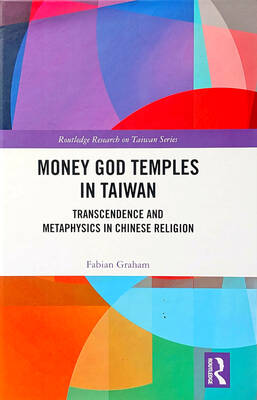
As someone who normally steers clear of books with “transcendence” or “metaphysics” in their subtitles, this reviewer — a casual observer of local belief systems since the 1990s — found Fabian Graham’s Money God Temples in Taiwan a challenging read. Those who’ve only dipped their toes into temple culture will likely need to parse several sections with special care if they’re to keep up with the author, a British ethnographic researcher whose previous books have investigated religious practices among ethnic Chinese in Southeast Asia. This scholarly volume examines a facet of Taiwan’s religious landscape that didn’t exist a century ago, and


 RSS
RSS