


If art is among your full-blown obsessions or just a budding interest, Google, which has altered the collective universe in so many ways, changed your life last week. It unveiled its Art Project, a Web endeavor that offers easy, if not yet seamless, access to some of the art treasures and interiors of 17 museums in the US and Europe.
It is very much a work in progress, full of bugs and information gaps, and sometimes blurry, careering virtual tours. But it is already a mesmerizing, world-expanding tool for self-education. You can spend hours exploring it, examining paintings from far off and close up, poking around some of the world’s great museums all by your lonesome. I have, and my advice is: Expect mood swings. This adventure is not without frustrations.
On the virtual tour of the Uffizi in Florence, Italy, the paintings are sometimes little more than framed smudges on the wall. (The Durer room: Don’t go there.) But you can look at Botticelli’s Birth of Venus almost centimeter by centimeter. It’s nothing like standing before the real thing. What you see is a very good reproduction that offers the option to pore over the surface with an adjustable magnifying rectangle. This feels like an eerie approximation, at a clinical, digital remove, of the kind of intimacy usually granted only to the artist and his assistants, or conservators and preparators.
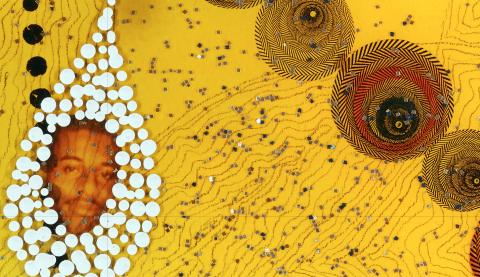
Photo: Bloomberg
There are high-resolution images of more than 1,000 artworks in the Art Project (googleartproject.com) and virtual tours of several hundred galleries and other spaces inside the 17 participating institutions. In addition, each museum has selected a single, usually canonical work — like Botticelli’s Venus — for star treatment. These works have been painstakingly photographed for super-high, mega-pixel resolution. (Although often, to my eye, the high-resolution version seems as good as the mega-pixel one.)
The Museum of Modern Art selected Van Gogh’s Starry Night, and you can see not only the individual colors in each stroke, but also how much of the canvas he left bare. The Metropolitan Museum of Art’s star painting is Bruegel’s Harvesters, with its sloping slab of yellow wheat and peasants lunching in the foreground. Deep in the background is a group of women skinny-dipping in a pond that I had never noticed before.
In the case of Van Gogh’s famous Bedroom, the star painting chosen by the Van Gogh Museum in Amsterdam, I was able to scrutinize the five framed artworks depicted on the chamber’s walls: two portraits, one still life and two works, possibly on paper, that are so cursory they look like contemporary abstractions. And I was enthralled by the clarity of the star painting of the National Gallery in London, Hans Holbein’s Ambassadors, and especially by the wonderful pile of scientific instruments — globes, sun dials, books — that occupy the imposing two-tiered stand flanked by the two young gentlemen.
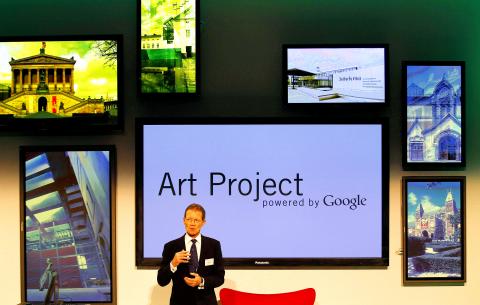
Photo: Reuters
Google maintains that, beyond details you may not have noticed before, you can see things not normally visible to the human eye. And it is probably true. I could make out Bruegel’s distant bathers when I visited the Met for a comparison viewing, but not the buttocks of one skinny-dipper, visible above the waves using the Google zoom. Still, the most unusual aspects of the experience are time, quiet and stasis: You can look from a seated position in the comfort of your own home or office cubicle, for as long as you want, without being jostled or blocked by other art lovers.
At the same time the chance to look closely at paintings, especially, as made things, really to study the way artists construct an image on a flat surface, is amazing, and great practice for looking at actual works. And while the Internet makes so much in our world more immediate, it is still surprising to see what it can accomplish with the subtle physicality of painting, whether it is the nervous, fractured, tilting brush strokes of Cezanne’s Chateau Noir from 1903-1904, at the Museum of Modern Art in New York, or the tiny pelletlike dots that make up most of Chris Ofili’s No Woman No Cry from about a century later at the Tate Modern in London (the only postwar work among the 17 mega-pixel stars).
The Ofili surface also involves collaged images of Stephen Lawrence, whose 1993 murder in London became a turning point in Britain’s racial politics; along with scatterings of glitter that read like minuscule, oddly cubic bits of gold and silver; and three of those endlessly fussed-over clumps of elephant dung, carefully shellacked and in two cases beaded with the word “No.” Take a good look and see how benign they really are. (You can also see the painting glow in the dark, revealing the lines “R.I.P./Stephen Lawrence/1974-1993.”)
Another innovation of the Art Project is Google’s adaptation of its Street View program for indoor use. This makes it possible, for example, to navigate through several of the spacious salons at Versailles gazing at ceiling murals — thanks to the 360? navigation — or to get a sharper, more immediate sense than any guidebook can provide of the light, layout and ambience of the Tretyakov Gallery in Moscow. It also means that if your skill set is shaky, you can suddenly be 86ed from the museum onto the street, as I was several times while exploring the National Gallery.
Keep in mind that usually only a few of the many, many works encountered on a virtual tour are available for high-res or super-high-res viewing. And those few aren’t always seen in situ, hanging in a gallery. The architectural mise-en-scene is the main event of the virtual tours in most cases, from the Uffizi’s long, grand hallways to the gift shop of the Rijksmuseum in Amsterdam and the modest galleries of the Kampa Museum in Prague, where the star paintings is Frantisek Kupka’s 1912-1913 Cathedral, the only abstraction among what could be called the Google 17.
The Art Project has been hailed as a great leap forward in terms of the online art experience, which seems debatable, since most museums have spent at least the past decade — and quite a bit of money — developing Web access to works in their collections. On the site of the National Gallery, for example, you can examine the lush surface of Velazquez’s Rokeby Venus with a zoom similar to the Art Project’s. Still, Google offers a distinct and extraordinary benefit in its UN-like gathering of different collections under one technological umbrella, enabling easy online travel among them.
When you view a work by one artist at one museum, clicking on the link “More works by this artist” will produce a list of all the others in the Art Project system. But some fine-tuning is needed here. Sometimes the link is missing, and sometimes it links only to other works in that museum. Other tweaks to consider: including the dates of the works on all pull-down lists, and providing measurements in inches as well as centimeters.
Despite the roster of world-class museums, there are notable omissions: titans like the Louvre and the Musee d’Orsay in Paris, the Prado in Madrid and the Kunsthistorisches Museum in Vienna, not to mention most major American museums, starting with the National Gallery in Washington. Without specifying who turned it down, Google says that many museums were approached, that 17 signed on, and that it hopes to add more as the project develops.
This implies an understandable wait-and-see attitude from many institutions, including some of the participants. The Museum of Modern Art, for example, has made only one large gallery available — the large room of French Post-Impressionist works that kicks off its permanent collection displays — along with 17 paintings that are all, again, examples of 19th century Post-Impressionism. (Oh, and you can wander around the lobby.)
On first glance this seems both unmodern in focus and a tad miserly, given that several museums offer more than 100 works and at least 15 galleries. But MoMA is being pragmatic. According to Kim Mitchell, the museum’s chief communications officer, the 17 paintings “are among the few in our collection that do not raise the copyright-related issues that affect so many works of modern and contemporary art.” In other words, if and when the Art Project is a clear success, the Modern will decide if it wants to spend the time and money to secure permission for Picasso’s Demoiselles d’Avignon and the like to appear on it.
This might also hold true for the Museo Reina Sofia in Madrid, which owns Picasso’s Guernica, but has so far limited its participation primarily to 13 paintings by the Cubist Juan Gris and 35 photographs from the Spanish Civil War. Needless to say, the works and galleries that each museum has selected for the first round of the Art Project makes for some interesting institutional psychoanalysis.
From where I sit, Google’s Art Project looks like a bandwagon everyone should jump on. It makes visual knowledge more accessible, which benefits us all.
In many ways this new Google venture is simply the latest phase of simulation that began with the invention of photography, which is when artworks first acquired second lives as images and in a sense, started going viral. These earlier iterations — while never more than the next best thing — have been providing pleasure for more than a century through art books, as postcards, posters and art-history-lecture slides. For all that time they have been the next best thing to being there. Now the next best thing has become better, even if it will never be more than next best.

For many people, Bilingual Nation 2030 begins and ends in the classroom. Since the policy was launched in 2018, the debate has centered on students, teachers and the pressure placed on schools. Yet the policy was never solely about English education. The government’s official plan also calls for bilingualization in Taiwan’s government services, laws and regulations, and living environment. The goal is to make Taiwan more inclusive and accessible to international enterprises and talent and better prepared for global economic and trade conditions. After eight years, that grand vision is due for a pulse check. RULES THAT CAN BE READ For Harper Chen (陳虹宇), an adviser

Traditionally, indigenous people in Taiwan’s mountains practice swidden cultivation, or “slash and burn” agriculture, a practice common in human history. According to a 2016 research article in the International Journal of Environmental Sustainability, among the Atayal people, this began with a search for suitable forested slopeland. The trees are burnt for fertilizer and the land cleared of stones. The stones and wood are then piled up to make fences, while both dead and standing trees are retained on the plot. The fences are used to grow climbing crops like squash and beans. The plot itself supports farming for three years.

The breakwater stretches out to sea from the sprawling Kaohsiung port in southern Taiwan. Normally, it’s crowded with massive tankers ferrying liquefied natural gas from Qatar to be stored in the bulbous white tanks that dot the shoreline. These are not normal times, though, and not a single shipment from Qatar has docked at the Yongan terminal since early March after the Strait of Hormuz was shuttered. The suspension has provided a realistic preview of a potential Chinese blockade, a move that would throttle an economy anchored by the world’s most advanced and power-hungry semiconductor industry. It is a stark reminder of

May 4 to May 10 It was once said that if you hadn’t performed at the Sapphire Grand Cabaret (藍寶石大歌廳), you couldn’t truly be considered a star. Taking the stage at the legendary Kaohsiung club was more than just a concert. Performers were expected to entertain in every sense, wearing outlandish or revealing costumes and staying quick on their feet as sharp-tongued, over-the-top hosts asked questions and delivered jokes that would be seen as vulgar, even offensive, by today’s standards. Opening in May 1967 during a period of strict political and social control, Sapphire offered a rare outlet for audiences in


 RSS
RSS