


The whirlwind romance between singer and actress Barbie Hsu (徐熙媛, aka Big S) and 29-year-old Chinese restaurateur and multimillionaire Wang Xiaofei (汪小菲) has spawned yet another surprise.
The couple, who got engaged last month on their fourth date and announced that the wedding would be next year, officially tied the knot by registering their marriage in Beijing last week.
“I couldn’t wait any longer,” the Apple Daily quoted Wang as saying.

Photo: Taipei times
The news must have come as a surprise to Hsu’s family, which includes her talk show host sister Dee Hsu (徐熙娣, aka Little S).
Their father, Hsu Chien (徐堅), initially denied the report, saying that Big S made no mention of her plans over dinner with the family before the news broke. “If it were true, she would have told me,” he said.
But as the Apple tells it, Big S took a leave of absence from the movie she’s currently shooting in China and returned to Taipei on a one-day trip to fetch documentation showing that she was single for Beijing authorities.
The two confirmed the wedding in a press statement on Wednesday last week, requesting that the media give them space and “pay attention to safety even as you hunt us down.”
With the rush to make things official, there has been speculation that Hsu is already pregnant. She has reportedly been spotted getting out of cars with the help of an assistant and wearing “loose clothing” and flats instead of her favored heels. Wang denied the rumors, telling Hong Kong’s Sing Tao Daily they got married early because “we just felt it was time.”
With that formality out of the way, the couple are planning at least three wedding parties in March next year, slated to be held in Taipei, Beijing, and Hainan Island.
Meanwhile, Selina Jen (任家萱) continues to recover from a serious accident last month during a television shoot in China in which the S.H.E. singer suffered severe burns.
The 29-year-old’s record company, HIM International Music (華研國際音樂), released an official account of her condition earlier this week. Jen has burns covering 54 percent of her body, with 41 percent of them third-degree burns concentrated on her legs and waist.
Jen has undergone several skin graft surgeries, and had to shave her head to provide skin from her scalp for the transplant.
Both her record company and fiance Richard Chang (張承中) have been providing regular updates on Jen’s recovery, which they say has been “better than expected,” but difficult nonetheless.
“For quite a while she’s been in so much pain that she doesn’t even have the strength to bite her tongue,” the Apple Daily quoted Chang as saying. “I don’t know where she gets the power to carry on.”
According to channelnewsasia.com, compensation talks are in the works between HIM and Hunan Television (湖南衛視), the broadcaster that invited Jen to participate in the ill-fated shoot.
Jen earned more than NT$130 million (US$4.3 million) last year, and considering that her recovery is expected to take at least a year, various media outlets are speculating that Hunan Television will have to make a substantial payout.
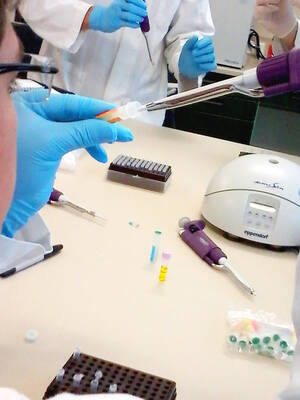
Google unveiled an artificial intelligence tool Wednesday that its scientists said would help unravel the mysteries of the human genome — and could one day lead to new treatments for diseases. The deep learning model AlphaGenome was hailed by outside researchers as a “breakthrough” that would let scientists study and even simulate the roots of difficult-to-treat genetic diseases. While the first complete map of the human genome in 2003 “gave us the book of life, reading it remained a challenge,” Pushmeet Kohli, vice president of research at Google DeepMind, told journalists. “We have the text,” he said, which is a sequence of
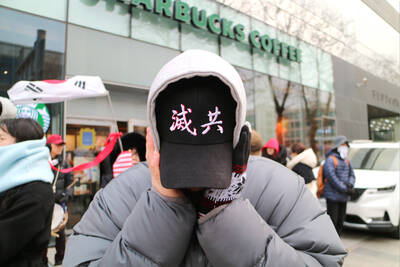
On a harsh winter afternoon last month, 2,000 protesters marched and chanted slogans such as “CCP out” and “Korea for Koreans” in Seoul’s popular Gangnam District. Participants — mostly students — wore caps printed with the Chinese characters for “exterminate communism” (滅共) and held banners reading “Heaven will destroy the Chinese Communist Party” (天滅中共). During the march, Park Jun-young, the leader of the protest organizer “Free University,” a conservative youth movement, who was on a hunger strike, collapsed after delivering a speech in sub-zero temperatures and was later hospitalized. Several protesters shaved their heads at the end of the demonstration. A
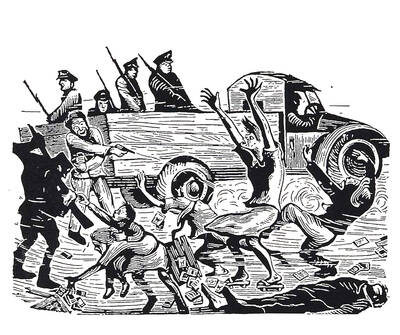
In August of 1949 American journalist Darrell Berrigan toured occupied Formosa and on Aug. 13 published “Should We Grab Formosa?” in the Saturday Evening Post. Berrigan, cataloguing the numerous horrors of corruption and looting the occupying Republic of China (ROC) was inflicting on the locals, advocated outright annexation of Taiwan by the US. He contended the islanders would welcome that. Berrigan also observed that the islanders were planning another revolt, and wrote of their “island nationalism.” The US position on Taiwan was well known there, and islanders, he said, had told him of US official statements that Taiwan had not

We have reached the point where, on any given day, it has become shocking if nothing shocking is happening in the news. This is especially true of Taiwan, which is in the crosshairs of the Chinese Communist Party (CCP), uniquely vulnerable to events happening in the US and Japan and where domestic politics has turned toxic and self-destructive. There are big forces at play far beyond our ability to control them. Feelings of helplessness are no joke and can lead to serious health issues. It should come as no surprise that a Strategic Market Research report is predicting a Compound


 RSS
RSS