


She is called Nicoletta and, undoubtedly, is as delightful as any healthy newborn baby. But her birth two weeks ago in the southern Spanish city of Jerez has provoked a storm — because her mother is just 10 years old.
What has shocked the rest of the world, however, is described as a happy event by the family.
“My daughter is well, as is the little girl — who is very fine and pretty. She is very happy with her daughter,” the baby’s Romanian grandmother, Olimpia, told Spanish journalists. “This is not a drama, it is a cause for happiness. At this age we marry in Romania. It is normal amongst we Gypsies.”
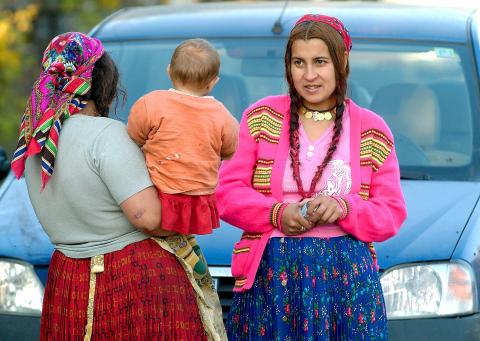
Photo: Bloomberg
Can that really be true? Recorded examples suggest that mothers this young tend to be victims of abuse or rape. And what does Nicoletta’s birth say about everything from the increasingly early development of young girls’ bodies and the cultural norms of Romania’s Roma community to the laws in Spain, where the child gave birth?
Doctors at the hospital in Jerez confirmed that the family had been pleased at the birth. Both the child’s mother and the grandmother took it in their stride, and there had been no need for a cesarean. The hospital apparently knew nothing about the pregnancy until the mother turned up on Oct. 26.
The father is said to be another minor, an unnamed Romanian boy aged 13. The relationship is now described as “over” by Olimpia. Under Spanish law, the age for consensual sex with an adult is 13 — one of the world’s lowest. And, in a measure apparently maintained for Spain’s own Gypsy community, the law allows a 14-year-old to marry if a judge decides there are exceptional circumstances.
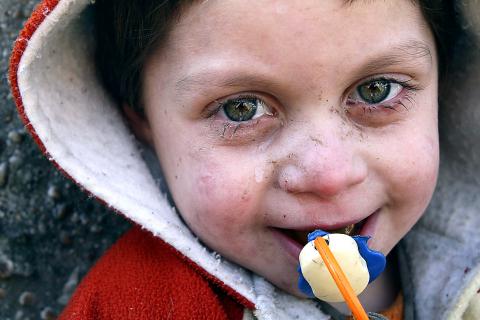
Photo: Reuters
The UN has called on Spain to raise that age. But the law has little to say about consensual sex among minors (those under the age of 18), nor the responsibility or otherwise of the parents. A magistrate in the provincial capital of Seville this week opened an investigation — but apparently only to find out why the mother had not been going to school and had not visited a doctor before the birth.
Little is known of the details of the young mother’s journey from pregnancy to childbirth. Some reports say that she arrived in Spain only three weeks ago, apparently to attend a wedding.
“The mother of the young girl says they came for a wedding and that she had got pregnant in Romania,” explains a town hall spokeswoman in Lebrija, where the family is living.
Attempts to paint the family as welfare scroungers have failed. “We have money, a home, electricity and water, so we do not need anything from the Spanish government,” Olimpia says.
The child’s mother herself stepped out of their small apartment on Wednesday last week to take her baby to the local heath clinic. The girl wore a loose pink top and a flowing red dress, and her family placed a cloth over her head to protect her from photographers. “She is scared they will take her baby away,” says Maria, a fellow Romanian who lives in the same apartment block. “The family is worried about what might happen, so they have stopped opening the door to people.”
The baby’s grandmother has been living in Lebrija for a while. Authorities seemed so stunned by the birth that they did not know what to do. The hospital released mother and child after four days. Only later did the local social services say they were investigating to see whether the baby would be properly looked after. Mayor Maria Jose Fernandez said the family had never visited the local health center before, but confirmed that the baby was doing fine.
Robert Rustem, of the European Roma and Travellers Forum based in Brussels, says the case is exceptional and does not reflect practices in Romania or anywhere else. “I was aware of some cases of children of 15 giving birth, but it the first time I have heard of a birth to a 10-year-old. This is not an example of what happens in the entire community, though there are cases of early marriages — which we do not support — in certain communities. At the end of the day, it is really a decision of the girl and the parents — who are the guardians. The girl is a minor so her parents are the ones who must take responsibility.”
But he adds: “It is not acceptable that a girl at the age of 10 is giving birth to a baby. She is still a child and still developing as a person. Early marriage fosters the gap between communities and reinforces the cycle of poverty.”
Doctors warn of the physical dangers to children whose own bodies are still growing. “If the mother has not completed her physical development or does not have the right nutrition to cope with the deficiencies caused by her age and condition, the consequences can be grave,” gynecologist De Manuel Alonso told El Pais. “Even if the body is ready, a young girl is not mentally prepared to become a mother,” warned child psychologist Carolina Fernandez.
In Lebrija some of the neighbors have questioned the girl’s age. “She looks much older,” said one. But the early onset of puberty among young girls is increasing across Europe.
Little Nicoletta’s case is by no means unique in Spain, where abortions were performed on two girls aged nine and 10 in 2008 — the last year for which data is available. Wikipedia — an admittedly unscientific source — lists 22 recorded cases of births to girls aged 10 and under around the world. The youngest was the extraordinary case of a six-year-old Peruvian, who suffered precocious puberty and gave birth to a healthy boy by cesarean in 1939. That birth warranted a mention in Time magazine.
Of the 22 cases, there are five births to nine-year-olds from Brazil, Thailand, China, Singapore and Rwanda over the past decade. Four 10-year-olds from the US are also on the list, including two in the past four years.
The increasingly early onset of puberty will inevitably bring earlier pregnancies, says Tam Fry, of Britain’s Child Growth Foundation. “This is an indication of how girls are going into puberty uncommonly early,” he says.
Child obesity and hormone-laden chemicals that have gotten into the food or water cycle have been blamed for this. But while doctors disagree about the cause, the results are clear. Breast development, the first sign of the arrival of puberty, has moved forward nine months since 1958, according to Peter Hindmarsh, professor of pediatric endocrinology at Great Ormond Street Hospital in London. The current average age for the onset of puberty for girls is 10.75.
“The UK has a history of an increasing number of teenage pregnancies,” Fry says. “My view, without having any figures to back it up, is that they are getting earlier and earlier ... I would be worried sick if I were a parent of these girls. They are young women at the age of 10. So then it is not impossible to be of child-bearing age at 10.”
Fry, who is in favor of medical intervention to slow down those who reach puberty too early, adds: “It is a kind of disaster.”
The one thing no one outside the family knows is exactly what the young Romanian mother herself thinks of the whole affair. “Now they will have to bring the child up,” her neighbor Maria says.

The primaries for this year’s nine-in-one local elections in November began early in this election cycle, starting last autumn. The local press has been full of tales of intrigue, betrayal, infighting and drama going back to the summer of 2024. This is not widely covered in the English-language press, and the nine-in-one elections are not well understood. The nine-in-one elections refer to the nine levels of local governments that go to the ballot, from the neighborhood and village borough chief level on up to the city mayor and county commissioner level. The main focus is on the 22 special municipality

In the 2010s, the Communist Party of China (CCP) began cracking down on Christian churches. Media reports said at the time that various versions of Protestant Christianity were likely the fastest growing religions in the People’s Republic of China (PRC). The crackdown was part of a campaign that in turn was part of a larger movement to bring religion under party control. For the Protestant churches, “the government’s aim has been to force all churches into the state-controlled organization,” according to a 2023 article in Christianity Today. That piece was centered on Wang Yi (王怡), the fiery, charismatic pastor of the

Hsu Pu-liao (許不了) never lived to see the premiere of his most successful film, The Clown and the Swan (小丑與天鵝, 1985). The movie, which starred Hsu, the “Taiwanese Charlie Chaplin,” outgrossed Jackie Chan’s Heart of Dragon (龍的心), earning NT$9.2 million at the local box office. Forty years after its premiere, the film has become the Taiwan Film and Audiovisual Institute’s (TFAI) 100th restoration. “It is the only one of Hsu’s films whose original negative survived,” says director Kevin Chu (朱延平), one of Taiwan’s most commercially successful

Jan. 12 to Jan. 18 At the start of an Indigenous heritage tour of Beitou District (北投) in Taipei, I was handed a sheet of paper titled Ritual Song for the Various Peoples of Tamsui (淡水各社祭祀歌). The lyrics were in Chinese with no literal meaning, accompanied by romanized pronunciation that sounded closer to Hoklo (commonly known as Taiwanese) than any Indigenous language. The translation explained that the song offered food and drink to one’s ancestors and wished for a bountiful harvest and deer hunting season. The program moved through sites related to the Ketagalan, a collective term for the


 RSS
RSS