


Is it just Pop Stop, or is religious zeal taking over Taiwan’s celebrity firmament?
First it was actor and singer Van Ness Wu (吳建豪), who became a born-again, Bible-thumping Christian a few years back and has been preaching to anyone who will listen ever since.
While filming his newest movie, Material Queen (拜金女王), in Paris, Wu said that he “thanks God” he didn’t have to do a bedroom scene with his co-star Lynn Hung (熊黛林), the United Daily News reported earlier this week.

Photo: Taipei times
The report implied that Wu’s comments were made in response to rumors that wealthy Singaporean Arissa Cheo (also known as Arissa Luna) dumped him because he refused to get to know her — in the biblical sense that is. “Regardless of love relationships or work, God is the one giving me strength and power,” he was verily quoted as saying.
It’s easy to see why piety such as Wu’s would prove popular among celebrities, many of whom are regularly caught engaging in wickedness. When found in a hot spot — say a drugs bust or cheating on a partner — turning to God really is the ultimate ticket to salvation.
At the weekend, Alan Luo (羅志祥, also known as Show Luo) called on the Almighty when he denied rumors that he had contracted “cauliflower” (菜花), a Chinese euphemism for genital warts, according to the United Daily News.
“[Perhaps] the media didn’t explain things clearly, or the person who originally started the rumors began circulating them again,” he said. “Let’s hope God forgives this wretched person.”
Luo, who also goes by the stage name Little Pig (小豬), then moved from religion into the realm of pseudo-science in a further attempt to dispel the gossip.
“If I had an STD, I’d walk with difficulty,” he said. “But right now my stride is normal.” Huh?
Netizens speculated that the rumors were originally circulated as a vicious attempt to hurt Luo’s chances of winning the Golden Bell Award for Best Actor last Friday for his role in Hi My Sweetheart (海派甜心). He was beaten by 15-year-old newcomer Wu Cheng-ti (吳政迪), but seemed to take the loss in his stride.
Chiang Cheng-chin (蔣承縉), Luo’s agent, said he was unsure if the gossip was related to the award, and then invoked the Almighty’s wrath for good measure. “I pray that God punishes the person who started the rumors,” he said.
In other STD news, Hong Kong crooner Aaron Kwok (郭富城), known as one of the Four Heavenly Kings (四大天王), is getting some bad press for reportedly transmitting a love bug to girlfriend. Kwok laughed off the rumors.
Meanwhile, thousands of fans are praying after Selina Jen (任家萱) of popular girl band S.H.E suffered severe burns to 40 percent of her body while filming in Shanghai, as reported in the Liberty Times (the Taipei Times’ sister newspaper), Apple Daily, China Times, United Daily News and pretty much every other media organization in Taiwan, Hong Kong and China.
Jen was filming the TV adaptation of the 1994 movie I Have a Date With Spring (我和春天有個約會) when an explosion engulfed her and co-star, actor and singer Yu Haoming (俞灝明), who gallantly shielded her from the flames.
She was flown back to Taipei on Sunday night to have an emergency skin graft. According to “Father Jen,” otherwise known as Jen’s dad, Jen Ming-ting (任明廷), she is recovering. The China Times reports that Yu, although out of danger, remains in a serious condition at a hospital in Shanghai.
Harlem Yu (庾澄慶), Jen’s co-host on the variety show Guess, Guess, Guess (我猜我猜我猜猜猜), lamented on his blog: “Why does God have to use this method to force us to think about a person’s life?”
The United Daily News, meanwhile, reported that thousands of fans had already offered their prayers on Jen’s Web site, with one concerned well-wisher fearing that the possible scarring might have an adverse affect on the star’s perfect skin.
In lighter, and God-free, news, “multi-talented” pop star Jay Chou (周杰倫) spoke out on the burgeoning relationship between his rumored ex-flame Jolin Tsai (蔡依林) and New Zealand model Vivian Dawson.
“Give their romance some space,” the Apple Daily quoted him as saying. Perhaps the Chairman (周董), as Chou is also known, still hopes to sign Tsai to his record label.
As Tsai’s celebrity romance continues to heat up, four feng shui masters from Hong Kong have predicted that Andy Lau (劉德華) and Nicholas Tse (謝霆鋒) will see their romantic flames extinguish next year, as reported by xinhuanet.com. In Tse’s case, it is difficult to imagine anything worse than the racy pictures of his wife Cecilia Cheung (張柏芝) cavorting with Edison Chen (陳冠希) that hit the Net in 2008.
But then, God does move in mysterious ways.

Taiwan’s English education system is being pulled apart by three opposing forces. Bilingual Nation 2030 pulls students toward English and global communication. Artificial Intelligence (AI) readiness pulls them toward digital judgment, verification and AI-mediated work. But Taiwan’s old exam culture pulls them back toward memorization, grammar drills, timed reading and correct answers. If the education system keeps using old exams to define success, it risks producing graduates who are neither genuinely bilingual nor genuinely AI-ready, but trained for tasks machines can already perform. The first force is Bilingual Nation 2030. Launched in 2018, the policy aimed to “help Taiwan’s workforce connect
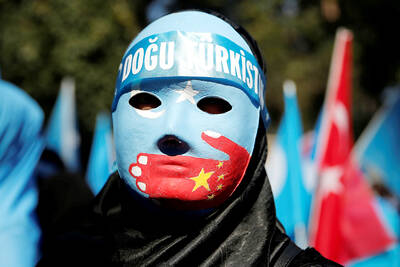
It seems every few days one bumps into one of those “real man” comments in which Taiwan is urged to “face reality” or similar, and “make a deal,” with the speaker implying that soon it will be too late. “Deal” advocates always present themselves as having a superior grip on reality, and the manly ability to make the “hard choice.” Their testosterone-laden language often echoes that of Taiwan sellout advocates. Note that such commentary always specifies a process (“make a deal, work with, make progress”), never the end state of what occupation by a violent authoritarian colonialist state will entail. In

“Taiwan’s Opposition Leader Comes to US With a Message Straight Out of Beijing” read a May 31 headline in the Wall Street Journal. Top US administration officials and members of Congress almost certainly read the WSJ, and if there was a bullet point takeaway that people in Washington should absorb ahead of Chinese Nationalist Party (KMT) Chair Cheng Li-wun’s (鄭麗文) arrival in DC on June 9, that headline is it. The last few columns have discussed this very topic, and the timing is not coincidental. While those top officials likely do not read the Taipei Times, judging by the number
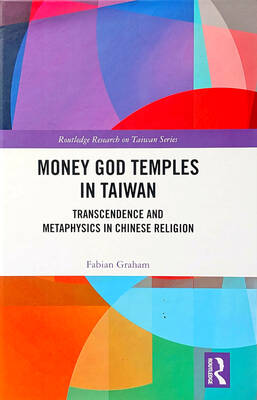
As someone who normally steers clear of books with “transcendence” or “metaphysics” in their subtitles, this reviewer — a casual observer of local belief systems since the 1990s — found Fabian Graham’s Money God Temples in Taiwan a challenging read. Those who’ve only dipped their toes into temple culture will likely need to parse several sections with special care if they’re to keep up with the author, a British ethnographic researcher whose previous books have investigated religious practices among ethnic Chinese in Southeast Asia. This scholarly volume examines a facet of Taiwan’s religious landscape that didn’t exist a century ago, and


 RSS
RSS