


T he Wedding Banquet (喜宴) meets Lan Yu (藍宇) in Creative Society Theatre Company’s (創作社劇團) He Is My Wife, He Is My Mother (少年金釵男孟母), a comedic costume drama that explores sexuality against the backdrop of the Republic of China’s early years and the 1940s.
The gay-themed play about lust, romance, family and friendship spanning two generations premiered in May last year and was proclaimed by the United Daily News as one of 2009’s top theatrical productions.
He Is My Wife, He Is My Mother was adapted from the sixth chapter of Qing Dynasty writer Li Yu’s (李漁) novel Silent Operas (無聲戲). The book was banned because of its risque subject matter, only to resurface during the second half of the 20th century.
Director and playwright Katherine Hui-ling Chou (周慧玲) discovered Silent Operas in a library at Columbia University while she was pursuing a PhD in drama at New York University.
“I was intrigued by how this writer obviously revels in his explicit description of homosexual love and sex but details them in a sardonic tone,” said Chou during rehearsal on Wednesday. “He portrays homosexual love in the first half of the story and decides to finish it with a virtuous mother raising a son in the second half.”
Though the novel is set in the early Qing Dynasty, Chou has adapted the story to a modern setting.
Her play tells the tale of a love triangle between three homosexual men.
Xu Jifang (�?�) (played by Hsu Hua-chien, 徐華謙), a widowed father, falls in love with the youthful You Ruilang (尤瑞郎) (played by actress Hsu Yen-ling, 徐堰鈴). The two become lovers and move in together.
Chen Dalong (陳大龍) (played by Lee Yi-hsiu, 李易修), Xu’s former lover, is so angered by his ex’s betrayal that he orchestrates You’s arrest, which, without giving too much away, leads to Xu’s death.
The bereaved You moves to a distant city with his late lover’s young son, where he impersonates the boy’s mother in order to raise him.
“This story is about communication both ways,” said Chou. “We usually think about children coming out of the closet to their parents, but parents sometimes need to come out to their children.”
During rehearsal on Wednesday, Xu and You’s first night of torrid sex was handled tastefully by the two actors with symbolic body gestures while Lee played nanguan (南管) music in the foreground.
The play neither sells itself as overblown comedic relief nor insults audiences’ intelligence with jazzed up sex scenes.
“There have been too many gay plays that try to peddle political agendas or rely on steamy sex scenes,” said Chou. “I just want to touch people’s hearts.”


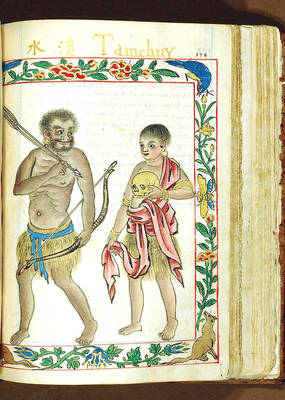
The Portuguese never established a presence on Taiwan, but they must have traded with the indigenous people because later traders reported that the locals referred to parts of deer using Portuguese words. What goods might the Portuguese have offered their indigenous trade partners? Among them must have been slaves, for the Portuguese dealt slaves across Asia. Though we often speak of “Portuguese” ships, imagining them as picturesque vessels manned by pointy-bearded Iberians, in Asia Portuguese shipping between local destinations was crewed by Asian seamen, with a handful of white or Eurasian officers. “Even the great carracks of 1,000-2,000 tons which plied

It’s only half the size of its more famous counterpart in Taipei, but the Botanical Garden of the National Museum of Nature Science (NMNS, 國立自然科學博物館植物園) is surely one of urban Taiwan’s most inviting green spaces. Covering 4.5 hectares immediately northeast of the government-run museum in Taichung’s North District (北區), the garden features more than 700 plant species, many of which are labeled in Chinese but not in English. Since its establishment in 1999, the site’s managers have done their best to replicate a number of native ecosystems, dividing the site into eight areas. The name of the Coral Atoll Zone might
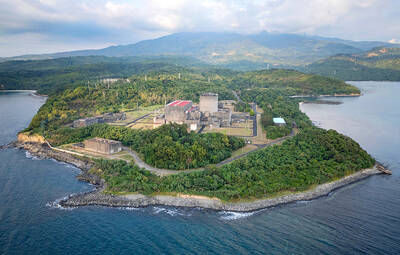
Nuclear power is getting a second look in Southeast Asia as countries prepare to meet surging energy demand as they vie for artificial intelligence-focused data centers. Several Southeast Asian nations are reviving mothballed nuclear plans and setting ambitious targets and nearly half of the region could, if they pursue those goals, have nuclear energy in the 2030s. Even countries without current plans have signaled their interest. Southeast Asia has never produced a single watt of nuclear energy, despite long-held atomic ambitions. But that may soon change as pressure mounts to reduce emissions that contribute to climate change, while meeting growing power needs. The
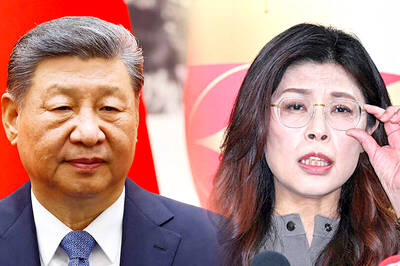
On Monday morning, in quick succession, the Chinese Communist Party (CCP) and the Chinese Nationalist Party (KMT) released statements announcing “that the Central Committee of the Communist Party of China and General Secretary Xi Jinping (習近平) have invited KMT Chairwoman Cheng Li-wun (鄭麗文) to lead a delegation on a visit to the mainland” as the KMT’s press release worded it. The KMT’s press release added “Chairwoman Cheng expressed her gratitude for the invitation and has gladly accepted it.” Beijing’s official Xinhua news release described Song Tao (宋濤), head of the Taiwan Work Office of the CCP Central Committee, as


 RSS
RSS