


For his fifth feature, Tears (眼淚)Cheng Wen-tang (鄭文堂) teamed up with Tsai Chen-nan (蔡振南) to paint a dark, pensive portrayal of a police officer haunted by his past.
Though the film is set in contemporary Taiwan and touches on human rights violations from a decade ago, the issue of the abuse of power by the police that it addresses is as salient in present-day Taiwan’s democratic society as it is in many other countries.
Tsai makes a rare comeback to the big screen as Guo, a veteran police officer who is divorced and lives with his dog in a hotel room.
The detective is a loner, thought of as cold-blooded for not shedding a tear in 10 years, and feared for teaching his juniors how to extract confessions through torture, which reveals as much of his violent streak as his self-hatred.
Guo takes up a new assignment involving a drug overdose. But instead of following his supervisor’s instruction to wrap up the case, the detective follows his instincts and digs deeper.
The investigation leads him to the dead girl’s friend, Lai Chun-chun, a college student who behind her innocent exterior hides more than a few secrets.
Guo has secrets of his own to hide.
In a parallel plotline, he befriends Wen (Enno Cheng, 鄭宜農), a betel nut beauty from whom he buys his daily fix. She bumps into Guo at the hospital while he is visiting her sick mother. He tells Wen he is a friend of the family. Puzzled, she later confronts him about his relationship with her family, and Guo confesses to torturing her late father while he was in police custody. Distraught, she sprays him in the face with a self-defense spray.
The camera then switches to Guo’s view and he wanders the streets, passing through Formosa Boulevard (美麗島) MRT Station, built below the spot where the Kaohsiung Incident (美麗島事件) took place in 1979, shown through a series of flickering images.
Fortunately, Tears, which the director says is the first part of a trilogy that addresses transitional justice, is far from a political gripe as the playbill suggests. In its sober portrayal of a man living with a tortured past, the film keeps the focus on its characters and carefully examines how an individual can inflict devastating consequences on others through behavior that is condoned by the state apparatus.
For most of the film, Cheng’s lens remains guarded and distant, and holds off from passing judgment on the protagonist. The director’s restraint is also evident in the film’s refusal to explain everything to the audience.
For example, early in the film, Tsai’s character demonstrates waterboarding on a junior police officer, played by young theater and film actor Huang Jian-wei (黃健瑋). But the scene’s significance only becomes apparent when the viewers piece together the detective’s past and present.
However, Cheng’s deliberately ambiguous storytelling sometimes confuses the storyline, especially the subplot that involves the murder suspect Lai, whose motives and emotions are handled in a flat, almost elliptical manner.
Throughout the film, Tsai, whose acting credits include Hou Hsiao-hsien’s (侯孝賢) City of Sadness (悲情城市) and Wu Nien-chen’s (吳念真) A Borrowed Life (多桑), turns in a vigorous performance. The 55-year-old actor brings an arresting mixture of anguish and cynicism to his haunted character, who lives in a vicious circle of never-ending remorse.
In what director Cheng calls a snub to the dominance of the capital’s big cinemas, which he says give local productions scant screening time, Tears has been shown across the country at a number of small venues before hitting Taipei’s theaters. Those interested in arranging a screening of Tears in a public space can call (02) 2720-6007 X15.



Taiwan’s English education system is being pulled apart by three opposing forces. Bilingual Nation 2030 pulls students toward English and global communication. Artificial Intelligence (AI) readiness pulls them toward digital judgment, verification and AI-mediated work. But Taiwan’s old exam culture pulls them back toward memorization, grammar drills, timed reading and correct answers. If the education system keeps using old exams to define success, it risks producing graduates who are neither genuinely bilingual nor genuinely AI-ready, but trained for tasks machines can already perform. The first force is Bilingual Nation 2030. Launched in 2018, the policy aimed to “help Taiwan’s workforce connect

It seems every few days one bumps into one of those “real man” comments in which Taiwan is urged to “face reality” or similar, and “make a deal,” with the speaker implying that soon it will be too late. “Deal” advocates always present themselves as having a superior grip on reality, and the manly ability to make the “hard choice.” Their testosterone-laden language often echoes that of Taiwan sellout advocates. Note that such commentary always specifies a process (“make a deal, work with, make progress”), never the end state of what occupation by a violent authoritarian colonialist state will entail. In

“Taiwan’s Opposition Leader Comes to US With a Message Straight Out of Beijing” read a May 31 headline in the Wall Street Journal. Top US administration officials and members of Congress almost certainly read the WSJ, and if there was a bullet point takeaway that people in Washington should absorb ahead of Chinese Nationalist Party (KMT) Chair Cheng Li-wun’s (鄭麗文) arrival in DC on June 9, that headline is it. The last few columns have discussed this very topic, and the timing is not coincidental. While those top officials likely do not read the Taipei Times, judging by the number
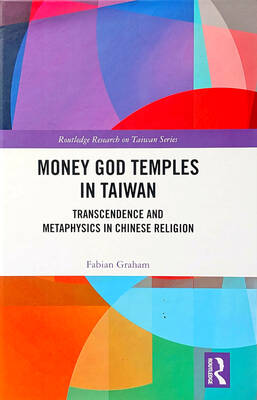
As someone who normally steers clear of books with “transcendence” or “metaphysics” in their subtitles, this reviewer — a casual observer of local belief systems since the 1990s — found Fabian Graham’s Money God Temples in Taiwan a challenging read. Those who’ve only dipped their toes into temple culture will likely need to parse several sections with special care if they’re to keep up with the author, a British ethnographic researcher whose previous books have investigated religious practices among ethnic Chinese in Southeast Asia. This scholarly volume examines a facet of Taiwan’s religious landscape that didn’t exist a century ago, and


 RSS
RSS