


In February 1862, General Ulysses S. Grant captured forts Henry and Donelson in Tennessee and won the American Civil War.
It took almost three more years and thousands of lives, but the capture of the two earthwork structures was key to all that came later, argues British historian John Keegan in The American Civil War: A Military History.
“Possession of the Tennessee River, if it were used correctly by the North, would give access to southern Tennessee, northern Alabama, and the upper Mississippi, and lend support to operations down the Mississippi River itself,” Keegan writes. “The capture of Forts Henry and Donelson effectively marked the end of the opening stage of the Civil War in the West.”
Surprised? I was. Most histories of the subject tend to rank the capture of the two forts as marking the emergence of Grant, and not much more. For many writers, and not just those with a sneaking admiration for various Confederate commanders, the Civil War is more of a close-run thing. You almost wonder how or even if the North won at all.
Keegan, a former lecturer at the Royal Military Academy, Sandhurst, and author of such works as A History of Warfare (1993), The Mask of Command (1987) and The Face of Battle (1978), is a big-picture writer. He’s more comfortable with the movements of armies and decisions by generals than with vignettes that romanticize people and places.
The overview format favored by Keegan is distinctly old-fashioned in a day when writers spend hundreds of pages on the heroics of a single engagement. The emphasis on the personal over the strategic has obscured the story of the war, which was essentially written with the North’s successful blockade of Southern ports and the isolation of the Confederacy. The North’s eventual victory was inevitable.
What this approach lacks in suspense, it makes up for in clarity and concision. Even buffs steeped in the subject will find value in Keegan’s observations and conclusions, especially about the nature of battle.
For one thing, there were lots of them: 10,000 between 1861 and 1865. For another, they were often indecisive, chiefly because both sides lacked the cavalry and artillery that would have forced the issue. Finally, there was the question of terrain. Many of the bloodiest battles were fought in relatively confined areas marked by dense vegetation.
The reputation of General Grant has seen a revival in recent years, and Keegan is a partisan. He considers Grant “the greatest general of the war, one who would have excelled at any time in any army,” followed by his friend and colleague William T. Sherman. He calls the Confederacy’s Robert E. Lee “a gifted battle-winner” whose defects included a lack of boldness, excessive sensitivity to the feelings of his subordinates and a failure to insist upon his own judgment.
And then there’s this, presented early on without elaboration: “The armies of the Civil War were the worst tailored of any great conflict, and the effect was heightened by the almost universal abandonment of shaving.”
If The American Civil War has a defect, it is the book’s less-than-chronological, sometimes jumbled narrative style.
Before the Appomattox finale, a grab-bag of chapters covers such subjects as black soldiers in the Union army, Walt Whitman and the quality of medical care, the war at sea, life on the home fronts and the obligatory “Could the South Have Survived?” Some of these chapters are compelling, even provocative, and yet here they seem presented as afterthoughts.
The one-volume approach is refreshing and, these days, unusual. Those who are looking for more can always go find full-length treatments of the Iron Brigade, or Collis’s Zouaves.

The Portuguese never established a presence on Taiwan, but they must have traded with the indigenous people because later traders reported that the locals referred to parts of deer using Portuguese words. What goods might the Portuguese have offered their indigenous trade partners? Among them must have been slaves, for the Portuguese dealt slaves across Asia. Though we often speak of “Portuguese” ships, imagining them as picturesque vessels manned by pointy-bearded Iberians, in Asia Portuguese shipping between local destinations was crewed by Asian seamen, with a handful of white or Eurasian officers. “Even the great carracks of 1,000-2,000 tons which plied

It’s only half the size of its more famous counterpart in Taipei, but the Botanical Garden of the National Museum of Nature Science (NMNS, 國立自然科學博物館植物園) is surely one of urban Taiwan’s most inviting green spaces. Covering 4.5 hectares immediately northeast of the government-run museum in Taichung’s North District (北區), the garden features more than 700 plant species, many of which are labeled in Chinese but not in English. Since its establishment in 1999, the site’s managers have done their best to replicate a number of native ecosystems, dividing the site into eight areas. The name of the Coral Atoll Zone might

On Monday morning, in quick succession, the Chinese Communist Party (CCP) and the Chinese Nationalist Party (KMT) released statements announcing “that the Central Committee of the Communist Party of China and General Secretary Xi Jinping (習近平) have invited KMT Chairwoman Cheng Li-wun (鄭麗文) to lead a delegation on a visit to the mainland” as the KMT’s press release worded it. The KMT’s press release added “Chairwoman Cheng expressed her gratitude for the invitation and has gladly accepted it.” Beijing’s official Xinhua news release described Song Tao (宋濤), head of the Taiwan Work Office of the CCP Central Committee, as
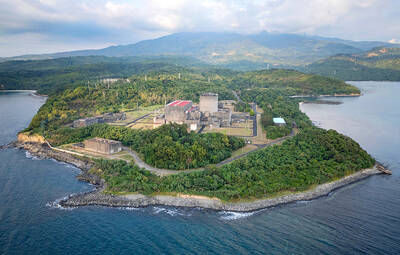
Nuclear power is getting a second look in Southeast Asia as countries prepare to meet surging energy demand as they vie for artificial intelligence-focused data centers. Several Southeast Asian nations are reviving mothballed nuclear plans and setting ambitious targets and nearly half of the region could, if they pursue those goals, have nuclear energy in the 2030s. Even countries without current plans have signaled their interest. Southeast Asia has never produced a single watt of nuclear energy, despite long-held atomic ambitions. But that may soon change as pressure mounts to reduce emissions that contribute to climate change, while meeting growing power needs. The


 RSS
RSS