


Chapter 1: An elderly actor loses his chops, can’t perform. Fearing suicide, he checks himself into a psychiatric hospital. Chapter 2: After his release, he falls into an intense, rejuvenating affair with a lesbian 25 years his junior, the child of old friends. Chapter 3: Can any good come of this?
The Humbling is the fourth novella Philip Roth has turned out in as many years. In these efficient little volumes, the author takes an almost sadistic pleasure in clasping the reader in a tightening vise. The Roth alter ego this time is Simon Axler, a powerful 65-year-old actor who, in the course of a run at the Kennedy Center (where he is starring, on alternate nights, in The Tempest and Macbeth), suddenly finds himself unable to act. The conviction is gone.
His incapacity certainly doesn’t suggest Roth, who at 76 is still leaving scorch marks on the page. Instead it must be the embodiment of Roth’s worst fears. Something similar was going on in Everyman (2006) and Exit Ghost (2007), whose protagonists were suffering the humiliations of old age, foremost among them impotence.
Simon isn’t infirm (apart from a bad back), his sexual powers appear undiminished, and his wealth and fame add to his allure. Yet on the scale of nightmares, vanished talent may look even worse to Roth than the end of sex.
Pegeen Stapleford, the woman he falls hard for, is a risky commitment, given her age and her sexual history. Much about her seems designed to make the reader ill at ease, including Simon’s recollections of her “as an infant at her mother’s breast.” Her parents are less than thrilled with the romance, and Simon soon begins to wonder whether they might be sabotaging it.
More disturbing is the way Simon sets out to divorce Pegeen from her lesbian past by buying her femmy designer clothes and an expensive new haircut — that is, by turning her into his (Roth’s?) idea of a straight woman:
“Wasn’t he dressing her up in costume as though a costly skirt could dispose of nearly two decades of lived experience? Wasn’t he distorting her while telling himself a lie — and a lie that in the end might be anything but harmless? What if he proved to be no more than a brief male intrusion into a lesbian life?”
These pages suggest a long outmoded notion of gay women as uniformly butch. But because Roth is such an expert craftsman — he’s wily enough to have Pegeen play along with Simon’s project — it’s impossible to say whether the prejudice is the character’s or his creator’s.
Roth’s books haven’t been funny for years, but even when they were sidesplitting the laughter carried an element of horror. As far back as Portnoy’s Complaint (1969), Roth would take a joke and push it dangerously far — and the further he pushed it the funnier it got, but also the crazier, the scarier. Even as you wiped away the tears you knew it was about something all too real. He wasn’t kidding.
But if these late novellas aren’t funny, they’re not quite humorless, either. It’s as though the joke is buried somewhere deep and he’s still pushing it to extremes that no reasonable writer would. And better that it should stay buried, because it’s a vicious joke whose butt is the hapless protagonist — as once it was Alexander Portnoy — and if we could hear the laughter it might be unbearable.

Taiwan’s English education system is being pulled apart by three opposing forces. Bilingual Nation 2030 pulls students toward English and global communication. Artificial Intelligence (AI) readiness pulls them toward digital judgment, verification and AI-mediated work. But Taiwan’s old exam culture pulls them back toward memorization, grammar drills, timed reading and correct answers. If the education system keeps using old exams to define success, it risks producing graduates who are neither genuinely bilingual nor genuinely AI-ready, but trained for tasks machines can already perform. The first force is Bilingual Nation 2030. Launched in 2018, the policy aimed to “help Taiwan’s workforce connect

“Taiwan’s Opposition Leader Comes to US With a Message Straight Out of Beijing” read a May 31 headline in the Wall Street Journal. Top US administration officials and members of Congress almost certainly read the WSJ, and if there was a bullet point takeaway that people in Washington should absorb ahead of Chinese Nationalist Party (KMT) Chair Cheng Li-wun’s (鄭麗文) arrival in DC on June 9, that headline is it. The last few columns have discussed this very topic, and the timing is not coincidental. While those top officials likely do not read the Taipei Times, judging by the number

With weighty, anxiety-inducing geopolitical topics dominating the headlines, checking in on the wild and weird state of local politics can take some of the edge off. This November’s elections will determine who will be in charge of fixing potholes in your neighborhood, not the potholes in Taiwan’s complicated geopolitical space. Recently, after an online interview with a Taipei-based journalist, I commented that Taipei journalists never go further than the MRT can take them. He laughed and agreed. Naturally, the Taipei mayoral race is eating up much of the press attention. TAIPEI CITY Democratic Progressive Party (DPP) candidate Puma Shen (沈伯洋) has
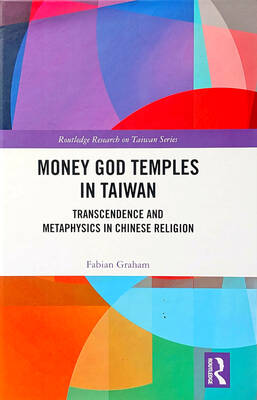
As someone who normally steers clear of books with “transcendence” or “metaphysics” in their subtitles, this reviewer — a casual observer of local belief systems since the 1990s — found Fabian Graham’s Money God Temples in Taiwan a challenging read. Those who’ve only dipped their toes into temple culture will likely need to parse several sections with special care if they’re to keep up with the author, a British ethnographic researcher whose previous books have investigated religious practices among ethnic Chinese in Southeast Asia. This scholarly volume examines a facet of Taiwan’s religious landscape that didn’t exist a century ago, and


 RSS
RSS