


Resplendent in pink satin and ostrich feathers, a drag queen runs through a tumbledown Russian village, miming to Gloria Gaynor’s I Will Survive.
Just one of the startling scenes from Jolly Fellows (Veselchaki) — the first mainstream Russian film about drag queens in a country where gays still face an uphill struggle to have basic rights recognized.
The bitter conclusion of the film is that survival is far from guaranteed.
The movie, which has echoes of the camp Australian classic The Adventures of Priscilla, Queen of the Desert, tells the story of five drag queens who perform at a Moscow gay club.
They share tears, joy, lip gloss and countless vodka shots as they reminisce, before setting off on an ill-fated road trip.
Starring actors who are well known — but none of whom is openly gay — the film has secured a release in 72 cinemas in 12 cities. It is also set to play in Kazakhstan, Ukraine and the Baltic states.
In Moscow, where Mayor Yury Luzhkov has repeatedly blocked attempts to hold a gay pride parade, the film is playing at 12 mainstream cinemas without a peep of protest.
A weekend audience laughed along with the film’s twists.
One of the drag queens unexpectedly encounters his mother — only for her to promise to sew him a nicer dress.
In another scene, an older queen recalls how a Soviet-era official complained about his first drag performance — not because of cross-dressing, but because he danced to a record by a singer who had emigrated to the West.
But a sudden silence fell at the end of the film as the five drag queens encounter a group of homophobic thugs and are shown running towards them in a final act of bravery.
The implication is that they do not survive the attack, in a disturbing reminder of the dangers of openly gay behavior in modern Russia.
The film was “great,” said one viewer, who gave his name as Sergei, as he made his way to the exit.
“I really liked the film. It makes me glad that for the first time, a film has been made on this topic,” said another, Vladimir Frolov.
Frolov praised the actors for taking part. “It shows that they weren’t embarrassed to act in such an ambiguous film. For them it was a certain risk, since in Russia society is very strongly homophobic,” he said.
So far the film has had positive reviews in the Russian press, which has unexpectedly taken the film’s theme seriously.
The director “has made the first articulate film in our country that supports ... gay people,” Vremya Novostei wrote in a review headlined “Painfully necessary.”
“You fall so much in love with [actor] Ville Haapasalo in a Lurex dress that his character’s tragic end seems like a personal grief,” Russian Time Out wrote, referring to a Finnish actor who works in Russia.
The director, Felix Mikhailov, came up with the idea for the film around 10 years ago, when he was working with a drag troupe, he said in an interview.
Mikhailov finally gained financing for the film and made it on a budget of US$2 million. He kept his day job making television shows including a celebrity ice-skating contest.
Some of the characters are based on real people, Mikhailov said. A drag queen in St Petersburg whose daughter acts as his manager inspired one character, while flamboyant drag queen Zaza Napoli gave tips on makeup and vocabulary.
Eastern Europe’s most famous drag queen, Verka Serdyuchka, who represented Ukraine at the Eurovision Song Contest in 2007, also got involved off screen.
Serdyuchka — real name Andrei Danilko — wrote the music, including a show-stopping song Casta Diva, performed by a drag queen in a crystal crown and silver sequined bikini.
The director is not gay himself and played down the gay aspect of the film. The “human element, the people’s stories” are more interesting than the characters’ orientation, he said.
The film wasn’t planned as a gay event, he said. “If they see it like that, it’s good that it happened,” he said. “We didn’t put any of that ideology into it at the start.”
Perhaps more surprisingly, he does not support the idea of a gay pride parade in Moscow. Mayor Luzhkov has said that society is not ready for the parade and has sent riot police to detain participants at unsanctioned protests.
“I think we don’t need it. Not because it’s good or bad. In our culture we don’t have the concept of a mass festival,” he said. “I think even if it was permitted, it would look pathetic and cheap.”
The parade organizer, Nikolai Alexeyev, said on Monday of last week that he has not seen the film yet, but supports the idea of using mainstream stars to influence the public.
Last week, he organized a press conference where a pop star known for her raunchy stage act, Lolita Milyavskaya, spoke out against living in the closet and revealed that her uncle hid his sexual orientation.
A key figure in Moscow’s gay community, Ed Mishin, who publishes a magazine called Kvir, or Queer, said he “really enjoyed” the film Jolly Fellows and believes it will have an effect — however small — on public opinion.
“When a good, fun film comes out, when it’s done with humor — and this is a kind, good film — it changes people, even just a little drop,” he said.

Taiwan’s English education system is being pulled apart by three opposing forces. Bilingual Nation 2030 pulls students toward English and global communication. Artificial Intelligence (AI) readiness pulls them toward digital judgment, verification and AI-mediated work. But Taiwan’s old exam culture pulls them back toward memorization, grammar drills, timed reading and correct answers. If the education system keeps using old exams to define success, it risks producing graduates who are neither genuinely bilingual nor genuinely AI-ready, but trained for tasks machines can already perform. The first force is Bilingual Nation 2030. Launched in 2018, the policy aimed to “help Taiwan’s workforce connect

“Taiwan’s Opposition Leader Comes to US With a Message Straight Out of Beijing” read a May 31 headline in the Wall Street Journal. Top US administration officials and members of Congress almost certainly read the WSJ, and if there was a bullet point takeaway that people in Washington should absorb ahead of Chinese Nationalist Party (KMT) Chair Cheng Li-wun’s (鄭麗文) arrival in DC on June 9, that headline is it. The last few columns have discussed this very topic, and the timing is not coincidental. While those top officials likely do not read the Taipei Times, judging by the number

With weighty, anxiety-inducing geopolitical topics dominating the headlines, checking in on the wild and weird state of local politics can take some of the edge off. This November’s elections will determine who will be in charge of fixing potholes in your neighborhood, not the potholes in Taiwan’s complicated geopolitical space. Recently, after an online interview with a Taipei-based journalist, I commented that Taipei journalists never go further than the MRT can take them. He laughed and agreed. Naturally, the Taipei mayoral race is eating up much of the press attention. TAIPEI CITY Democratic Progressive Party (DPP) candidate Puma Shen (沈伯洋) has
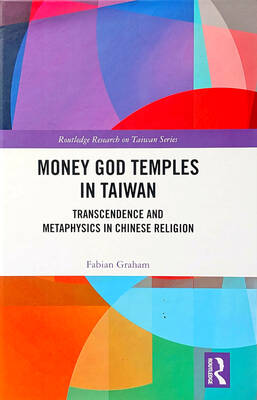
As someone who normally steers clear of books with “transcendence” or “metaphysics” in their subtitles, this reviewer — a casual observer of local belief systems since the 1990s — found Fabian Graham’s Money God Temples in Taiwan a challenging read. Those who’ve only dipped their toes into temple culture will likely need to parse several sections with special care if they’re to keep up with the author, a British ethnographic researcher whose previous books have investigated religious practices among ethnic Chinese in Southeast Asia. This scholarly volume examines a facet of Taiwan’s religious landscape that didn’t exist a century ago, and


 RSS
RSS