


It is easy to understand why Lin Hwai-min (林懷民) says he favors Cursive II (行草貳) over the other two parts of his Cursive trilogy. Its sleek, spare lines, minimalist costumes and staging, and stark score all serve to focus the audiences’ eyes on Lin’s choreography. But even as you watch Cloud Gate Dance Theatre’s (雲門舞集) incredibly supple dancers — super supple, since theirs is a profession where suppleness is a given — those other elements quietly filter into your awareness, sometimes as imperceptibly as the slight shifts that gradually change the backdrop from eggshell white to bisque to a textured ivory or from a silvery filigree to a light mauve crackled glaze.
Four years ago I wrote a review of Wild Cursive (狂草) that described the piece as “dance stripped down to the bare essentials.” While I had seen Cursive (行草) at that point, I had not seen Cursive II. I now stand corrected. Part II is the barest of the bare. It is a celebration of emptiness — from the vast expanses of stage space that go unused, to the stark whiteness of the floor, to the costumes — flesh-toned leotards and white pants for the women, black wide-legged pants for the men — to the score that isn’t a score.
If the first half of last year’s Whisper of Flowers sometimes seemed like Lin was channeling the exuberance of Paul Taylor, in Cursive II he is forging his own take on the late American minimalist modern choreographer Merce Cunningham’s code — movement for its own sake. The choice of John Cage for the score was apt, since Cage was Cunningham’s artistic and life partner.
The score, what there was of it, seem to be a selection of notes, tones and sounds — often as drawn out and tremulous as the way a dancer quivers slightly as he or she stretches to extend an arm or a leg or a back. The dancers neither moved to the sounds nor seemed to respond to them; Cage’s music was just part of the background.
The show opens with two dancers posed against a white floor and black backdrop, one woman standing and the other kneeling before her. It ends with a folded woman silhouetted against a rapidly diminishing white square until the entire stage goes black. During the 11 segments, the dancers move in small groups, in duets, trios and quartets as Lin demonstrated his command of space and form. I was struck once again on Saturday night by how much of Lin’s choreography is from the ground up, as dancers lower themselves almost to the floor in deep plies that with a turn of foot are transformed into a tai chi pose with the right leg outstretched and left knee bent, effortlessly shifting their weight from one leg to the other, moving low to the ground.
Chinese calligraphy may have been Lin’s inspiration, but the backdrops and the women’s costumes bring to mind the delicateness of the finest porcelain teacups. The calligraphic punch, as it were, comes from the men’s black pants, which have a panel that makes the outfit look like a skirt from the back, so that when the men lift a leg out to the side or over their head or twirl across the stage, the black cloth moves like the broad end to a brush stroke.
Cloud Gate may have found Cursive II to be a harder sell to fans than the first and third parts — it didn’t sell out, whereas all five shows for next week’s Wild Cursive were gone by last week — but it is a finely crafted work.
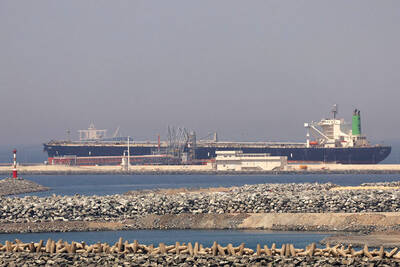
The breakwater stretches out to sea from the sprawling Kaohsiung port in southern Taiwan. Normally, it’s crowded with massive tankers ferrying liquefied natural gas from Qatar to be stored in the bulbous white tanks that dot the shoreline. These are not normal times, though, and not a single shipment from Qatar has docked at the Yongan terminal since early March after the Strait of Hormuz was shuttered. The suspension has provided a realistic preview of a potential Chinese blockade, a move that would throttle an economy anchored by the world’s most advanced and power-hungry semiconductor industry. It is a stark reminder of
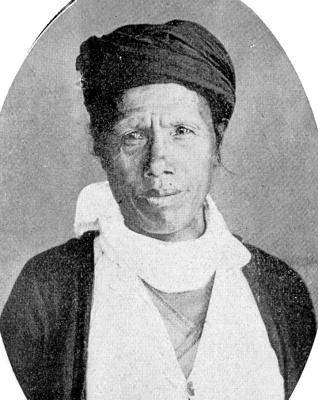
May 11 to May 17 Traversing the southern slopes of the Yushan Range in 1931, Japanese naturalist Tadao Kano knew he was approaching the last swath of Taiwan still beyond colonial control. The “vast, unknown territory,” protected by the “fierce” Bunun headman Dahu Ali, was “filled with an utterly endless jungle that choked the mountains and valleys,” Kano wrote. He noted how the group had “refused to submit to the measures of our authorities and entrenched themselves deep in these mountains … living a free existence spent chasing deer in the morning and seeking serow in the evening,” even describing them as
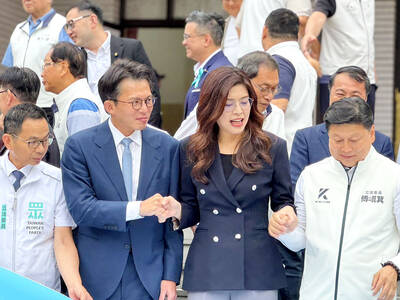
As a different column was being written, the big news dropped that Chinese Nationalist Party (KMT) caucus whip Fu Kun-chi (傅?萁) announced that negotiations within his caucus, with legislative speaker Han Kuo-yu (韓國瑜) of the KMT, party Chair Cheng Li-wun (鄭麗文), Taichung Mayor Lu Shiow-yen (盧秀燕) and Taiwan People’s Party (TPP) Chair Huang Kuo-chang (黃國昌) had produced a compromise special military budget proposal. On Thursday morning, prior to meeting with Cheng over a lunch of beef noodles, Lu reiterated her support for a budget of NT$800 or NT$900 billion — but refused to comment after the meeting. Right after Fu’s
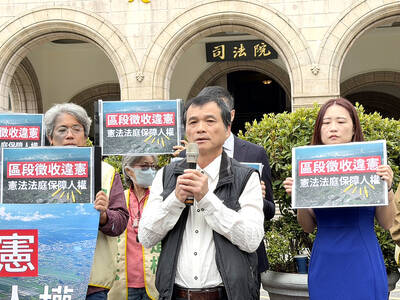
What government project has expropriated the most land in Taiwan? According to local media reports, it is the Taoyuan Aerotropolis, eating 2,500 hectares of land in its first phase, with more to come. Forty thousand people are expected to be displaced by the project. Naturally that enormous land grab is generating powerful pushback. Last week Chen Chien-ho (陳健和), a local resident of Jhuwei Borough (竹圍) in Taoyuan City’s Dayuan District (大園) filed a petition for constitutional review of the project after losing his case at the Taipei Administrative Court. The Administrative Court found in favor of nine other local landowners, but


 RSS
RSS