


Zhang Yu (張羽) wants to take Chinese ink and wash painting in new directions. Throughout the 1980s, he attempted to fuse the ancient art form with Western abstractionism and expressionism. In 1991, he put down his brushes and started to paint with his fingers.
Since then, the Chinese artist’s works of experimental wash and ink have been exhibited in cities such as Beijing, Hong Kong, Tokyo, Moscow, London and New York City. Many can be found in permanent collections at the Shanghai Art Museum, San Francisco Museum of Modern Art, Louisiana Modern Art Museum in Copenhagen and the Royal Academy of Fine Arts, Antwerp, to name just a few.
By freeing brush painting from its traditional modus operandi, Zhang, 50, reinvents Chinese ink and wash painting as a form of contemporary expression. Several examples of his innovative works are on display at the Kuandu Museum of Fine Arts (關渡美術館) in Fingerprints — the Trace of Zhang Yu’s Practice (指印—張羽修行的痕跡), Zhang’s first solo exhibition in Taiwan.
The exhibition includes three 7m-long scrolls hung from ceiling to floor, covered not with brushstrokes, but tens of thousands of Zhang’s fingerprints, which took him one year to complete. An accompanying video shows Zhang, in meditative concentration, repeatedly dipping his finger into water and ink and pressing it onto the paper.
Beyond the finger-painted scrolls are nearly a hundred of what Zhang calls “wordless books” (無字書) — tomes filled with his fingerprints.
“My Fingerprints series has a certain degree of affinity with Chinese ink and wash painting, but at the same time, goes beyond existing ideas and concepts about the art form,” said Zhang. “My art is, above all, a performance. The traces of my performing are the result and the second form of my expression.”
Zhang says he strives to produce a form of art that is rooted in Chinese culture and transcends Western genres yet is also contemporary. “To me, to be contemporary is to construct your own approach to perceiving the world. It is both culturally informed and personal, and has never before appeared in the history of art. Such is an artist’s task,” Zhang said. “We can’t always follow the West. To break traditions is to create something new and pass it down.”
The artist said the exhibits are meant to be appreciated as a whole, as an integrated space, rather than viewed separately.
Zhang draws inspiration from the Chinese belief in communion between humans and nature. “To me, the ultimate state of art — or life, for that matter — is nature. My art represents nature through nature,” he said, referring to the materials he employs, such as highly regarded Xuan paper (宣紙).
Other works from Zhang’s Fingerprints series are currently on display at Da Xiang Art Space (大象藝術空間館) in Taichung City. Entitled Zhang Yu’s One-Finger Zen (張羽的一指禪), the exhibition runs through Aug. 9. For more information, visit www.daxiang.com.tw, or call (04) 2208-4288.
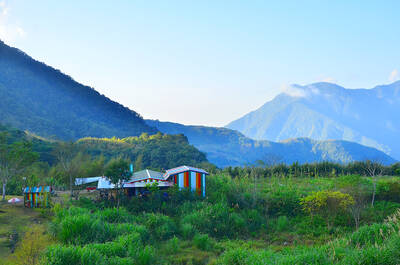
If one asks Taiwanese why house prices are so high or why the nation is so built up or why certain policies cannot be carried out, one common answer is that “Taiwan is too small.” This is actually true, though not in the way people think. The National Property Administration (NPA), responsible for tracking and managing the government’s real estate assets, maintains statistics on how much land the government owns. As of the end of last year, land for official use constituted 293,655 hectares, for public use 1,732,513 hectares, for non-public use 216,972 hectares and for state enterprises 34 hectares, yielding
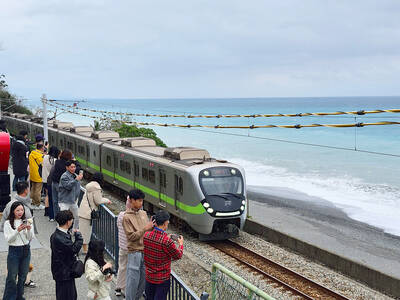
The small platform at Duoliang Train Station in Taitung County’s Taimali Township (太麻里) served villagers from 1992 to 2006, but was eventually shut down due to lack of use. Just 10 years later, the abandoned train station had become widely known as the most beautiful station in Taiwan, and visitors were so frequent that the village had to start restricting traffic. Nowadays, Duoliang Village (多良) is known as a bit of a tourist trap, with a mandatory, albeit modest, admission fee of NT$10 giving access to a crowded lane of vendors with a mediocre view of the ocean and the trains
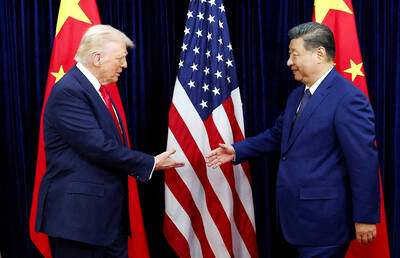
The March/April volume of Foreign Affairs, long a purveyor of pro-China pablum, offered up another irksome Beijing-speak on the issues and solutions for the problems vexing the People’s Republic of China (PRC) and the US: “America and China at the Edge of Ruin: A Last Chance to Step Back From the Brink” rang the provocative title, by David M. Lampton and Wang Jisi (王緝思). If one ever wants to describe what went wrong with US-PRC relations, the career of Wang Jisi is a good place to start. Wang has extensive experience in the US and the West. He was a visiting

One of the challenges with the sheer availability of food in today’s world is that lots of us end up spending many of our waking hours eating. Whether it’s full meals, snacks or desserts, scientists have found that it’s not uncommon for us to be mindlessly grazing at some point during all of our 16 or so waking hours. The problem? As soon as this food hits the bloodstream in the form of glucose, it initiates the release of the hormone insulin. This in turn activates a switch present in every one of our cells, which is responsible for driving cell


 RSS
RSS