


Panai’s (巴奈) latest solo album, A Piece of Blue, is full of lulling, soothing sounds and poetic musings that transport listeners to the oceanside setting of her home in Taitung.
But don’t expect the 40-year-old Aboriginal singer-songwriter to wax romantic about the future of her hometown when she comes to Taipei this weekend.
In addition to an evening show on Sunday at the Riverside Live House (河岸留言西門紅樓展演館), Panai intends to voice her opposition to the construction of a nuclear waste dump in Taitung at a protest event outside of Red House Theater (西門紅樓) in the early afternoon.
The event aims to galvanize opposition against a proposal by Taiwan Power Company (台電) to build a nuclear waste storage facility in Taitung County’s Daren (達仁) Township.
If the project goes through, it would be yet another example of the government’s “lack of sincerity” in dealing with Taiwan’s Aboriginal communities, said Panai.
“Over 20 years ago, during the Martial Law era, they put [nuclear waste] on Orchid Island (蘭嶼). Now, in the democractic era, they still want to put it in an Aboriginal area,” she said on the telephone from Dulan (都蘭).
“Why put it in a place where we’re poorer?” she asked, adding that the issue of where to put nuclear waste also touches upon a larger issue: the development gap between southern and northern Taiwan.
“For example, in Taitung, we have many people that are doing music and are passionate about it. Why doesn’t [the government] put that much money into helping us make music?”
Panai and her bandmates from Message join several other bands for Sunday afternoon’s event, organized by an alliance of Aboriginal, environmental and anti-nuclear power organizations.
The groups will set up booths offering information about the proposed Taipower project and efforts to oppose it. The event starts with a traditional Aboriginal dance and runs from 2pm to 9pm.
For her evening performance, Panai, who enjoys a loyal following for her low-range, soulful voice, plans to perform a solo set that includes songs from her well-regarded 2000 debut album Ni Wawa (泥娃娃, “Mud Pie Dolly”).
The evening show looks more like a musical revue, as it also features musicians and friends from Taitung, including Amis singer Long-ge (龍哥), who is known for his soulful singing and rousing drinking songs.
Also appearing is Takanow (達卡鬧), a singer of Rukai (魯凱族) and Paiwan (排灣族) ancestry, and the recipient of several songwriting accolades at the 2007 Taiwan Original Music Awards (臺灣原創流行音樂大獎).
Both musicians, along with Panai, are part of Message, a 10-person band that performs a mix of traditional Aboriginal and original songs, with many tunes sung
a capella. They open the evening show.
The group’s self-titled debut is up for the best Aboriginal album award at the Golden Melody Awards (金曲獎) ceremony, which takes place tomorrow night, and Panai intends to take advantage of any available publicity.
“If our luck is good and we win a Golden Melody award, we hope to direct the media’s attention [to the fact that] nuclear waste is a problem for all of Taiwan,” she said.
For information in Mandarin on anti-nuclear waste activism in Taitung, visit tw.myblog.yahoo.com/hunter-motion or taitung-place.blogspot.com.

The Portuguese never established a presence on Taiwan, but they must have traded with the indigenous people because later traders reported that the locals referred to parts of deer using Portuguese words. What goods might the Portuguese have offered their indigenous trade partners? Among them must have been slaves, for the Portuguese dealt slaves across Asia. Though we often speak of “Portuguese” ships, imagining them as picturesque vessels manned by pointy-bearded Iberians, in Asia Portuguese shipping between local destinations was crewed by Asian seamen, with a handful of white or Eurasian officers. “Even the great carracks of 1,000-2,000 tons which plied
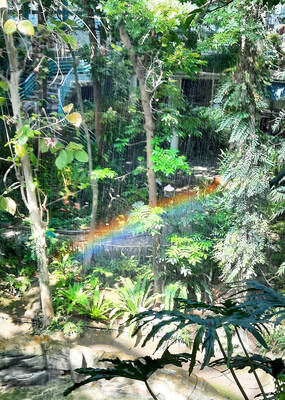
It’s only half the size of its more famous counterpart in Taipei, but the Botanical Garden of the National Museum of Nature Science (NMNS, 國立自然科學博物館植物園) is surely one of urban Taiwan’s most inviting green spaces. Covering 4.5 hectares immediately northeast of the government-run museum in Taichung’s North District (北區), the garden features more than 700 plant species, many of which are labeled in Chinese but not in English. Since its establishment in 1999, the site’s managers have done their best to replicate a number of native ecosystems, dividing the site into eight areas. The name of the Coral Atoll Zone might

On Monday morning, in quick succession, the Chinese Communist Party (CCP) and the Chinese Nationalist Party (KMT) released statements announcing “that the Central Committee of the Communist Party of China and General Secretary Xi Jinping (習近平) have invited KMT Chairwoman Cheng Li-wun (鄭麗文) to lead a delegation on a visit to the mainland” as the KMT’s press release worded it. The KMT’s press release added “Chairwoman Cheng expressed her gratitude for the invitation and has gladly accepted it.” Beijing’s official Xinhua news release described Song Tao (宋濤), head of the Taiwan Work Office of the CCP Central Committee, as
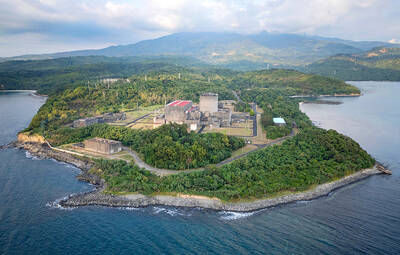
Nuclear power is getting a second look in Southeast Asia as countries prepare to meet surging energy demand as they vie for artificial intelligence-focused data centers. Several Southeast Asian nations are reviving mothballed nuclear plans and setting ambitious targets and nearly half of the region could, if they pursue those goals, have nuclear energy in the 2030s. Even countries without current plans have signaled their interest. Southeast Asia has never produced a single watt of nuclear energy, despite long-held atomic ambitions. But that may soon change as pressure mounts to reduce emissions that contribute to climate change, while meeting growing power needs. The


 RSS
RSS