


Ariel Kuo (郭芃君) leads me through the tiny alleys that surround her Tainan studio and residence. The narrow cobblestone roadways are lined with functional buildings, surreptitiously placed potted plants and walls of multicolored tiles — all of which serve as inspiration for Kuo’s solo exhibition at the Dogpig Art Cafe (豆皮文藝咖啡館) in Kaoshiung.
The exhibit, Place (地方), features Kuo’s photography and paintings in an artistic dialogue that reveals her impressionistic search for the soul of Tainan — and by extension Taiwan.
The exhibit is divided into three sections. The first displays images of colorful ceramic tiles, floor mosaics and other architectural wall and floor coverings that Kuo photographed as a means of investigating color and pattern. These studies are then deconstructed and recreated as canvases of solid color, which are found in the second section, and become the palette for her representational works in the third section.
The relationship between the photographs and canvases of solid color (or “color charts,” as Kuo calls them) are exemplified in Detail 4 (Alley No. 2) (巷子底 No. 2) and Alley No. 2 (巷子底 No. 2). The blanched brown rectangular tiles, white window frame and blue blinds depicted in the photo are reconstructed as blocks of solid color on the six canvas panels.
It’s a good idea: placing the photographs and panels of color in the same exhibition draws the viewer’s attention to the colorful details of Taiwan’s often drab cityscape of concrete-block buildings and suggests that these edifices might be deserving of a second look.
However, the transition from the colored panels to the representational works is less fluid, perhaps because Kuo is trying to do too many things at once. In her artist’s statement, she said she wants to separate the rational and the emotional aspects of the artistic enterprise and then bring them together in one exhibit. The colored panels and photographs investigate the former while the representational works largely cover the latter.
But it isn’t clear how the artist makes the transition from the rational to the emotional, from the pictures and panels to pictorial representation.
At first glance, Tainan-Place No. 14 (地方-台南 No. 14) and Tainan-Place No. 15 (地方-台南 No. 15) are an interesting study of contrasts. The former depicts a 7-Eleven sign over a background rendered in a mosaic of greens, grays and browns, with a pathway of white winding into the distance. It suggests functionality and convenience with a touch of the hectic. The latter features a Starbucks sign with the same mosaic background, but in orange, gray and white. It evokes the leisurely lifestyle that has come to define Tainan for many.
Within the context of the exhibit, however, these paintings fail to express any deeper insights into the atmosphere of Taiwan’s former capital city.
Additionally, some representational paintings avoid the use of vibrant color. Place-Tainan No. 3 (地方-台南No. 3), with its claustrophobic interior of grays, whites and blacks, does more to depict the colorless buildings erected in the 1950s and 1960s than the wonderfully colorful decorative fixtures depicted in the photographs and recreated in the color charts. This reviewer found it difficult to understand how these canvases represent the “place” called Tainan. (Is it a mixture of the frenetic, languid and confining?)
Some might also balk at Kuo’s explicit use of the 7-Eleven logo in her work. Yet with more than 4,800 units throughout Taiwan, 7-Eleven is undeniably part of the nation’s culture, as is to a lesser extent Starbucks. Regardless, one is left with the impression that the historic city of Tainan (and Taiwan in general) is a collection of convenience stores, franchise coffee shops and buildings with somewhat colorless interiors.
Kuo sets out to reveal the dynamic and multilayered aspect of Taiwan’s culture through the colorful details of Tainan’s architecture. With the photographs and color charts it works because they offer the viewer an examination of phenomena that many take for granted. But the representational pictures digress into kitschy renderings of commonly seen buildings and interiors — ones that don’t do justice to Taiwan’s complex culture.

The Portuguese never established a presence on Taiwan, but they must have traded with the indigenous people because later traders reported that the locals referred to parts of deer using Portuguese words. What goods might the Portuguese have offered their indigenous trade partners? Among them must have been slaves, for the Portuguese dealt slaves across Asia. Though we often speak of “Portuguese” ships, imagining them as picturesque vessels manned by pointy-bearded Iberians, in Asia Portuguese shipping between local destinations was crewed by Asian seamen, with a handful of white or Eurasian officers. “Even the great carracks of 1,000-2,000 tons which plied
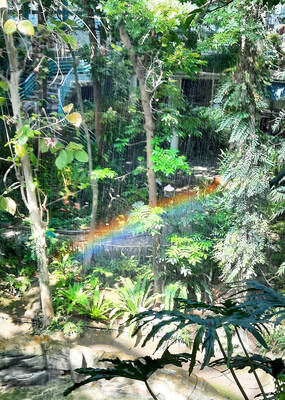
It’s only half the size of its more famous counterpart in Taipei, but the Botanical Garden of the National Museum of Nature Science (NMNS, 國立自然科學博物館植物園) is surely one of urban Taiwan’s most inviting green spaces. Covering 4.5 hectares immediately northeast of the government-run museum in Taichung’s North District (北區), the garden features more than 700 plant species, many of which are labeled in Chinese but not in English. Since its establishment in 1999, the site’s managers have done their best to replicate a number of native ecosystems, dividing the site into eight areas. The name of the Coral Atoll Zone might

On Monday morning, in quick succession, the Chinese Communist Party (CCP) and the Chinese Nationalist Party (KMT) released statements announcing “that the Central Committee of the Communist Party of China and General Secretary Xi Jinping (習近平) have invited KMT Chairwoman Cheng Li-wun (鄭麗文) to lead a delegation on a visit to the mainland” as the KMT’s press release worded it. The KMT’s press release added “Chairwoman Cheng expressed her gratitude for the invitation and has gladly accepted it.” Beijing’s official Xinhua news release described Song Tao (宋濤), head of the Taiwan Work Office of the CCP Central Committee, as
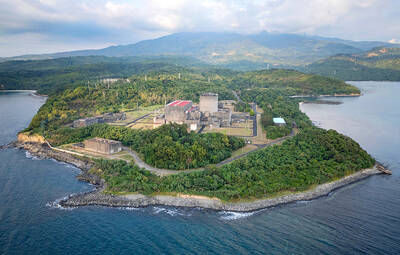
Nuclear power is getting a second look in Southeast Asia as countries prepare to meet surging energy demand as they vie for artificial intelligence-focused data centers. Several Southeast Asian nations are reviving mothballed nuclear plans and setting ambitious targets and nearly half of the region could, if they pursue those goals, have nuclear energy in the 2030s. Even countries without current plans have signaled their interest. Southeast Asia has never produced a single watt of nuclear energy, despite long-held atomic ambitions. But that may soon change as pressure mounts to reduce emissions that contribute to climate change, while meeting growing power needs. The


 RSS
RSS