


While students in creative fields are encouraged to think outside the box, one designer at the 28th Young Designers’ Exhibition 2009 (YODEX) has done the opposite. Chow Chen-ming’s (周振明) “Perfume” is a box that can collect a scent, say in a forest or in a bakery. The box retains the odor and can reproduce it using digital technology.
YODEX, held at the World Trade Center from Thursday to May 17, showcases design projects from students who are selected through competitions within their schools. It is recognized by the International Council of Societies of Industrial Design (ICSID) as the largest student design fair in Asia.
The entries are “students’ graduation final projects” said Jessica Chang (張智捷), a spokeswoman for the Taiwan Design Center (台灣創意設計中心), which organized the event. “They are not always very professional but the students’ ideas are very creative.”
Students from more than 90 local and 25 international institutions will participate in this event, with entries from Australia, China, Germany, Italy, Japan, the Netherlands, New Zealand, Spain, Sweden, Switzerland, the UK and the US. Up-and-coming young designers’ submissions cover the spectrum from fashion, industrial and graphic design, to communication, interior and multimedia presentations.
The criteria rest on five categories: creativity, marketability, presentation of Taiwan’s culture, environmental considerations and safety. With the future of the world such a hot topic, it will be interesting to see what the next generation has in store.
“Most of the students in Taiwan have a laptop and they love to ride bicycles,” said Chang. “So a group made a bike that can fold into a desk so you can use your notebook [computer] at it.” The Shu Tong bike, designed by Shih Cheng-yin (施正茵), Lai Wen-yi (賴穩伊) and Hung Pei-shiuan (洪珮軒), has an attractive streamlined design as well as an interesting function.
Other designs, such as a cart that allows a dog to carry its accessories (leash, bowl, jacket), or a bench that turns into a rather unwieldy magazine rack on wheels, are perhaps less obviously sellable. Entries in the fashion category range from exquisite to outlandish.
One of the things the judges will be looking for, said Chang, are “products that are marketable, and able to be reproduced.” Ultimately the goal is to have students use the exhibit not only to gain international exposure, but as a platform to launch a post-graduation career.
In this sense, the ability to think outside of the box, in terms of creativity and originality in design, is not to be outdone by the ability to be able to also think inside the box, in terms of practicality and salability.
The exhibit offers a glimpse into what is currently happening in design around the world, and what direction we are heading in. If Chow’s Perfume box could be used as a gauge, the future, embodied in the youthful explorations of these designers, might just smell like teen spirit.
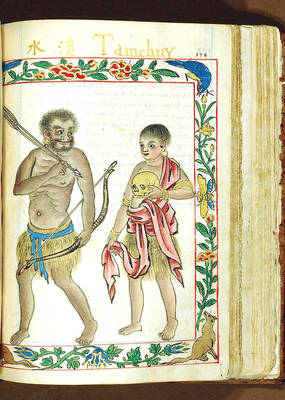
The Portuguese never established a presence on Taiwan, but they must have traded with the indigenous people because later traders reported that the locals referred to parts of deer using Portuguese words. What goods might the Portuguese have offered their indigenous trade partners? Among them must have been slaves, for the Portuguese dealt slaves across Asia. Though we often speak of “Portuguese” ships, imagining them as picturesque vessels manned by pointy-bearded Iberians, in Asia Portuguese shipping between local destinations was crewed by Asian seamen, with a handful of white or Eurasian officers. “Even the great carracks of 1,000-2,000 tons which plied
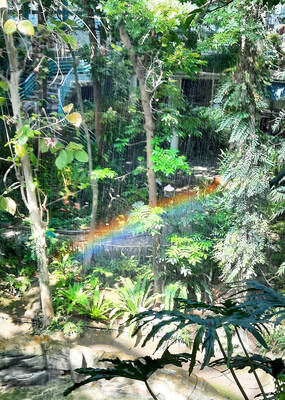
It’s only half the size of its more famous counterpart in Taipei, but the Botanical Garden of the National Museum of Nature Science (NMNS, 國立自然科學博物館植物園) is surely one of urban Taiwan’s most inviting green spaces. Covering 4.5 hectares immediately northeast of the government-run museum in Taichung’s North District (北區), the garden features more than 700 plant species, many of which are labeled in Chinese but not in English. Since its establishment in 1999, the site’s managers have done their best to replicate a number of native ecosystems, dividing the site into eight areas. The name of the Coral Atoll Zone might

On Monday morning, in quick succession, the Chinese Communist Party (CCP) and the Chinese Nationalist Party (KMT) released statements announcing “that the Central Committee of the Communist Party of China and General Secretary Xi Jinping (習近平) have invited KMT Chairwoman Cheng Li-wun (鄭麗文) to lead a delegation on a visit to the mainland” as the KMT’s press release worded it. The KMT’s press release added “Chairwoman Cheng expressed her gratitude for the invitation and has gladly accepted it.” Beijing’s official Xinhua news release described Song Tao (宋濤), head of the Taiwan Work Office of the CCP Central Committee, as
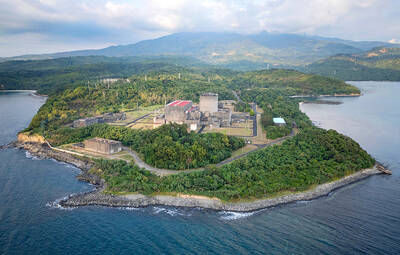
Nuclear power is getting a second look in Southeast Asia as countries prepare to meet surging energy demand as they vie for artificial intelligence-focused data centers. Several Southeast Asian nations are reviving mothballed nuclear plans and setting ambitious targets and nearly half of the region could, if they pursue those goals, have nuclear energy in the 2030s. Even countries without current plans have signaled their interest. Southeast Asia has never produced a single watt of nuclear energy, despite long-held atomic ambitions. But that may soon change as pressure mounts to reduce emissions that contribute to climate change, while meeting growing power needs. The


 RSS
RSS