


School Days With a Pig (Buta ga Ita Kyoshitsu) is a simple little picture about children faced with a life and death issue — the future of a pig they have been raising as a pet during the final year of primary school. There is plenty of cuteness, but the film has a serious issue at its heart, and in documenting the response of the cast of young children, director Tetsu Maeda manages to create a very appealing entertainment. It has won hearts, if not critical acclaim, garnering the audience choice award at the Tokyo International Film Festival in October of last year.
The story begins with rookie teacher Mr Hoshi (Satoshi Tsumabuki) deciding that he will confront his students with some real issues of life by bringing a pig into the curriculum. He states clearly at the beginning that when the class graduates, the pig will be sent to the slaughterhouse.
The premise is a departure from Disney, and the story is in fact based on an actual event in a primary school in Osaka. The teacher’s idea is that by rearing a pig for slaughter, students will be forced to confront the idea that their life owes much to the sacrifice of other living things. It’s a big topic, but Mr Hoshi has no idea how big it will get. Mr Hoshi’s objections to naming the pig are soon overruled by his class, and the pig rapidly assumes the status of class mascot.
The kids are initially horrified by the realities of rearing a pig, not least from the need to clean copious amounts of excrement from the super cute pig pen that they build in the school’s playground. Parents object when children come home smelling of the sty. Other teachers are less than supportive, and indulge in some “told you so” schadenfreude when Mr Hoshi has to deal with issues like feeding the pig during the summer holidays and the passionate objection of some of his class to dealing with the pig as originally arranged.
While the pig, P-chan, is presented in a cute way, Maeda does not avoid issues of the animal’s bodily functions and its disruption to the orderly conduct of the school. In fact, that’s really the point. School Days With a Pig emphasizes that life is a messy business.
Maeda proves particularly adept at handling his cast of children and their various ways of responding to the question of what will happen to P-chan. The arguments become passionate, but the debate about life and death never becomes improbable, and offers an insight into a child’s way of looking at the world, the ways they try to grapple with responsibility for another living thing. The children’s characters are allowed to emerge gradually through their different relations to the pig and their ideas about its future. It is a fine ensemble performance and a child star is notably absent.
The adult cast also puts in a strong performance, with Mieko Harada particularly attractive as the sympathetic principal who supports Mr Hoshi in his unconventional educational experiment. Parents are very much on the fringe, but there are some good cameos, not least from one father, a pork butcher, who tries a matter-of-fact approach with his son about P-chan’s fate. Then there is the regular pork chop in the children’s bento boxes every lunchtime, a mundane object that becomes endowed with huge significance as the children think about where it comes from.
The documentary style in which the film is shot suits the material, and the children shine, giving real passion to their attachment to an animal, which though slightly romanticized, remains quite definitely a true-to-life pig. As to what happens in the end, it turns out that Mr Hoshi can’t leave it all up to his students, a fact that gives him a few difficult moments as well. Voting on the local distributor’s site pig.catchplay.com shows people are in favor of keeping P-chan from the chopping block.

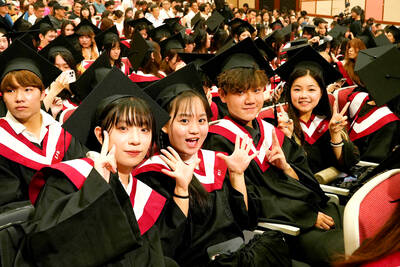
Taiwan’s English education system is being pulled apart by three opposing forces. Bilingual Nation 2030 pulls students toward English and global communication. Artificial Intelligence (AI) readiness pulls them toward digital judgment, verification and AI-mediated work. But Taiwan’s old exam culture pulls them back toward memorization, grammar drills, timed reading and correct answers. If the education system keeps using old exams to define success, it risks producing graduates who are neither genuinely bilingual nor genuinely AI-ready, but trained for tasks machines can already perform. The first force is Bilingual Nation 2030. Launched in 2018, the policy aimed to “help Taiwan’s workforce connect

“Taiwan’s Opposition Leader Comes to US With a Message Straight Out of Beijing” read a May 31 headline in the Wall Street Journal. Top US administration officials and members of Congress almost certainly read the WSJ, and if there was a bullet point takeaway that people in Washington should absorb ahead of Chinese Nationalist Party (KMT) Chair Cheng Li-wun’s (鄭麗文) arrival in DC on June 9, that headline is it. The last few columns have discussed this very topic, and the timing is not coincidental. While those top officials likely do not read the Taipei Times, judging by the number

With weighty, anxiety-inducing geopolitical topics dominating the headlines, checking in on the wild and weird state of local politics can take some of the edge off. This November’s elections will determine who will be in charge of fixing potholes in your neighborhood, not the potholes in Taiwan’s complicated geopolitical space. Recently, after an online interview with a Taipei-based journalist, I commented that Taipei journalists never go further than the MRT can take them. He laughed and agreed. Naturally, the Taipei mayoral race is eating up much of the press attention. TAIPEI CITY Democratic Progressive Party (DPP) candidate Puma Shen (沈伯洋) has
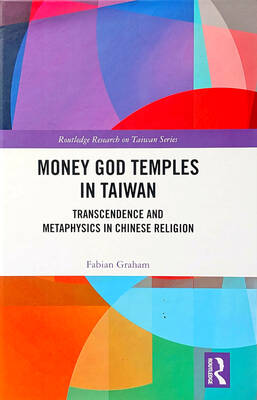
As someone who normally steers clear of books with “transcendence” or “metaphysics” in their subtitles, this reviewer — a casual observer of local belief systems since the 1990s — found Fabian Graham’s Money God Temples in Taiwan a challenging read. Those who’ve only dipped their toes into temple culture will likely need to parse several sections with special care if they’re to keep up with the author, a British ethnographic researcher whose previous books have investigated religious practices among ethnic Chinese in Southeast Asia. This scholarly volume examines a facet of Taiwan’s religious landscape that didn’t exist a century ago, and


 RSS
RSS