


The first thing that needs to be noted about Tanhou is that it is far more than just a restaurant. In fact, people passing by are likely to mistake it for a posh or gourmet supermarket. The large establishment consists of a bakery, a dry goods market, a frozen meat and fish section, a shabu-shabu counter and a coffee, juice and snack counter on the ground floor. The area for formal dining is in the basement. What makes Tanhou stand out from other places that offer healthy and natural foods is that this location is the retail face of a huge natural and organic foods production enterprise that includes its own fishery, pig and chicken rearing operations, and organic farm.
“Natural” and “organic” are words that are bandied about rather willy-nilly in this health-conscious age, and CEO Liu Tien-ho (劉天和) is careful not to make excessive claims for the food he sells. The fish and meat are “natural,” reared without the aid of growth hormones and antibiotics. It is only the vegetables that are strictly “organic.” The restaurant serves food prepared exclusively from Tanhou’s agricultural operation and affiliated farms, and as Tanhou has, until recently, primarily been involved in export, its products conform to a slew of international certifications including HACCP, one of the most stringent food safety assurance standards. Even the herbs used in the cooking are grown on Tanhou farms.
The restaurant, which had its soft opening last week, offers set menus (NT$480 to NT$880) designed to show off the quality of the foods on sale upstairs. Currently the menu favors very simple preparations. A salad of nuts and raw vegetables with an almost invisible vinaigrette impressed with the sweetness of the individual elements — the slices of red onion were so flavorful they could have been enjoyed unaccompanied. A portion of sashimi hit home with the delicacy of its flavors and the use of freshly ground wasabi. The oysters in a mixed appetizer were the most succulent local oysters that I have tasted in Taiwan, though the addition of a richly flavored sauce was an unfortunate distraction. While part of Tanhou’s appeal must certainly lie in the guarantee it offers regarding all of its ingredients, the food itself is competently prepared and staff is helpful in explaining each dish as it arrives. A good range of French and Californian wines is also available. And for those in a hurry, there is a selection of lunch boxes including pork and egg fried rice (海藻豬油蛋炒飯便當, NT$80) and steamed fish (鮮物魚片便當, NT$150). Vegetarian menus are also available.
The bakery upstairs is a must-visit for anyone interested in good bread, with some of the best white bread on offer in the city, as well as excellent brioches, baguettes and a selection of fancy breads. This is proper Western-style bread, sold at reasonable prices, with no fluffy pork in sight. The dry goods area features both local and imported organic goods, ranging from fruit preserves, condiments and rice to environmentally friendly household cleaning products.

The Portuguese never established a presence on Taiwan, but they must have traded with the indigenous people because later traders reported that the locals referred to parts of deer using Portuguese words. What goods might the Portuguese have offered their indigenous trade partners? Among them must have been slaves, for the Portuguese dealt slaves across Asia. Though we often speak of “Portuguese” ships, imagining them as picturesque vessels manned by pointy-bearded Iberians, in Asia Portuguese shipping between local destinations was crewed by Asian seamen, with a handful of white or Eurasian officers. “Even the great carracks of 1,000-2,000 tons which plied
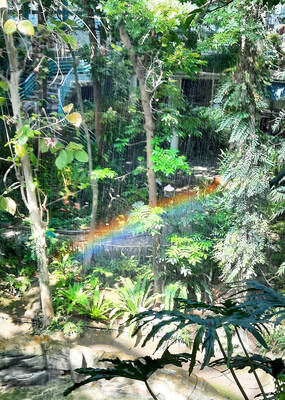
It’s only half the size of its more famous counterpart in Taipei, but the Botanical Garden of the National Museum of Nature Science (NMNS, 國立自然科學博物館植物園) is surely one of urban Taiwan’s most inviting green spaces. Covering 4.5 hectares immediately northeast of the government-run museum in Taichung’s North District (北區), the garden features more than 700 plant species, many of which are labeled in Chinese but not in English. Since its establishment in 1999, the site’s managers have done their best to replicate a number of native ecosystems, dividing the site into eight areas. The name of the Coral Atoll Zone might

On Monday morning, in quick succession, the Chinese Communist Party (CCP) and the Chinese Nationalist Party (KMT) released statements announcing “that the Central Committee of the Communist Party of China and General Secretary Xi Jinping (習近平) have invited KMT Chairwoman Cheng Li-wun (鄭麗文) to lead a delegation on a visit to the mainland” as the KMT’s press release worded it. The KMT’s press release added “Chairwoman Cheng expressed her gratitude for the invitation and has gladly accepted it.” Beijing’s official Xinhua news release described Song Tao (宋濤), head of the Taiwan Work Office of the CCP Central Committee, as
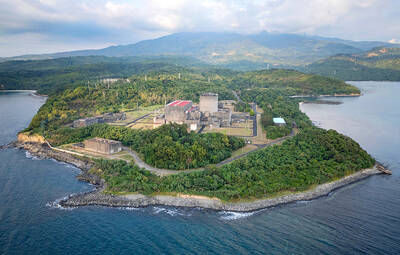
Nuclear power is getting a second look in Southeast Asia as countries prepare to meet surging energy demand as they vie for artificial intelligence-focused data centers. Several Southeast Asian nations are reviving mothballed nuclear plans and setting ambitious targets and nearly half of the region could, if they pursue those goals, have nuclear energy in the 2030s. Even countries without current plans have signaled their interest. Southeast Asia has never produced a single watt of nuclear energy, despite long-held atomic ambitions. But that may soon change as pressure mounts to reduce emissions that contribute to climate change, while meeting growing power needs. The


 RSS
RSS