


Behind a shop window near the Shida night market, passersby can glimpse four workbenches placed back to back, their surfaces laden with small blowtorches, tiny anvils and miniature hammers. Most afternoons, young men sit hunched over the tables, their hands delicately tapping away. Turn the corner and you will see the fruits of their meticulous labor: intricately handcrafted sterling silver jewelry artfully displayed in an airy showroom.
Primary Silver (元銀手作) opened in September on Longquan Street, just a few steps from the night market and right next to a popular purveyor of steamed buns. The store was founded by a group of four jewelers, including manager Zhou Jian-Ting (周建廷). The team originally produced gold jewelry for clients. Eventually, they decided it was time to start focusing on their own designs. Primary Silver provides Zhou and his colleagues with a workspace and a showroom for their creations.
“Each of us like creating things that are a bit more unusual than what other jewelry stores usually want. We figured that if we opened Primary Silver, we’d be able to find time to create and sell our own designs in between doing production work for other companies,” Zhou says.
The designers use sterling silver for their own pieces because it is cheaper than white gold and allows them to manipulate the natural oxidation of silver to create design effects. One bracelet (NT$4,500) has cloud-like whorls highlighted with iridescent blue and purple hues that resemble enamel on first glance, but is in fact the oxide that forms on silver after it has been exposed to air or water.
Each piece is created in limited quantities, and Zhou hopes that the intricacy of the designs will redefine people’s notions of what a handmade object can look like.
“When people hear ‘handmade’ now, I think they tend to think of things that are relatively simple and maybe a bit homespun-looking, so it’s obvious that it’s not machine-made,” Zhou says. “Of course that has its appeal, but we wanted to show our customers that something made by hand can also be very refined and very detailed.”
Pieces include earrings made to look like a pair of miniature lily pads (NT$880), with the texture of the leaves and each thin vein carefully delineated in sterling silver; and a playful pendant that looks like a kitten dangling from a branch with its tiny claws (NT$2,200). More abstract pieces include a series of pendants inspired by the undulating curves of the female body (NT$2,200). Techniques used by the designers include shaping the silver by hammering, drilling or soldering it, and lost-wax casting, in which a wax form is first carved, allowing for finer detailing, then used to make a mold.
Primary Silver also makes custom designs, which range from a few hundred NT dollars for small, simple pieces to about NT$20,000 for larger and more detailed jewelry. Custom jewelry is also available in white gold, which is priced according to the weight and complexity of the finished piece.
One customer recently requested a pair of matching pendants for him and his girlfriend but wasn’t quite sure what design he wanted.
“He said it had to be romantic, but he didn’t want a traditional heart pendant,” Zhou says.
Zhou asked the man about his girlfriend’s tastes and interests and found out that she likes elephants, a motif he decided to incorporate into the jewelry. The finished set of pendants are identical but meant to be worn differently: the girlfriend’s pendant, which hangs horizontally, looks like a stylized, heart-shaped elephant; the boyfriend’s vertically-hung pendant transforms the same design into a more masculine, abstract stone shape.
By placing Primary Silver’s workbenches in the showroom and right next to a large window, Zhou hopes to not only attract potential customers, but give passersby a peek into the art of silversmithing.
“A lot of stores don’t want people to see inside their workspaces,” Zhou says. “But I think a lot of people enjoy seeing how jewelry is made. And we think that understanding the care that is put into each piece allows people to value and enjoy their jewelry even more.”

The Portuguese never established a presence on Taiwan, but they must have traded with the indigenous people because later traders reported that the locals referred to parts of deer using Portuguese words. What goods might the Portuguese have offered their indigenous trade partners? Among them must have been slaves, for the Portuguese dealt slaves across Asia. Though we often speak of “Portuguese” ships, imagining them as picturesque vessels manned by pointy-bearded Iberians, in Asia Portuguese shipping between local destinations was crewed by Asian seamen, with a handful of white or Eurasian officers. “Even the great carracks of 1,000-2,000 tons which plied
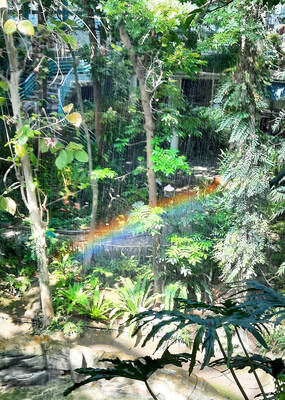
It’s only half the size of its more famous counterpart in Taipei, but the Botanical Garden of the National Museum of Nature Science (NMNS, 國立自然科學博物館植物園) is surely one of urban Taiwan’s most inviting green spaces. Covering 4.5 hectares immediately northeast of the government-run museum in Taichung’s North District (北區), the garden features more than 700 plant species, many of which are labeled in Chinese but not in English. Since its establishment in 1999, the site’s managers have done their best to replicate a number of native ecosystems, dividing the site into eight areas. The name of the Coral Atoll Zone might

On Monday morning, in quick succession, the Chinese Communist Party (CCP) and the Chinese Nationalist Party (KMT) released statements announcing “that the Central Committee of the Communist Party of China and General Secretary Xi Jinping (習近平) have invited KMT Chairwoman Cheng Li-wun (鄭麗文) to lead a delegation on a visit to the mainland” as the KMT’s press release worded it. The KMT’s press release added “Chairwoman Cheng expressed her gratitude for the invitation and has gladly accepted it.” Beijing’s official Xinhua news release described Song Tao (宋濤), head of the Taiwan Work Office of the CCP Central Committee, as
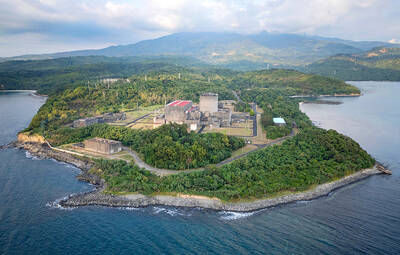
Nuclear power is getting a second look in Southeast Asia as countries prepare to meet surging energy demand as they vie for artificial intelligence-focused data centers. Several Southeast Asian nations are reviving mothballed nuclear plans and setting ambitious targets and nearly half of the region could, if they pursue those goals, have nuclear energy in the 2030s. Even countries without current plans have signaled their interest. Southeast Asia has never produced a single watt of nuclear energy, despite long-held atomic ambitions. But that may soon change as pressure mounts to reduce emissions that contribute to climate change, while meeting growing power needs. The


 RSS
RSS