


In today’s world of contemporary art, style is the mark of greatness. At least this is the impression that could be gleaned from Japanese art and its mimickers. But what of substance? Where’s the connection to the human condition in all its multiplicity?
These are just some of the questions begged by the 10 works of art by three of Japan’s preeminent artists, currently on display at the Metaphysical Art Gallery.
Takashi Murakami’s iconic acrylic on canvas Eye Love Superflat celebrates the Louis Vuitton brand — a company the artist has collaborated with — and Murakami’s own “superflat” sensibility.
Discussion of Murakami’s oeuvre is usually prefaced with his own success as a brand. But that’s style, that’s Warhol, that’s America — where Murakami’s art is popular. Showing only one work from Murakami’s vast output is misleading because there is so much more to his paintings, drawings, sculpture and installation, and looking at the one canvas on the wall — though gaining the attention of the gallery viewers — is a tease.
Murakami’s canvas, however, is the exception in an exhibition that provides a brief glimpse of the artists’ styles and preoccupations.
Contemporary Asian art is often preoccupied with cuteness (可愛). Rather than a term denoting the adorableness of a stuffed animal, it has become a moniker used to describe Asian pop culture separated from other ideas of art by both time and stylistic innovation. With the artists in this show, the visual language takes inspiration from manga (comics) and anime and celebrates youth culture and the social movements of the 1960s and 1970s, both in the US and Japan.
The four works by Yoshitomo Nara, 49, introduce the artist’s approach and are fairly representative of his style.
Each of the four canvases features a “cute” child with a simple background. The bemused gazes and knowing air of the children belies the fact that Nara’s subjects are fully conscious of what the world has in store for them. Nara’s work invites us to move beyond the conformity that comes with adulthood and return to the optimism and rebelliousness of childhood, while at the same time recognizing that children are soon thrust into a world largely beyond their control.
While the children found in Nara’s works are self-knowing, Yayoi Kusama’s work digs deep into, or perhaps confronts and reveals, her own pathology.
Kusama, 80, says that she has suffered from hallucinations since her early youth, which included seeing spots and hearing the voices. Instead of fighting the sensory illusions, she painted and drew them. As a result, her characteristic imagery of dots and webs, monochrome pigment and repetitive forms are incorporated in her sculpture and painting and betrays an obsessive mind at work.
Her way of seeing discom-bobulates the viewer and is reminiscent of the psychedelic 1960s and 1970s (when she was a resident of New York) and the cultural movements she experienced during those formative decades. Kusama’s work is fascinating because she’s turned her childhood visions into an art that replicates the obsessive nature of the mind and art itself.
Although somewhat disappointing in size, especially the single Murakami canvas, the works in this exhibit provide a key to Japanese contemporary art and the mythology of the pop culture that it reflects. Whether the exhibit contains substance (or does the artists justice) is left up to the viewer to decide.

The Portuguese never established a presence on Taiwan, but they must have traded with the indigenous people because later traders reported that the locals referred to parts of deer using Portuguese words. What goods might the Portuguese have offered their indigenous trade partners? Among them must have been slaves, for the Portuguese dealt slaves across Asia. Though we often speak of “Portuguese” ships, imagining them as picturesque vessels manned by pointy-bearded Iberians, in Asia Portuguese shipping between local destinations was crewed by Asian seamen, with a handful of white or Eurasian officers. “Even the great carracks of 1,000-2,000 tons which plied
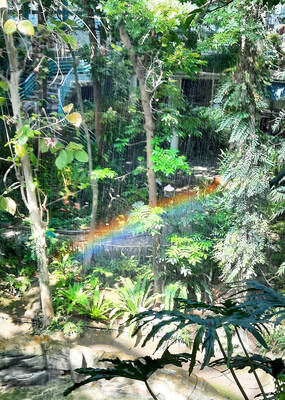
It’s only half the size of its more famous counterpart in Taipei, but the Botanical Garden of the National Museum of Nature Science (NMNS, 國立自然科學博物館植物園) is surely one of urban Taiwan’s most inviting green spaces. Covering 4.5 hectares immediately northeast of the government-run museum in Taichung’s North District (北區), the garden features more than 700 plant species, many of which are labeled in Chinese but not in English. Since its establishment in 1999, the site’s managers have done their best to replicate a number of native ecosystems, dividing the site into eight areas. The name of the Coral Atoll Zone might

On Monday morning, in quick succession, the Chinese Communist Party (CCP) and the Chinese Nationalist Party (KMT) released statements announcing “that the Central Committee of the Communist Party of China and General Secretary Xi Jinping (習近平) have invited KMT Chairwoman Cheng Li-wun (鄭麗文) to lead a delegation on a visit to the mainland” as the KMT’s press release worded it. The KMT’s press release added “Chairwoman Cheng expressed her gratitude for the invitation and has gladly accepted it.” Beijing’s official Xinhua news release described Song Tao (宋濤), head of the Taiwan Work Office of the CCP Central Committee, as
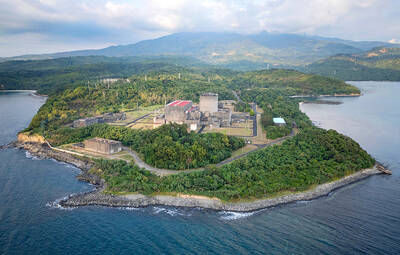
Nuclear power is getting a second look in Southeast Asia as countries prepare to meet surging energy demand as they vie for artificial intelligence-focused data centers. Several Southeast Asian nations are reviving mothballed nuclear plans and setting ambitious targets and nearly half of the region could, if they pursue those goals, have nuclear energy in the 2030s. Even countries without current plans have signaled their interest. Southeast Asia has never produced a single watt of nuclear energy, despite long-held atomic ambitions. But that may soon change as pressure mounts to reduce emissions that contribute to climate change, while meeting growing power needs. The


 RSS
RSS