


Most teens may not get excited about church, but in Finland they go out of their way to attend in the latest testimony to the country’s infatuation with heavy metal music: Metal Mass.
“It’s nice that there are slightly different church services compared to the usual ones,” says 15-year-old Teea Pallaskari, who skipped geography class to make the service in the plain, red-brick Lutheran Church — the state religion — in this small town about 60km north of Helsinki.
Inside, Pallaskari and her classmates squash together on packed pews, belting out hymns as a lead singer moshes wildly onstage to his band’s earsplitting tones.
When the music stops, the students burst into ecstatic applause and whistles — to smiling approval from Pastor Haka Kekaelaeinen. It’s Metal Mass — or Metallimessu — and it’s okay to be loud.
“It was really good,” Akseli Inkinen, a 17-year-old high school student with long, messy hair and big headphones, says afterwards.
It is hardly surprising that masses with metal hymns have surfaced in Finland, which won the Eurovision Song Contest for the first time in 2006 with Lordi’s monster heavy metal song Hard Rock Hallelujah.
If it has a niche audience elsewhere, heavy metal is now mainstream in Finland. Helsinki alone abounds with heavy metal karaoke bars, dedicated metal clubs and regular gigs, adding to the dozens of summertime heavy metal festivals held around the Nordic country.
Some say the answer lies in the Finnish character.
“Finns are known to be reserved, serious and very honest. Somehow heavy metal fits into this as it is no-nonsense, honest, straightforward and quite gloomy,” Mikko Saari, a co-founder of Metallimessu, said.
“When you switch on the radio in Finland, you hear heavy metal music. The Finnish Eurovision Song Contest and even Idols (the Finnish equivalent to the American Idol competition), were won with metal songs,” says Kimmo Kuusniemi, one of Finland’s metal music pioneers.
The first Metal Mass in Finland was held in 2006 at the Tuska (Pain) metal music festival in Helsinki. Since then, a Metal Mass tour bus has been zigzagging across the country.
“This is not the church’s plan. Bishops did not plan this. It was started by five metal fans, three of whom worked at a church,” Saari says.
Not everyone is happy with the mix. Some church-goers feel loud rock music has no place in a house of God, and some pure metal fans accuse the Lutheran Church of co-opting their music to lure young people.
“Of course some Christian circles were scared and some true metal people were irate. But many said that the idea was great and that they had been waiting for it,” Saari says.
Kuusniemi, 50, who is producing a documentary about Finnish metal music, says he too was at first skeptical. “For me, Metal Mass was a surprise. Metal music and church did not fit in the same room,” he said.
But the Finnish music scene has changed dramatically since he started his own band, Sarcofagus, in the late 1970s when the genre was widely considered “devil music,” he said. Today, heavy metal “is truly a mainstream phenomenon; metal is everywhere, and people have a positive attitude towards it.”
So far this year, Finland’s top 10 album sellers include three heavy metal records.
Heavy metal gained a foothold in Finland thanks to independent record labels that gave little-known metal bands a chance to record, according to Jouni Markkanen, a promoter and agent with Finnish Metal Events.
But now, the big — and small — record companies are investing heavily.
“There are many bands with export potential in Finland, it has been proven,” says Markkanen, saying bands Nightwish and HIM as well as Children of Bodom have sold well abroad.
But “we are still waiting for a mega class success.”

Taiwan’s English education system is being pulled apart by three opposing forces. Bilingual Nation 2030 pulls students toward English and global communication. Artificial Intelligence (AI) readiness pulls them toward digital judgment, verification and AI-mediated work. But Taiwan’s old exam culture pulls them back toward memorization, grammar drills, timed reading and correct answers. If the education system keeps using old exams to define success, it risks producing graduates who are neither genuinely bilingual nor genuinely AI-ready, but trained for tasks machines can already perform. The first force is Bilingual Nation 2030. Launched in 2018, the policy aimed to “help Taiwan’s workforce connect

It seems every few days one bumps into one of those “real man” comments in which Taiwan is urged to “face reality” or similar, and “make a deal,” with the speaker implying that soon it will be too late. “Deal” advocates always present themselves as having a superior grip on reality, and the manly ability to make the “hard choice.” Their testosterone-laden language often echoes that of Taiwan sellout advocates. Note that such commentary always specifies a process (“make a deal, work with, make progress”), never the end state of what occupation by a violent authoritarian colonialist state will entail. In

“Taiwan’s Opposition Leader Comes to US With a Message Straight Out of Beijing” read a May 31 headline in the Wall Street Journal. Top US administration officials and members of Congress almost certainly read the WSJ, and if there was a bullet point takeaway that people in Washington should absorb ahead of Chinese Nationalist Party (KMT) Chair Cheng Li-wun’s (鄭麗文) arrival in DC on June 9, that headline is it. The last few columns have discussed this very topic, and the timing is not coincidental. While those top officials likely do not read the Taipei Times, judging by the number
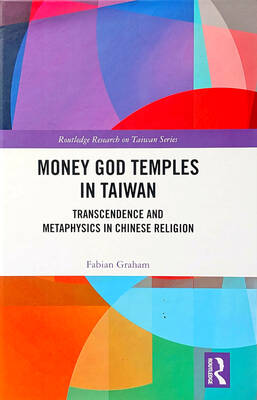
As someone who normally steers clear of books with “transcendence” or “metaphysics” in their subtitles, this reviewer — a casual observer of local belief systems since the 1990s — found Fabian Graham’s Money God Temples in Taiwan a challenging read. Those who’ve only dipped their toes into temple culture will likely need to parse several sections with special care if they’re to keep up with the author, a British ethnographic researcher whose previous books have investigated religious practices among ethnic Chinese in Southeast Asia. This scholarly volume examines a facet of Taiwan’s religious landscape that didn’t exist a century ago, and


 RSS
RSS