


Seen from the perspective of a window washer who is one of the main characters in Lost in Beijing (蘋果), the Chinese capital is an endless vista of glassy high-rises. Closer to the ground, in the lyrical documentary montages that frame Li Yu’s (李玉) modern urban melodrama, the city is a hive of human work and pleasure seeking. There are tango clubs and dive bars, car dealerships and open-air markets, nouveau riches in their Mercedes-Benzes and homeless people stretched out on benches.
There are, at last count, something like 17 million stories in this naked city, and Li, who wrote the screenplay for Lost in Beijing with Fang Li (方勵), relates a tale that is at once representative of the social and economic tensions afflicting 21st-century China and ripely, improbably melodramatic. The director and her cast work in a rough, naturalistic style, but the narrative offers both the pleasures and the limitations of old-fashioned class-conscious pulp. In spite of its raw, explicit moments, the film is at heart a sturdy morality tale about innocence and corruption, wealth and want, sex and power.
An-kun (played by Tong Da Wei, 佟大為), the window washer, is married to Ping-guo (Fan Bingbing, 范冰冰), who works at the Gold Basin Massage Palace rubbing the feet of tired businessmen and deflecting their roving hands. Her boss, Mr Lin (Tony Leung Ka Fai, 梁家輝), is a rough character as yet unpolished by money, an unapologetic gambler and womanizer. One afternoon he finds Ping-guo passed out in his office, and his attempt to take advantage of her turns from a clumsy pass into a rape. An-kun, who happens to be washing the window of Mr Lin’s office and witnesses the assault — this is what I mean by improbable — tries first to attack the older, more powerful man and then to blackmail him.
When Ping-guo discovers she’s pregnant, Lost in Beijing begins a curious, not entirely successful transition from melodrama to domestic comedy. Mrs Lin (Elaine Jin, 金燕玲), who is infertile, takes her revenge on her husband by sleeping with An-kun, even as Mr Lin starts to see his own possible paternity as a neat solution for everyone. The baby, he reasons, will save his marriage, and the more than 100,000 yuan he will pay Ping-guo and An-kun for their trouble will assuage his guilt and help the young couple toward a better and more prosperous life.
Though the film’s emotional tone is blurry — toward the end it swerves away from farce and back toward anguish — its social criticism could hardly be more clear. The metropolis it depicts is one in which money is the measure of all value, and in which every human relationship can be reduced to a transaction, a deal. Ping-guo and An-kun, industrious young people from a Northeastern province, are unsurprisingly overwhelmed by this way of life, but so, in their own way, are Mr and Mrs Lin. Jin, one of Taiwan’s finest actresses, and Leung, a durable star of the Hong Kong cinema, rescue their characters from easy caricature.
The other actors are also very good — Fan’s blend of toughness and delicacy places her in a rich tradition of Chinese screen heroines — and, along with the city itself, they help give Lost in Beijing a human complexity that cuts against the schematic artifice of its story.
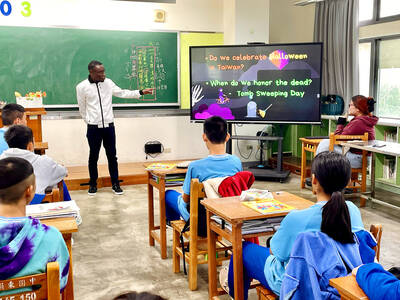
For many people, Bilingual Nation 2030 begins and ends in the classroom. Since the policy was launched in 2018, the debate has centered on students, teachers and the pressure placed on schools. Yet the policy was never solely about English education. The government’s official plan also calls for bilingualization in Taiwan’s government services, laws and regulations, and living environment. The goal is to make Taiwan more inclusive and accessible to international enterprises and talent and better prepared for global economic and trade conditions. After eight years, that grand vision is due for a pulse check. RULES THAT CAN BE READ For Harper Chen (陳虹宇), an adviser

Traditionally, indigenous people in Taiwan’s mountains practice swidden cultivation, or “slash and burn” agriculture, a practice common in human history. According to a 2016 research article in the International Journal of Environmental Sustainability, among the Atayal people, this began with a search for suitable forested slopeland. The trees are burnt for fertilizer and the land cleared of stones. The stones and wood are then piled up to make fences, while both dead and standing trees are retained on the plot. The fences are used to grow climbing crops like squash and beans. The plot itself supports farming for three years.

The breakwater stretches out to sea from the sprawling Kaohsiung port in southern Taiwan. Normally, it’s crowded with massive tankers ferrying liquefied natural gas from Qatar to be stored in the bulbous white tanks that dot the shoreline. These are not normal times, though, and not a single shipment from Qatar has docked at the Yongan terminal since early March after the Strait of Hormuz was shuttered. The suspension has provided a realistic preview of a potential Chinese blockade, a move that would throttle an economy anchored by the world’s most advanced and power-hungry semiconductor industry. It is a stark reminder of

May 4 to May 10 It was once said that if you hadn’t performed at the Sapphire Grand Cabaret (藍寶石大歌廳), you couldn’t truly be considered a star. Taking the stage at the legendary Kaohsiung club was more than just a concert. Performers were expected to entertain in every sense, wearing outlandish or revealing costumes and staying quick on their feet as sharp-tongued, over-the-top hosts asked questions and delivered jokes that would be seen as vulgar, even offensive, by today’s standards. Opening in May 1967 during a period of strict political and social control, Sapphire offered a rare outlet for audiences in


 RSS
RSS