


You don’t have to be in northern Taiwan long before life becomes a noisy whirlwind of tiled facades, scooters and pollution.
When you begin to fantasize about knocking over scooter-riders as they barrel down the sidewalk in search of parking, or stomping on the cellphone of the high school student on the MRT who feels it is a perfectly reasonable to scream into his receiver (“Nothing. What are you doing? I said, what are you doing? Nothing?! Me too!”), then it is time to get away from the city.
You could, of course, head to the mountains of central Taiwan or the eastern coast. But for those who live in and around Taipei, another option offers a much easier way to retreat from the hustle and bustle of the city.
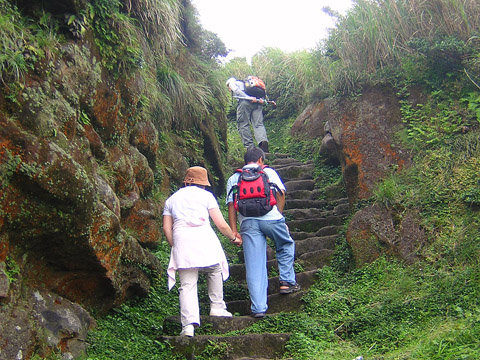
PHOTO: MAC WILLIAM BISHOP
Many people know that Yangmingshan National Park (陽明山國家公園) is easily accessible from Taipei, but few are aware of the quality of the hiking and the beautiful landscapes that can be found in the park.
It goes without saying that if you go there on a weekend, you will be joining a throng of people who are equally as intent on getting outdoors as you are. But there is enough space that, as you venture further along, your hike will become more solitary.
So it was for me on a recent weekend, as I set out from my base in Taoyuan City with one goal in mind: hiking Qixingshan (七星山, or Seven Stars Mountain).
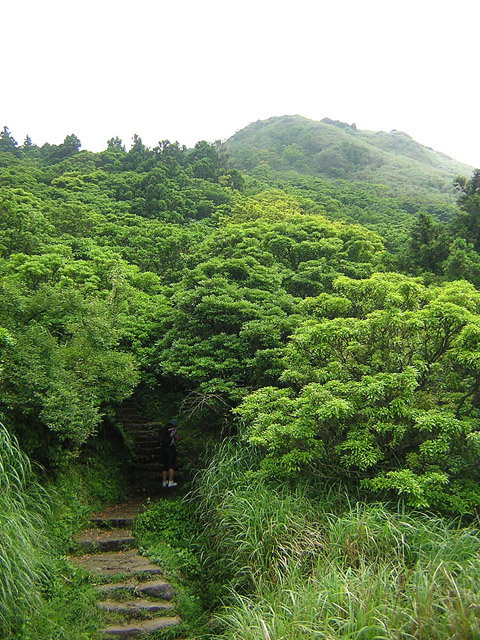
PHOTO: MAC WILLIAM BISHOP
After a nearly two-hour bus, train and MRT journey, I arrived at Beitou MRT Station at the foot of Yangmingshan. From there I caught another bus that took me about 10km up Yangmingshan, the sprawling mountain north of Taipei. From the bus station on Yangmingshan, a 15-minute walk brought me to the Yangmingshan National Park Headquarters (陽明山國家公園管理處), with its visitor center, and several trailheads.
The visitor center is a modern facility with an English-speaking staff. Here, you can pick up decent guide maps for the park in several languages, use the restrooms, and get refreshments at a cafe.
With its many trails, a visitor could easily spend several trips exploring new sections of Yangmingshan.
PHOTO: MAC WILLIAM BISHOP
My choice was a trail that led from the visitor center up to the main peak of Qixingshan and back down again in a wide loop.
At 1,120m, Qixingshan (which, using Tongyong Pinyin, the park spells “Cisingshan” in all of its publications) is the highest peak in Yangmingshan National Park.
As a veteran mountaineer who grew up hiking, skiing and camping among the peaks of Colorado, which often exceed 4,200m, I figured this mere 1,120m peak would be no big deal. I am in decent physical condition and am well acclimated to Taiwan’s climate.
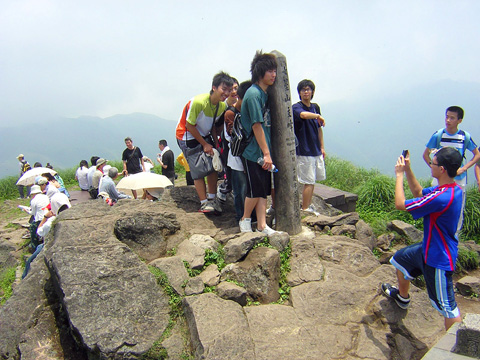
PHOTO: MAC WILLIAM BISHOP
Plus, the visitor center is at about 550m above sea level (Taipei and its environs average 10m above sea level, on the alluvial plain between the Danshui and Keelung rivers). Qixingshan’s main peak is about 2.3km from the trailhead, so it is an elevation gain of 247m per kilometer — seemingly not too much of a challenge for a good hiker.
I started out fine, striding effortlessly past a gaggle of high-school students on a field trip. But it wasn’t long before sweat was streaming from every pore and I was laboring to keep my feet moving up the trail.
It was when an elderly, dumpling-shaped woman flew by me on her way down that I realized what a toll the humidity was taking.
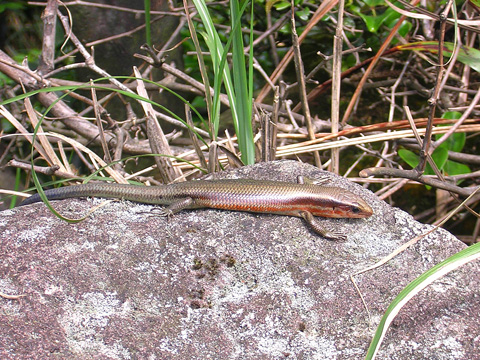
PHOTO: MAC WILLIAM BISHOP
“Foreigners sweat so much!” she said cheerfully, as she effortlessly bounded down the stone stairs.
The heat and humidity can be a real challenge. According to the weather service, it was a reasonable 26°C in Taipei City, with a humidity of 83 percent. Yangmingshan was noticeably cooler, but until you get toward the top, don’t expect any breezes to cool you off among the densely packed trees.
I expected hiking in this area to be thirsty work, and I was right. I was carrying about 1.5 liters of water, and I had drunk all of it before I even reached the peak.
Two or three liters are probably more reasonable amounts for a six- to eight-hour hike on a hot day in the park. As with any kind of intensive physical activity that lasts for more than one or two hours, you will want to bring along snacks to maintain your energy.
The main trails in Yangmingshan are pretty much stone, with lots of steep staircases. This is necessary to maintain heavily used trails in that environment, as most dirt paths would turn into a rut or become overgrown in days with the heavy foot traffic, frequent rain and profuse vegetation. Despite this, there are many smaller, hard-to-find and less-used dirt trails wending through the park, and one of these is your best bet if you really want to go it alone.
Halfway up Qixingshan I met a group of people in full mountaineering gear, boiling tea on camping stoves and eating steamed buns. This seemed like overkill — the loop is after all, only 6km — until they told me that they were just using Qixinghsan to help train for a trip to Yushan — a much more serious climb.
Although hiking in Yangmingshan is not comparable to hiking in “real” wilderness, it is still a very pretty journey.
The tall grass that spreads profusely through the park — especially the higher elevations — is Japanese silver grass, which looks quite beautiful sighing in the breeze. There are a wide variety of trees in the park, including Japanese cypress and Formosa koa.
Things you will not get from any pictures, and some of the best parts of hiking in the park, include the perfumes of tropical flowers and the sandalwood-like aroma of the undergrowth. And your hike will be accompanied by beautiful birdsongs, such as the cries of the Chinese bamboo partridge (which one almost never sees, but often hears).
When you make it to the top of one of Qixingshan’s two peaks (the main peak or the east peak), there is usually a decent breeze to help you cool off. But although the cliche says it’s lonely at the top, don’t expect it to be lonely on Qixingshan, especially on a weekend. There is often a crowd of people taking a break and snapping photos.
Despite the people and the heat, I found it hard not to smile when I reached the top and looked out over the wide expanse of trees and grass, spilling down toward the outskirts of Taipei City, dimly visible through the haze.
If you go
Getting there:
From Taipei Main Station, your best option is to take bus No. 260 from Zhongshan North Road (中山北路). Otherwise, take the MRT’s Danshui Line north to Beitou MRT Station. From there, you can take the bus No. 230 on the west side of the station. You can also catch the Red No. 5 bus from Jiantan MRT Station, near Shilin Night Market.
For all buses, get off at the Yangmingshan (陽明山) bus terminal (next to a Starbucks and 7-Eleven).
Cars require a resident’s permit on weekends and holidays, so a bus is the easiest option for visitors.
Yangmingshan National Park Web site:
www.ymsnp.gov.tw
Yangmingshan National Park Headquarters:
1-20 Jhuzihhu Rd, Beitou Dist, Yangmingshan, Taipei City (台北市陽明山竹子湖路1-20號)
Telephone: (02) 2861-3601 X233
Hours: 9am to 4:30pm; closed Mondays and the day after public holidays
Weather and environment:
Yangmingshan is generally a few degrees cooler than Taipei City, but hikers will not notice much of a difference. Storms can break out suddenly during the spring and early summer, so be prepared for rain. Take insect repellent and sunscreen.
Food and drink:
There are a number of street vendors and small restaurants near the Yangmingshan bus terminal. You can also get a snack at the 7-Eleven near the Yangmingshan bus terminal or refreshments at the Yangmingshan National Park Headquarters’ visitor center.

For many people, Bilingual Nation 2030 begins and ends in the classroom. Since the policy was launched in 2018, the debate has centered on students, teachers and the pressure placed on schools. Yet the policy was never solely about English education. The government’s official plan also calls for bilingualization in Taiwan’s government services, laws and regulations, and living environment. The goal is to make Taiwan more inclusive and accessible to international enterprises and talent and better prepared for global economic and trade conditions. After eight years, that grand vision is due for a pulse check. RULES THAT CAN BE READ For Harper Chen (陳虹宇), an adviser

Traditionally, indigenous people in Taiwan’s mountains practice swidden cultivation, or “slash and burn” agriculture, a practice common in human history. According to a 2016 research article in the International Journal of Environmental Sustainability, among the Atayal people, this began with a search for suitable forested slopeland. The trees are burnt for fertilizer and the land cleared of stones. The stones and wood are then piled up to make fences, while both dead and standing trees are retained on the plot. The fences are used to grow climbing crops like squash and beans. The plot itself supports farming for three years.

The breakwater stretches out to sea from the sprawling Kaohsiung port in southern Taiwan. Normally, it’s crowded with massive tankers ferrying liquefied natural gas from Qatar to be stored in the bulbous white tanks that dot the shoreline. These are not normal times, though, and not a single shipment from Qatar has docked at the Yongan terminal since early March after the Strait of Hormuz was shuttered. The suspension has provided a realistic preview of a potential Chinese blockade, a move that would throttle an economy anchored by the world’s most advanced and power-hungry semiconductor industry. It is a stark reminder of

May 4 to May 10 It was once said that if you hadn’t performed at the Sapphire Grand Cabaret (藍寶石大歌廳), you couldn’t truly be considered a star. Taking the stage at the legendary Kaohsiung club was more than just a concert. Performers were expected to entertain in every sense, wearing outlandish or revealing costumes and staying quick on their feet as sharp-tongued, over-the-top hosts asked questions and delivered jokes that would be seen as vulgar, even offensive, by today’s standards. Opening in May 1967 during a period of strict political and social control, Sapphire offered a rare outlet for audiences in


 RSS
RSS