


Cinderella meets The Ugly Duckling in Penelope, a muddled, charm-free fairy tale whose title character, played by Christina Ricci, is a rich girl born with the snout of a pig.
The movie's fundamental flaws begin with Penelope's appearance. She is supposed to be so hideous that potential suitors dive out of the windows of her family's London mansion at the first sight of her. After an encounter one greedy twit, Edward Vanderman (Simon Woods), goes to the newspapers with a tale of being attacked by a fanged monster, but nobody believes him.
In actuality Penelope Wilhern, who is hidden away in the house by her snobbish parents, Jessica (Catherine O'Hara) and Franklin (Richard Grant), is more adorable than Miss Piggy. Her nose, through which runs a carotid artery (thus precluding cosmetic surgery), is well-shaped, symmetrical and cutely turned up. Ricci plays her as a smart, hardheaded young woman who stoically accepts her fate. She suffers from an ancient family curse that can be lifted, she is told, only when she marries a man of equivalent social station. There are no takers.
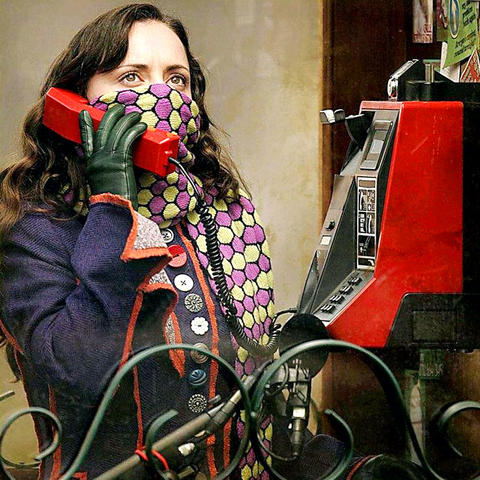
PHOTO: COURTESY OF FOX
The movie takes a wrong turn when Edward, ridiculed for his horror story, teams up with Lemon (Peter Dinklage), a tabloid journalist wearing an eye patch, to prove her existence. They recruit Max (James McAvoy), a down-and-out aristocrat with gambling debts, to court Penelope and photograph her. Max fails to produce a picture, but in their brief encounter a spark is struck.
Penelope, desperate to experience the real world, eventually runs away from home with a scarf wrapped over her nose and is befriended by Annie, a tough-talking bike messenger played by Reese Witherspoon (one of the movie's producers in a thankless cameo performance). Once Penelope's identity is discovered, she becomes a tabloid celebrity.
Directed by Mark Palansky from a screenplay by Leslie Caveny, Penelope is a hopeless jumble of visual and linguistic styles. Its Tim Burton-manque look combines old-fashioned storybook London with a 21st-century cityscape, and the characters speak in a welter of accents (British and American and in between). This is a movie in which even O'Hara, whose twinkling sense of mischief can make almost anything funny, is comically stymied.
Without humor the movie's messages about self-acceptance, snobbery and a paparazzi-infected media register as annoyingly smug.

If one asks Taiwanese why house prices are so high or why the nation is so built up or why certain policies cannot be carried out, one common answer is that “Taiwan is too small.” This is actually true, though not in the way people think. The National Property Administration (NPA), responsible for tracking and managing the government’s real estate assets, maintains statistics on how much land the government owns. As of the end of last year, land for official use constituted 293,655 hectares, for public use 1,732,513 hectares, for non-public use 216,972 hectares and for state enterprises 34 hectares, yielding

The small platform at Duoliang Train Station in Taitung County’s Taimali Township (太麻里) served villagers from 1992 to 2006, but was eventually shut down due to lack of use. Just 10 years later, the abandoned train station had become widely known as the most beautiful station in Taiwan, and visitors were so frequent that the village had to start restricting traffic. Nowadays, Duoliang Village (多良) is known as a bit of a tourist trap, with a mandatory, albeit modest, admission fee of NT$10 giving access to a crowded lane of vendors with a mediocre view of the ocean and the trains

The March/April volume of Foreign Affairs, long a purveyor of pro-China pablum, offered up another irksome Beijing-speak on the issues and solutions for the problems vexing the People’s Republic of China (PRC) and the US: “America and China at the Edge of Ruin: A Last Chance to Step Back From the Brink” rang the provocative title, by David M. Lampton and Wang Jisi (王緝思). If one ever wants to describe what went wrong with US-PRC relations, the career of Wang Jisi is a good place to start. Wang has extensive experience in the US and the West. He was a visiting

One of the challenges with the sheer availability of food in today’s world is that lots of us end up spending many of our waking hours eating. Whether it’s full meals, snacks or desserts, scientists have found that it’s not uncommon for us to be mindlessly grazing at some point during all of our 16 or so waking hours. The problem? As soon as this food hits the bloodstream in the form of glucose, it initiates the release of the hormone insulin. This in turn activates a switch present in every one of our cells, which is responsible for driving cell


 RSS
RSS