


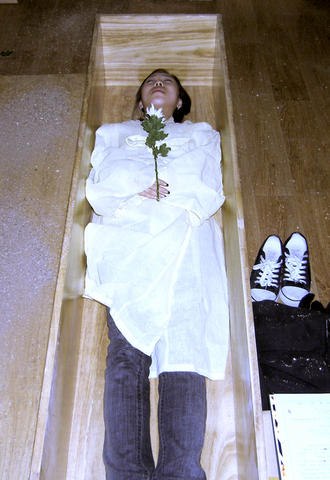
After solemnly reading their wills, seven perfectly healthy university students climb into caskets in a dimly lit hall.
"I want to give all of you one more day to live, but it's time to be placed into coffins," a man in a black suit says in a resounding voice. "I hope your tired flesh and bodies will be peacefully put to rest." Workers nail the coffins shut, then sprinkle dirt on top as the lights are switched off and a dirge is played. Muffled sobs can be heard from some of the coffins. About 15 minutes later, they are opened and the five men and two women are "reborn." The mock funeral, which aims to get participants to map out a better future by reflecting on their past, is part of a new trend in South Korea called "well-dying." The fad is an extension of well-being, an English phrase adopted into Korean to describe a growing interest in leading healthier, happier lives.
"I felt really, really scared inside the coffin and also thought a lot about my mom," said Lee Hye-jung, a 23-year-old woman studying engineering. "I'll live differently from now on so as not to have any regrets about my life." Other well-dying activities focus on death itself. Web sites store wills to be conveyed to relatives after death. Death coordinators help plan funerals in advance in case of unexpected death.
Experts see the well-being and well-dying trend as a sign that South Koreans have grown affluent enough to be able to consider quality-of-life issues. But some dismiss services such as the fake funerals as moneymaking ventures.
Korea Life Consulting Co, which staged the mock funeral for the students, charges up to US$325 per customer.
"Real death is totally different than this," said Chung Jae-hyun, a board director at the Korea Association of Thanatology, a Seoul-based group of academics who study death-related issues.
Some companies see the service as a way of improving job performance. Samsung Electronics Co sent 900 workers in 2006 from its factory in Gumi to the southeast of Seoul for sessions.
The experience makes workers more efficient, said Kim Hee-jin, a personnel manager at the Gumi plant, which makes mobile phones, computer printers and fax machines.
Korea Life Consulting held the students' funeral at a mountain resort in Chungju, 150km south of Seoul. Photos of celebrities who died prematurely, including Princess Diana and former US president John F. Kennedy, were hung on the walls.
The students donned a traditional garment for the dead, made from hemp. One worker wore a black robe and a wide-brimmed cylindrical hat, the outfit of a death messenger in Korean folklore.
Participants take a class on the meaning of life, pose for portrait photos to be used at the service and write wills as if they have three days to live.
"Mom and Dad! Everything I have now is from you, your teaching and your love. I'm so sorry that I have to leave you behind," said Hwang Yun-jin, a 29-year-old mechanical engineering major, crying as she read her will aloud.
Ko Min-su, who hosted the ceremony and heads Korea Life Consulting, said about 50,000 people have taken part in his fake funerals since they began in 2004. Most are in their 30s and 40s.
His company has eight offices around the country, and copycats have sprung up.
"To die well, we should live well," he said. "Many participants cried while reading their wills, which means they felt they had much to regret." Ko, a 40-year-old former insurance agent, launched the business after realizing the fragility of life following the deaths of his two older brothers in a plane and a car accident.
"Everyone can die unexpectedly," he said.
If one asks Taiwanese why house prices are so high or why the nation is so built up or why certain policies cannot be carried out, one common answer is that “Taiwan is too small.” This is actually true, though not in the way people think. The National Property Administration (NPA), responsible for tracking and managing the government’s real estate assets, maintains statistics on how much land the government owns. As of the end of last year, land for official use constituted 293,655 hectares, for public use 1,732,513 hectares, for non-public use 216,972 hectares and for state enterprises 34 hectares, yielding
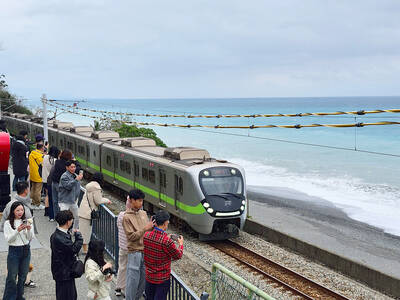
The small platform at Duoliang Train Station in Taitung County’s Taimali Township (太麻里) served villagers from 1992 to 2006, but was eventually shut down due to lack of use. Just 10 years later, the abandoned train station had become widely known as the most beautiful station in Taiwan, and visitors were so frequent that the village had to start restricting traffic. Nowadays, Duoliang Village (多良) is known as a bit of a tourist trap, with a mandatory, albeit modest, admission fee of NT$10 giving access to a crowded lane of vendors with a mediocre view of the ocean and the trains

The March/April volume of Foreign Affairs, long a purveyor of pro-China pablum, offered up another irksome Beijing-speak on the issues and solutions for the problems vexing the People’s Republic of China (PRC) and the US: “America and China at the Edge of Ruin: A Last Chance to Step Back From the Brink” rang the provocative title, by David M. Lampton and Wang Jisi (王緝思). If one ever wants to describe what went wrong with US-PRC relations, the career of Wang Jisi is a good place to start. Wang has extensive experience in the US and the West. He was a visiting

One of the challenges with the sheer availability of food in today’s world is that lots of us end up spending many of our waking hours eating. Whether it’s full meals, snacks or desserts, scientists have found that it’s not uncommon for us to be mindlessly grazing at some point during all of our 16 or so waking hours. The problem? As soon as this food hits the bloodstream in the form of glucose, it initiates the release of the hormone insulin. This in turn activates a switch present in every one of our cells, which is responsible for driving cell


 RSS
RSS