


John Carpenter's original 1978 Halloween was a slumber-party spook tale about a mask-clad bogeyman hacking his way through a sleepy Illinois suburb. Rob Zombie's remake wants to be all that and a case study as well, devoting its first act to the childhood of the future serial killer Michael Myers, a chubby, sweet-faced, socially awkward boy whose mental illness is transformed into murderous rage by school bullies and a home life of Dickensian squalor.
Unfortunately, the spook tale and the case study are incompatible storytelling modes. Zombie's movie, which he wrote and directed, wants us to care about Myers - who busts out of a mental institution 17 years after murdering most of his family and goes home to reconnect with the baby sister he spared - even while it depicts him as a mute, literally faceless grim reaper. The two impulses cancel each other out.
That's too bad, because the case study part of the film re-establishes Zombie's status as modern American horror's most eccentric and surprising filmmaker.
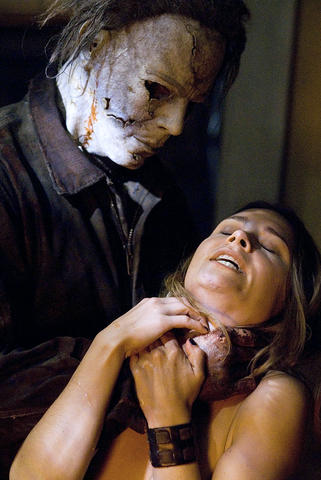
PHOTO: COURTESY OF VIE VISION
Like Zombie's first two features, House of 1,000 Corpses and The Devil's Rejects, this Halloween is unusually at ease among white, working-class characters who drawl, curse and like their fun loud. Between the movie's classic rock soundtrack, the screenplay's lively characterizations and Phil Parmet's chaotic camerawork, Zombie often seems less an heir to Carpenter and other 1970s horror filmmakers than a sociologist who happens to make horror movies: the John Cassavetes of splatter.
Zombie lavishes attention on the killer's sad origins to the point that his film suggests a boy's answer to Brian De Palma's Carrie. Young Michael (Daeg Faerch) is cursed with a frazzled mother, Deborah (Sheri Moon Zombie, the director's wife), who has a newborn daughter and a job as an exotic dancer, a sexually active older sister (Hanna Hall) and a loutish stepfather (overacted by William Forsythe) who taunts the boy.
Michael wears masks all the time and acts out his buried anger by killing animals, warning signs that his family ignores to their peril.
The boy's equivalent of Carrie's prom detonation is his Halloween night rampage. It begins with a touching montage that cuts between Michael brooding alone in his neighborhood and his mother sliding around a strip-club pole to the tune of Love Hurts, and climaxes with a killing spree that alludes to suppressed Oedipal and incestuous desires.
Alas, once Michael is locked away in a mental institution under the care of Samuel Loomis (Malcolm McDowell), the movie starts to spin its wheels. When Zombie reintroduces Michael as a long-haired giant (Tyler Mane) pining for a reunion with his now-teenage sister, a spunky baby sitter named Laurie (Scout Taylor-Compton), the film's energy and originality dissipate.
Michael's escape from the asylum and his knife-wielding, door-smashing progress through his old neighborhood are competently handled but tedious. Parmet's lighting and compositions link the adult Michael to Boris Karloff's Frankenstein, but the film's obligation to serve up the expected body count prevents Zombie from laying the groundwork for the explosion of tragic feeling that the movie's finale deserves.
The new Halloween has sympathy for the Devil, but not enough.

If one asks Taiwanese why house prices are so high or why the nation is so built up or why certain policies cannot be carried out, one common answer is that “Taiwan is too small.” This is actually true, though not in the way people think. The National Property Administration (NPA), responsible for tracking and managing the government’s real estate assets, maintains statistics on how much land the government owns. As of the end of last year, land for official use constituted 293,655 hectares, for public use 1,732,513 hectares, for non-public use 216,972 hectares and for state enterprises 34 hectares, yielding

The small platform at Duoliang Train Station in Taitung County’s Taimali Township (太麻里) served villagers from 1992 to 2006, but was eventually shut down due to lack of use. Just 10 years later, the abandoned train station had become widely known as the most beautiful station in Taiwan, and visitors were so frequent that the village had to start restricting traffic. Nowadays, Duoliang Village (多良) is known as a bit of a tourist trap, with a mandatory, albeit modest, admission fee of NT$10 giving access to a crowded lane of vendors with a mediocre view of the ocean and the trains
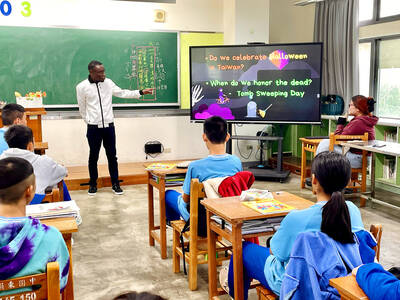
For many people, Bilingual Nation 2030 begins and ends in the classroom. Since the policy was launched in 2018, the debate has centered on students, teachers and the pressure placed on schools. Yet the policy was never solely about English education. The government’s official plan also calls for bilingualization in Taiwan’s government services, laws and regulations, and living environment. The goal is to make Taiwan more inclusive and accessible to international enterprises and talent and better prepared for global economic and trade conditions. After eight years, that grand vision is due for a pulse check. RULES THAT CAN BE READ For Harper Chen (陳虹宇), an adviser

Traditionally, indigenous people in Taiwan’s mountains practice swidden cultivation, or “slash and burn” agriculture, a practice common in human history. According to a 2016 research article in the International Journal of Environmental Sustainability, among the Atayal people, this began with a search for suitable forested slopeland. The trees are burnt for fertilizer and the land cleared of stones. The stones and wood are then piled up to make fences, while both dead and standing trees are retained on the plot. The fences are used to grow climbing crops like squash and beans. The plot itself supports farming for three years.


 RSS
RSS