


Royal is a cantankerous old male baboon whose troop of some 80 members lives in the Moremi Game Reserve in Botswana. A perplexing event is about to disturb his day.
From the bushes to his right, he hears a staccato whoop, the distinctive call that female baboons always make after mating. He recognizes the voice as that of Jackalberry, the current consort of Cassius, a male who outranks Royal in the strict hierarchy of male baboons. No hope of sex today.
But then, surprisingly, he hears Cassius' signature greeting grunt to his left. His puzzlement is plain on the video made of his reaction. You can almost see the wheels turn slowly in his head:
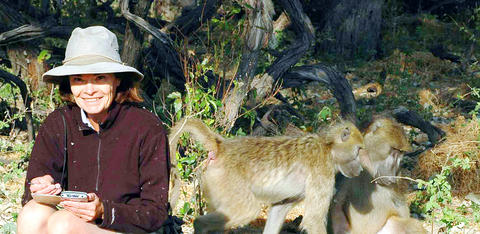
PHOTO: NY TIMES NEWS SERVICE
"Jackalberry here, but Cassius over there. Hmm, Jackalberry must be hooking up with some one else. But that means Cassius has left her unguarded. Say what - this is my big chance!"
The video shows him loping off in the direction of Jackalberry's whoop. But all that he will find is the loudspeaker from which researchers have played Jackalberry's recorded call.
The purpose of the experiment is not to ruin Royal's day but to understand what goes on in a baboon's mind, in this case, how carefully the animals keep track of transient relationships.
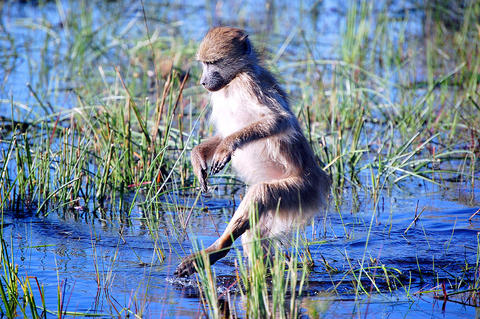
PHOTO: NY TIMES NEWS SERVICE
Dorothy Cheney and Robert Seyfarth, a husband-and-wife team of biologists at the University of Pennsylvania, have spent 14 years observing the Moremi baboons. Through ingenious playback experiments performed by themselves and colleagues, the researchers say they have worked out many aspects of what baboons use their minds for, along with their limitations.
Reading a baboon's mind affords an excellent grasp of the dynamics of baboon society. But more than that, it bears on the evolution of the human mind and the nature of human existence. As Darwin jotted down in a notebook of 1838: "He who understands baboons would do more towards metaphysics than Locke."
Cheney and Seyfarth are well known for a 1990 book on vervet monkeys, How Monkeys See the World, in which they showed how much about the animals' mental processes could be deduced from careful experiments.

PHOTO: NY TIMES NEWS SERVICE
When a baby vervet's call is played to three females, for instance, the mother looks to the source of the sound. The two others look to the mother, evidence that vervets know whose baby is whose.
An experiment like this - recording the sounds, waiting until the animals are in the right place and performing numerous controls - can take months to complete, but the results are widely admired by other biologists. "Any work of Dorothy and Robert's is going to be as good as you get in the field," said Robert Sapolsky, a Stanford biologist and an author who has studied baboons in the wild for many years.
"There is no one else in the area of animal behavior who does such incredibly interesting experiments in the field," said Marc Hauser, a biologist at Harvard who was their first student.
Cheney and Seyfarth have summed up their new cycle of research in a book titled, after Darwin's comment, Baboon Metaphysics. Their conclusion, based on many painstaking experiments, is that baboons' minds are specialized for social interaction, for understanding the structure of their complex society and for navigating their way within it.
The shaper of a baboon's mind is natural selection. Those with the best social skills leave the most offspring.
"Monkey society is governed by the same two general rules that governed the behavior of women in so many 19th-century novels," Cheney and Seyfarth write. "Stay loyal to your relatives (though perhaps at a distance, if they are an impediment), but also try to ingratiate yourself with the members of high-ranking families."
Baboon society revolves around mother-daughter lines of descent. Eight or nine matrilines are in a troop, each with a rank order. This hierarchy can remain stable for generations.
By contrast, the male hierarchy, which consists mostly of baboons born in other troops, is always changing as males fight among themselves and with new arrivals.
Rank among female baboons is hereditary, with a daughter assuming her mother's rank.
News of that fact gave great satisfaction to a member of the British royal family, Princess Michael of Kent. She visited Cheney and Seyfarth in Botswana, remarking to them, they report: "I always knew that when people who aren't like us claim that hereditary rank is not part of human nature, they must be wrong. Now you've given me evolutionary proof!"
Baboons live with danger on every side. Many fall prey to lions, leopards, pythons and the crocodiles that in the wet season stalk the fords where baboons cross from one island to another. Baboon watchers are subject to the same hazards. Cheney and Seyfarth say their rules are not to work alone or to wade into water deeper than knee high. They often find themselves sitting in a tree with baboons waiting out a lion below. But going into New York is more petrifying, they contend, than dodging Botswana's predators.
The baboons will bark to warn of lions and leopards, but pay no attention to some other species dangerous to humans, like buffalo and elephant. On two occasions, baboons have attacked animals, a leopard and a honey badger, that threatened their human companions. "We haven't lost any post-docs," Seyfarth said.
For female baboons, another constant worry besides predation is infanticide. Their babies are put in peril at each of the frequent upheavals in the male hierarchy. The reason is that new alpha males enjoy brief reigns, seven to eight months on average, and find at first that the droits de seigneur they had anticipated are distinctly unpromising. Most of the females are not sexually receptive because they are pregnant or nurturing unweaned infants.
An unpleasant fact of baboon life is that the alpha male can make mothers re-enter their reproductive cycles, and boost his prospects of fatherhood, by killing their infants. The mothers can secure some protection for their babies by forming close bonds with other females and with male friends, particularly those who were alpha when their children were conceived and who may be the father. Still, more than half of all deaths among baby baboons are from infanticide.
So important are these social skills that it is females with the best social networks, not those most senior in the hierarchy, who leave the most offspring.
Although the baboon and human lines of descent split apart some 30 million years ago, the species have much in common. Both are primates whose ancestors came down from the trees and learned to survive on the ground in large social groups. The baboon mind may therefore shed considerable light on the early stages of the evolution of the human mind.
In some of their playback experiments, Cheney and Seyfarth have tested baboons' knowledge of where everyone stands in the hierarchy. In a typical interaction, a dominant baboon gives a threat grunt, and its inferior screams. From their library of recorded baboon sounds, the researchers can fabricate a sequence in which an inferior baboon's threat grunt is followed by a superior's scream.
Baboons pay little attention when a normal interaction is played to them but show surprise when they hear the fabricated sequence implying their social world has been turned upside down.
This simple reaction says a lot about what is going in the baboon's mind. That the animal can construe "A dominates B," and distinguish it from "B dominates A," means it must be able to break a stream of sounds down into separate elements, recognize the meaning of each, and combine the meanings into a sentence-like thought.
Human language seems unique because no other species is capable of anything like speech. But when it comes to perceiving and deconstructing sounds, as opposed to making them, baboons' ability seems much more language-like.

For many people, Bilingual Nation 2030 begins and ends in the classroom. Since the policy was launched in 2018, the debate has centered on students, teachers and the pressure placed on schools. Yet the policy was never solely about English education. The government’s official plan also calls for bilingualization in Taiwan’s government services, laws and regulations, and living environment. The goal is to make Taiwan more inclusive and accessible to international enterprises and talent and better prepared for global economic and trade conditions. After eight years, that grand vision is due for a pulse check. RULES THAT CAN BE READ For Harper Chen (陳虹宇), an adviser

Traditionally, indigenous people in Taiwan’s mountains practice swidden cultivation, or “slash and burn” agriculture, a practice common in human history. According to a 2016 research article in the International Journal of Environmental Sustainability, among the Atayal people, this began with a search for suitable forested slopeland. The trees are burnt for fertilizer and the land cleared of stones. The stones and wood are then piled up to make fences, while both dead and standing trees are retained on the plot. The fences are used to grow climbing crops like squash and beans. The plot itself supports farming for three years.

The breakwater stretches out to sea from the sprawling Kaohsiung port in southern Taiwan. Normally, it’s crowded with massive tankers ferrying liquefied natural gas from Qatar to be stored in the bulbous white tanks that dot the shoreline. These are not normal times, though, and not a single shipment from Qatar has docked at the Yongan terminal since early March after the Strait of Hormuz was shuttered. The suspension has provided a realistic preview of a potential Chinese blockade, a move that would throttle an economy anchored by the world’s most advanced and power-hungry semiconductor industry. It is a stark reminder of

May 4 to May 10 It was once said that if you hadn’t performed at the Sapphire Grand Cabaret (藍寶石大歌廳), you couldn’t truly be considered a star. Taking the stage at the legendary Kaohsiung club was more than just a concert. Performers were expected to entertain in every sense, wearing outlandish or revealing costumes and staying quick on their feet as sharp-tongued, over-the-top hosts asked questions and delivered jokes that would be seen as vulgar, even offensive, by today’s standards. Opening in May 1967 during a period of strict political and social control, Sapphire offered a rare outlet for audiences in


 RSS
RSS