


The moral of Ratatouille is delivered by a critic: a gaunt, unsmiling fellow named Anton Ego who composes his acidic notices in a coffin-shaped room and who speaks in the parched baritone of Peter O'Toole. "Not everyone can be a great artist," Ego muses. "But a great artist can come from anywhere."
Quite so. Written and directed by Brad Bird and displaying the usual meticulousness associated with the Pixar brand, Ratatouille is a nearly flawless piece of popular art, as well as one of the most persuasive portraits of an artist ever committed to film. It provides the kind of deep, transporting pleasure, at once simple and sophisticated, that movies at their best have always promised.
Its sensibility, implicit in Ego's aphorism, is both exuberantly democratic and unabashedly elitist, defending good taste and aesthetic accomplishment not as snobbish entitlements but as universal ideals. Like The Incredibles, Bird's earlier film for Pixar, Ratatouille celebrates the passionate, sometimes aggressive pursuit of excellence, an impulse it also exemplifies.
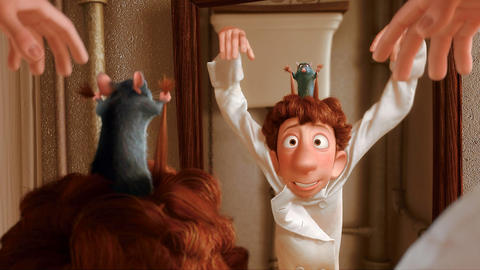
PHOTOS: COURTESY OF BVI/SONY
The hero (and perhaps Bird's alter ego) is Remy (Patton Oswalt), a young rat who lives somewhere in the French countryside and conceives a passion for fine cooking. Raised by garbage-eaters, he is drawn toward a more exalted notion of food by the sensitivity of his own palate and by the example of Auguste Gusteau (Brad Garrett), a famous chef who insists - more in the manner of Julia Child than of his real-life haute cuisine counterparts - that "anyone can cook."
What Remy discovers is that anyone, including his uncultured brother, can be taught to appreciate intense and unusual flavors. (How to translate the reactions of the nose and tongue by means of sound and image is a more daunting challenge, one that the filmmakers, including Michael Giacchino, author of the marvelous musical score, meet with effortless ingenuity.) Remy's budding culinary vocation sets him on a lonely course, separating him from his clannish, philistine family and sending him off, like so many young men from the provinces before him, to seek his fortune in Paris. That city, from cobblestones to rooftops, is brilliantly imagined by the animators.
And, as usual in a Pixar movie, a whole new realm of physical texture and sensory detail has been conquered for animation. Finding Nemo found warmth in the cold-blooded, scaly creatures of the deep; Cars brought inert metal to life. At first glance, Ratatouille may look less groundbreaking, since talking furry rodents are hardly a novelty in cartoons. But the innovations are nonetheless there, in the fine grain of every image: in the matted look of wet rat fur and the bright scratches in the patina of well-used copper pots, in the beads of moisture on the surface of cut vegetables and the sauce-stained fabric of cooks' aprons.
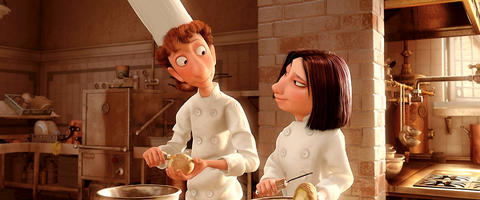
Individually, the rats are appealing enough, but the sight of dozens of them swarming through pantries and kitchens is appropriately icky, and Bird acknowledges that interspecies understanding may have its limits.
Perhaps because animation, especially the modern computer-assisted variety, is the work of so many hands and the product of so much invested capital, we are used to identifying animated movies with their corporate authors: Disney, DreamWorks, Pixar and so on. But while the visual effects in Ratatouille show a recognizable company stamp, the sensibility that governs the story is unmistakably Bird's. A veteran of The Simpsons and a journeyman writer for movies and television, he has emerged as an original and provocative voice in American filmmaking.
He is also, at least implicitly, a severe critic of the laziness and mediocrity that characterize so much popular culture. He criticizes partly by example, by avoiding the usual kid-movie cliches and demonstrating that a clear, accessible story can also be thoughtful and unpredictable. Ratatouille features no annoying sidekick and no obtrusive celebrity voice-work, and while Remy is cute, he can also be prickly, demanding and insecure.
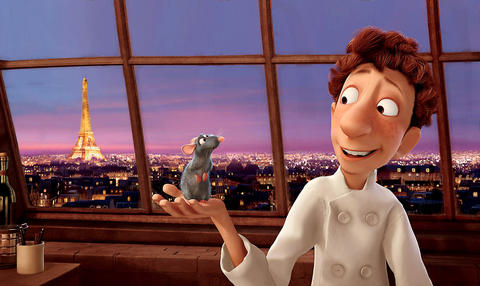
Moreover, his basic moral conflict - between family obligation and individual ambition - is handled with unusual subtlety and complexity, so that the reassurances and resolutions of the movie's end feel earned rather than predetermined.
And while the film buzzes with eye-pleasing action and incident - wild chases, hairbreadth escapes, the frenzied choreography of a busy kitchen - it does not try to overwhelm its audience with excessive noise and sensation. Instead Bird integrates story and spectacle with the light, sure touch that Vincente Minnelli brought to his best musicals and interweaves the tale of Remy's career with beguiling subplots and curious characters.
Since no Parisian restaurant will let a rat work in its kitchen, Remy strikes a deal with a hapless low-level worker named Linguini (Lou Romano), who executes Remy's recipes by means of an ingenious (and hilarious) form of under-the-toque puppetry. Linguini's second mentor is Colette (Janeane Garofalo), a tough sous-chef who unwittingly becomes the rodent's rival for Linguini's allegiance. Even minor figures - assistant cooks, waiters, a hapless health inspector - show remarkable individuality.
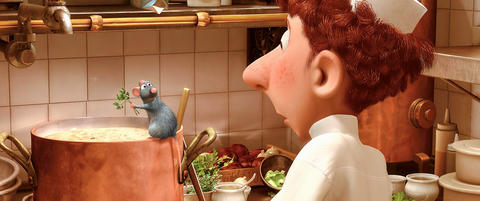
At stake in Ratatouille is not only Remy's ambition but also the hallowed legacy of Gusteau, whose ghost occasionally floats before Remy's eyes and whose restaurant is in decline. Part of the problem is Gusteau's successor, Skinner (Ian Holm), who is using the master's name and reputation to market a line of mass-produced frozen dinners.
Against him, Remy and Bird take a stand in defense of an artisanal approach that values both tradition and individual talent: classic recipes renewed by bold, creative execution. The movie's grand climax, and the source of its title, is the preparation of a rustic dish made of common vegetables - a dish made with ardor and inspiration and placed, as it happens, before a critic.
And what, faced with such a ratatouille, is a critic supposed to say? Sometimes the best response is the simplest. Sometimes "thank you" is enough.

Jason Han says that the e-arrival card spat between South Korea and Taiwan shows that Seoul is signaling adherence to its “one-China” policy, while Taiwan’s response reflects a reciprocal approach. “Attempts to alter the diplomatic status quo often lead to tit-for-tat responses,” the analyst on international affairs tells the Taipei Times, adding that Taiwan may become more cautious in its dealings with South Korea going forward. Taipei has called on Seoul to correct its electronic entry system, which currently lists Taiwan as “China (Taiwan),” warning that reciprocal measures may follow if the wording is not changed before March 31. As of yesterday,

The Portuguese never established a presence on Taiwan, but they must have traded with the indigenous people because later traders reported that the locals referred to parts of deer using Portuguese words. What goods might the Portuguese have offered their indigenous trade partners? Among them must have been slaves, for the Portuguese dealt slaves across Asia. Though we often speak of “Portuguese” ships, imagining them as picturesque vessels manned by pointy-bearded Iberians, in Asia Portuguese shipping between local destinations was crewed by Asian seamen, with a handful of white or Eurasian officers. “Even the great carracks of 1,000-2,000 tons which plied

It’s only half the size of its more famous counterpart in Taipei, but the Botanical Garden of the National Museum of Nature Science (NMNS, 國立自然科學博物館植物園) is surely one of urban Taiwan’s most inviting green spaces. Covering 4.5 hectares immediately northeast of the government-run museum in Taichung’s North District (北區), the garden features more than 700 plant species, many of which are labeled in Chinese but not in English. Since its establishment in 1999, the site’s managers have done their best to replicate a number of native ecosystems, dividing the site into eight areas. The name of the Coral Atoll Zone might

Nuclear power is getting a second look in Southeast Asia as countries prepare to meet surging energy demand as they vie for artificial intelligence-focused data centers. Several Southeast Asian nations are reviving mothballed nuclear plans and setting ambitious targets and nearly half of the region could, if they pursue those goals, have nuclear energy in the 2030s. Even countries without current plans have signaled their interest. Southeast Asia has never produced a single watt of nuclear energy, despite long-held atomic ambitions. But that may soon change as pressure mounts to reduce emissions that contribute to climate change, while meeting growing power needs. The


 RSS
RSS