


At Easy Coffee inside the Shantao Temple MRT station (善導寺站), Lin Chien-hsuan (林建炫) serves coffee every morning to the rush hour crowd. At first glance, one would never suspect that he is a mentally disabled patient who couldn't converse with people when first starting work at the coffee shop.
"I've been here for over four years. Sometimes I still forget things and need the instructor's helps. And there are more and more products to remember now ... But I think I'll stay and keep working here," said the shy, retiring 28-year-old employee.
Run by the Taipei Mental Rehabilitation Association (TMRA, 台北市康復之友協會), Easy Coffee is one of dozens of sheltered workshops commissioned by the Department of Labor (勞工局) of the Taipei City Government that offers a supportive environment where physically and mentally disabled people can acquire vocational experience and job skills.
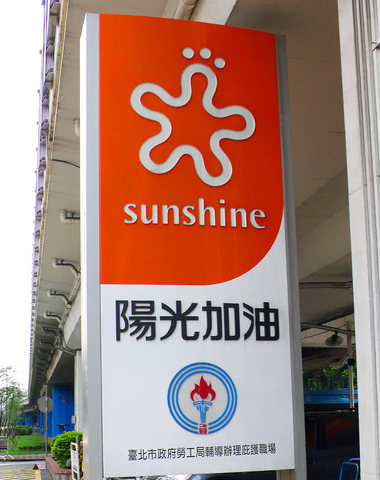
PHOTO: HO YI, TAIPEI TIMES
Having worked with schizophrenics and manic-depressives with stabilized symptoms for four years at the coffee shop, the association's training instructor Chen Hsuan-chia (陳萱佳) said the biggest challenge the employees have to overcome is interpersonal interaction, as they are socially backward when taking the first step out of families and hospitals. He said that a long training phase is needed to help them regain confidence and learn to react to others.
Peer support, as well as care and guidance from trained instructors, is essential to adaptation to the workplace. "Our student-employees are under tremendous pressure since lots of our clients are office workers who are in a rush and don't have much patience … They often want to give up and it's our job to guide them from thinking 'I want to give up' to 'I am tired and need a break.' With practice, they are able to deal with the stress and make the mental transition themselves," said Chen.
What sets Easy Coffee apart from other more protection-oriented sheltered workshops is its goal, which is to open itself to market competition and encourage the disabled to work in a place where people come for good services and products rather than out of sympathy.
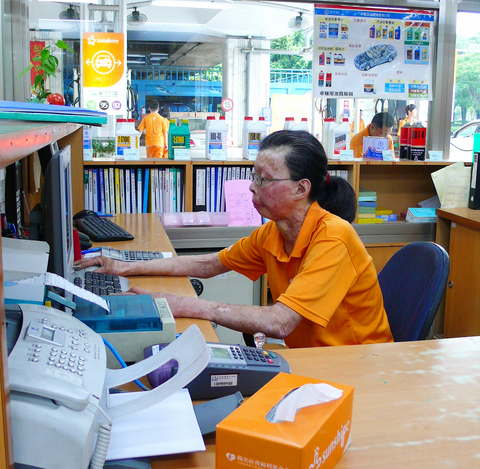
PHOTO: HO YI, TAIPEI TIMES
This strategy has been adopted by 12 Baskets (十 二個籃子), a sheltered restaurant on Heping East Road (和平東路) near Linkuang MRT station (麟光站) and run by the Chinese National Association of the Deaf (中華民國聽障人協會) with five hearing-impaired and mentally handicapped employees.
"I often tell staff to think about this place as the last stop before stepping into real a work place," said employment instructor Chen Wei-ting (陳維廷), adding that they are also reluctant to advertise the restaurant as a sheltered store since "buying cookies made by anonymous disabled people is one thing, but being served by them face to face is another."
In Chen Wei-ting's opinion, though social interaction is the biggest issue to be tackled, every hired disable individual has his or her own story, problems and demons to fight.
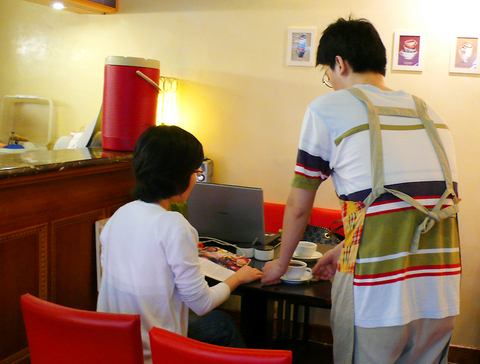
PHOTO: HO YI, TAIPEI TIMES
"I once had a schizophrenic working here. Though he was under medication, there was always a voice in his head saying 'I am not normal and that's why I am here' … He didn't make it in the end," she said.
Although the simple tasks required may take most people only a few day to pick up, the training time at 12 Baskets ranges from three to five months, as even one simple step has to be repeatedly practiced.
"But you never give up. No matter what method you take to teach them, you never give up on them because they'll learn eventually," Chen stressed.
This intensive training process is shared by instructor Chien Hung-sheng (簡宏生) at the Sunshine gas station (陽光加油站) near the intersection of Heping East Road (和平東路) and Jianguo South Road (建國南路) that employs 35 disabled individuals, many of whom are suffering from moderate to severe physical or mental disabilities.
"The gas station work is what we call a high-level functional vocation since the employees need to have many work skills, such as the ability to calculate, communicate, organize and comprehend with a relatively high level of agility," Chien said, "the most important aspect of our job is to put ourselves into their position and break the work process into many simple steps."
For the mentally challenged, the work is simplified using diagrams, key words and cues as they have weaker language ability, comprehension and memory. "For example, we teach them to take one certain act [step] as a cue to the next to help them establish the connection with what they should do and say," Chien explained.
To the physically challenged, the most important thing is to learn how to navigate through the station safely without tripping over pipes and other obstacles or bump into cars. As the labor-intensive work poses more challenges to their weakened bodily functions, the gas station offers their staff daily rehabilitation exercise and annual medical checkups.
When those acquiring job skills and social adjustment feel ready to step out of the relatively isolated environment of the sheltered store, the last step of the employment instructors' work is to help them with the transition into the often unfriendly and sometimes frightening outside world. "It's not as simple as finding them jobs. They are the minority with very limited resources. You have to teach them how to go online, to job-hunt, to prepare themselves and arm themselves with basic self-learning skills," Chien said.
While the Department of Labor encourages sheltered workshops to transfer their employees to normal workplaces, Chen Hsuan-chia thinks pushing the disabled into the outside world doesn't necessarily mean success in practical terms, as many may be frustrated by their low-degree of acceptance at work and retreat into isolation again.
Vocational training aside, the key function of sheltered workshops is to offer a social setting where the disabled can gain dignity, self-worth and socialization with their peers. Because of these projects, people like Lin can visit with friends, go out for dinners or have fun on company outings.
"To have a normal social life is a great pleasure to them. They can now save money, buy pretty clothes, fall in love with coworkers, think of the future and have worries like others," said TMRA's Chen, adding that the disabled staff cherish their work more than the able-bodied since they understand that their opportunities are hard-won.
To the parents of the disabled, knowing their children can learn to live independently, have paid jobs and are able to make friends, is like having a heavy burden lifted from their shoulders. "When employees' families come to the store and watch them work, they often have tears of joy in their eyes. It's the most satisfying part of my job," Chien of the Sunshine gas station said. "There is also a bright side to what we do. I enjoy working with them because here you don't have company intrigues and mind games. They are simply happy to help each other."

Taiwan’s English education system is being pulled apart by three opposing forces. Bilingual Nation 2030 pulls students toward English and global communication. Artificial Intelligence (AI) readiness pulls them toward digital judgment, verification and AI-mediated work. But Taiwan’s old exam culture pulls them back toward memorization, grammar drills, timed reading and correct answers. If the education system keeps using old exams to define success, it risks producing graduates who are neither genuinely bilingual nor genuinely AI-ready, but trained for tasks machines can already perform. The first force is Bilingual Nation 2030. Launched in 2018, the policy aimed to “help Taiwan’s workforce connect

It seems every few days one bumps into one of those “real man” comments in which Taiwan is urged to “face reality” or similar, and “make a deal,” with the speaker implying that soon it will be too late. “Deal” advocates always present themselves as having a superior grip on reality, and the manly ability to make the “hard choice.” Their testosterone-laden language often echoes that of Taiwan sellout advocates. Note that such commentary always specifies a process (“make a deal, work with, make progress”), never the end state of what occupation by a violent authoritarian colonialist state will entail. In

“Taiwan’s Opposition Leader Comes to US With a Message Straight Out of Beijing” read a May 31 headline in the Wall Street Journal. Top US administration officials and members of Congress almost certainly read the WSJ, and if there was a bullet point takeaway that people in Washington should absorb ahead of Chinese Nationalist Party (KMT) Chair Cheng Li-wun’s (鄭麗文) arrival in DC on June 9, that headline is it. The last few columns have discussed this very topic, and the timing is not coincidental. While those top officials likely do not read the Taipei Times, judging by the number
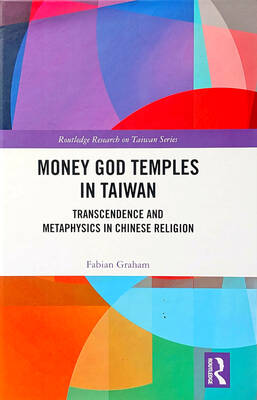
As someone who normally steers clear of books with “transcendence” or “metaphysics” in their subtitles, this reviewer — a casual observer of local belief systems since the 1990s — found Fabian Graham’s Money God Temples in Taiwan a challenging read. Those who’ve only dipped their toes into temple culture will likely need to parse several sections with special care if they’re to keep up with the author, a British ethnographic researcher whose previous books have investigated religious practices among ethnic Chinese in Southeast Asia. This scholarly volume examines a facet of Taiwan’s religious landscape that didn’t exist a century ago, and


 RSS
RSS