


After his loosely themed vengeance trilogy of Sympathy for Mr Vengeance, Oldboy and Lady Vengeance that has established him as one of Asia's most stylish directors, South Korean filmmaker Park Chan-wook returns to the director's chair with oddball movie I'm a Cyborg, But That's OK, a love story and offbeat comedy that is far from a teenybopper romance. It is an original and highly stylized work filled with resplendent visual imagery.
The film tells the tale of Young-goon (Im Soo-jung), a new patient committed to a mental institution suffering from paranoid schizophrenia. Believing she is a half-machine cyborg, Young-goon communicates only with electrical appliances such as soda vending machines and fluorescent lights while gradually starving herself to death as she refuses all food and chooses to recharge herself by licking batteries.
Among other asylum residents is the antisocial kleptomaniac Il-soon (played by Asian heartthrob Rain), who supposedly possesses the power to steal other people's attributes and fantasies. As the two develop a bond with each other, Il-soon tries to enter Young-goon's closed world through stolen fantasies to help her start eating again, complete her mission of returning a set of dentures to her mentally ill grandmother and find a purpose in her own world.
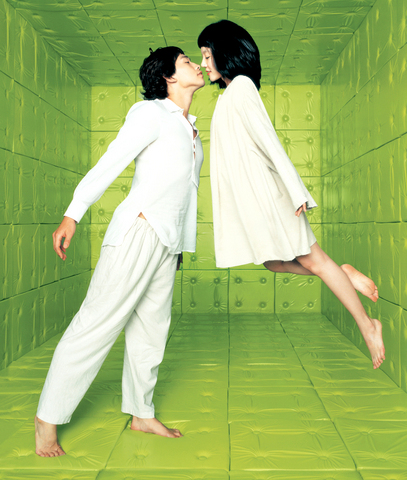
PHOTO: COURTESY OF SERNITY ENTERTAINMENT INTERNATIONAL
Clearly showing Park's gentler side, the film, however, is not a sweet, tear-jerking TV-style drama but is packed with fantastic and fairytale-like visions on par with those of Tim Burton. With the cute and charming characters running around in scenes full of quirky humor set against the asylum backdrop and punctuated by technicolor flashes, the film's warm and fuzzy feel makes it immediately enjoyable. Yet Park's strength arises from the contrast between the warmth and disquieting whimsy that renders the film both edgy and entertaining as exemplified in the memorable opening sequence when Young-goon slashes her wrists, sticks electric wires into her arm and hook herself up to an electrical outlet at a cartoon-like factory.
The fantasy sequences work well and give the film an archetypically science-fiction manga-ish look that is refreshing to watch and which is best illustrated in the sequences where Il-soon shrinks into a homunculus to meet his panicky urge to become visible, the yodeling number where Young-goon is flown to the Swiss Alps by a giant ladybug and inspired sequences in which she turns into a human machine gun to massacre the hospital staff.
It is also through such fantasy scenes that members of the audience gradually surrender their position as observers taking pleasure in watching the colorful inmates, including the perpetual apologist who walks backwards, the obese bully who claims to fly with her socks and a Swiss yodeler and engage in the inner logic of the "crazy" people.
Instead of trying to make Young-goon rejoin the "normal" world, Park simply creates a romantic cosmos the inhabitants of which share an unreality and subjective world co-habited by others through alternative ways of communication.
As fantasies and visuals take precedence over the narrative, the film looks more like a series of beautiful vignettes and sometimes loses the direction from a narrative standpoint. A good cast of big-name pop stars steps in to boost the film's commercial appeal as Rain proves his comic talent in his first big-screen role and pop idol Im Soo-jung delivers a convincing performance as a marionette-like human android.
Witty, charming and gloriously bizarre, the movie may be regarded as a playful detour for the celebrated director before he sets out for another dark, grueling film on the human condition. Yet Park's talent to engage audiences in such an unexpected way and his visual inventions and slightly disquieting aura may very well render I'm a Cyborg, But That's OK a beloved curio in the director's rapidly growing body of work.

Taiwan’s English education system is being pulled apart by three opposing forces. Bilingual Nation 2030 pulls students toward English and global communication. Artificial Intelligence (AI) readiness pulls them toward digital judgment, verification and AI-mediated work. But Taiwan’s old exam culture pulls them back toward memorization, grammar drills, timed reading and correct answers. If the education system keeps using old exams to define success, it risks producing graduates who are neither genuinely bilingual nor genuinely AI-ready, but trained for tasks machines can already perform. The first force is Bilingual Nation 2030. Launched in 2018, the policy aimed to “help Taiwan’s workforce connect

“Taiwan’s Opposition Leader Comes to US With a Message Straight Out of Beijing” read a May 31 headline in the Wall Street Journal. Top US administration officials and members of Congress almost certainly read the WSJ, and if there was a bullet point takeaway that people in Washington should absorb ahead of Chinese Nationalist Party (KMT) Chair Cheng Li-wun’s (鄭麗文) arrival in DC on June 9, that headline is it. The last few columns have discussed this very topic, and the timing is not coincidental. While those top officials likely do not read the Taipei Times, judging by the number

With weighty, anxiety-inducing geopolitical topics dominating the headlines, checking in on the wild and weird state of local politics can take some of the edge off. This November’s elections will determine who will be in charge of fixing potholes in your neighborhood, not the potholes in Taiwan’s complicated geopolitical space. Recently, after an online interview with a Taipei-based journalist, I commented that Taipei journalists never go further than the MRT can take them. He laughed and agreed. Naturally, the Taipei mayoral race is eating up much of the press attention. TAIPEI CITY Democratic Progressive Party (DPP) candidate Puma Shen (沈伯洋) has
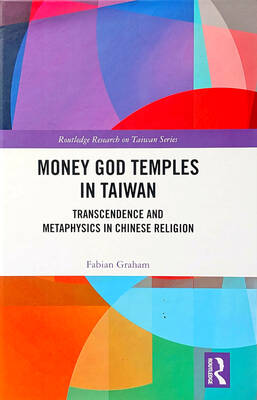
As someone who normally steers clear of books with “transcendence” or “metaphysics” in their subtitles, this reviewer — a casual observer of local belief systems since the 1990s — found Fabian Graham’s Money God Temples in Taiwan a challenging read. Those who’ve only dipped their toes into temple culture will likely need to parse several sections with special care if they’re to keep up with the author, a British ethnographic researcher whose previous books have investigated religious practices among ethnic Chinese in Southeast Asia. This scholarly volume examines a facet of Taiwan’s religious landscape that didn’t exist a century ago, and


 RSS
RSS