


For years, Taiwan's cultural and creative industries have been promoted by economic and cultural officials as well as artists, professionals and local companies that have long recognized the added value created by top-notch design and brand building.
Beautiful Chaos (亂,有秩序) currently being held at the Taipei Fine Arts Museum (TFAM) champions made-in-Taiwan design at its finest with an exhibition of 23 pieces by five life-style brands and seven designers.
In collaboration with the museum, the Taiwan Design Center (台灣創意設計中心) and Design Together (集設計聯盟) — a collective project initiated last year by several local life-style brands — the exhibition gathers together a group of 20- to 30-something artisans who take their cues from the island's seemingly conflicting cultural vocabularies in a post-modern milieu and highlight local identities.
PHOTOS COURTESY OF TFAM
Designers from the Taipei-based international design company AGUA Design (水越設計) applied their ingenuity to the practice of outdoor banquets (辦桌) and created playful table cloths that can be fixed to tables with ropes.
For industrial designer Huang Mong-chih (黃明智), creative design comes from everyday life experience. This life-style aesthetic has found a lively manifestation in his works, such as movable bookcases that can be fixed onto bars and hangers with two ear-shaped hooks on both sides.
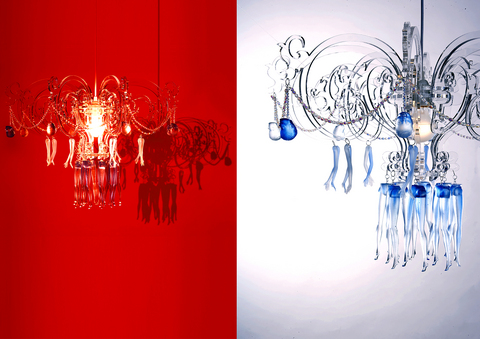
The delicate pendant lamps by designer and college instructor Lin Hsiao-ying (林曉瑛) serve as a reminder of the former Barbie doll factories of Taishan Township, Taipei County (台北縣泰山鄉) and juxtapose the fantasies of young girls with the fate of the now-closed factories.
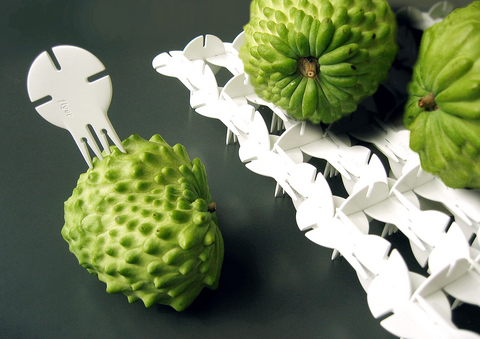
In more conceptual works by 29-year-old product designer Wu Tung-chih (吳東治), Taiwan's labor-intensive industries are put under the spotlight. The angle-steel chair in his OEM series tracks the nation's industrialization and its relationship to the global division of labor through reference to the once-booming furniture industry that has now relocated to China.
For those interested in knowing more about the multi-award winning design companies and designers, log on to www.designtogether.com.tw.

Exhibition notes:
What: Beautiful Chaos (亂,有秩序)
Where: Taipei Fine Arts Museum (台北市立美術館), 181 Zhongshan N Rd Sec 3, Taipei (台北市中山北路三段181號)

When: Until April 1
Open: Tuesday to Sunday 9:30am to 5:30pm and Saturday until 9:30pm
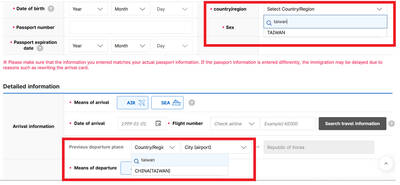
Jason Han says that the e-arrival card spat between South Korea and Taiwan shows that Seoul is signaling adherence to its “one-China” policy, while Taiwan’s response reflects a reciprocal approach. “Attempts to alter the diplomatic status quo often lead to tit-for-tat responses,” the analyst on international affairs tells the Taipei Times, adding that Taiwan may become more cautious in its dealings with South Korea going forward. Taipei has called on Seoul to correct its electronic entry system, which currently lists Taiwan as “China (Taiwan),” warning that reciprocal measures may follow if the wording is not changed before March 31. As of yesterday,
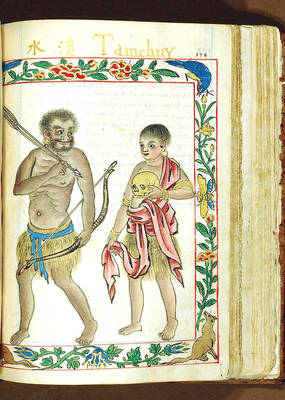
The Portuguese never established a presence on Taiwan, but they must have traded with the indigenous people because later traders reported that the locals referred to parts of deer using Portuguese words. What goods might the Portuguese have offered their indigenous trade partners? Among them must have been slaves, for the Portuguese dealt slaves across Asia. Though we often speak of “Portuguese” ships, imagining them as picturesque vessels manned by pointy-bearded Iberians, in Asia Portuguese shipping between local destinations was crewed by Asian seamen, with a handful of white or Eurasian officers. “Even the great carracks of 1,000-2,000 tons which plied
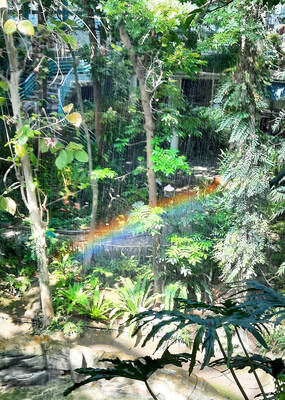
It’s only half the size of its more famous counterpart in Taipei, but the Botanical Garden of the National Museum of Nature Science (NMNS, 國立自然科學博物館植物園) is surely one of urban Taiwan’s most inviting green spaces. Covering 4.5 hectares immediately northeast of the government-run museum in Taichung’s North District (北區), the garden features more than 700 plant species, many of which are labeled in Chinese but not in English. Since its establishment in 1999, the site’s managers have done their best to replicate a number of native ecosystems, dividing the site into eight areas. The name of the Coral Atoll Zone might
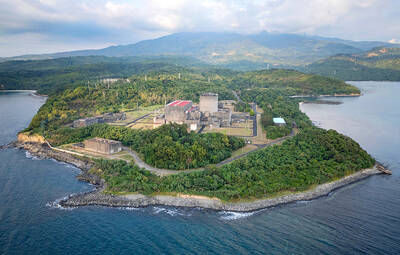
Nuclear power is getting a second look in Southeast Asia as countries prepare to meet surging energy demand as they vie for artificial intelligence-focused data centers. Several Southeast Asian nations are reviving mothballed nuclear plans and setting ambitious targets and nearly half of the region could, if they pursue those goals, have nuclear energy in the 2030s. Even countries without current plans have signaled their interest. Southeast Asia has never produced a single watt of nuclear energy, despite long-held atomic ambitions. But that may soon change as pressure mounts to reduce emissions that contribute to climate change, while meeting growing power needs. The


 RSS
RSS