


Takashi Suzuki has a reputation for being merciless when training his actors. The founder and director of the Suzuki Company of Toga (SCOT), a retreat in the forests outside Tokyo, produces some of the world's best actors.
But at a price.
In an interview with Anatoly Smeliansky, head of the Moscow Art Theater school, Anatoly Bely, an actor with the Moscow Art Theater, describes how immediately after landing in Japan following a long flight from Moscow, Suzuki brought the contingent of Russian actors through a two-hour training session that, "[was] so difficult that after 20 minutes, even the youngest, strongest men in our company started to collapse. Suzuki told us that we had to overcome this limit."
PHOTOS COURTESY OF CKS CULTURAL CENTER
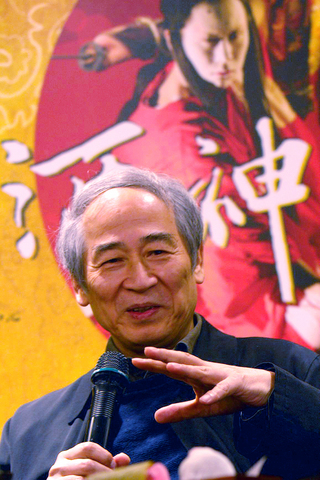
The severe method Suzuki uses to train his actors is in marked contrast to the man who arrived in Taiwan on Monday for the first time in his 40-year career to prepare for his production of Dionysus this weekend at the National Theater. Dressed casually and joking with reporters, the 68 year-old performance theorist, director and "Japanese treasure" showed no evidence of jet lag.
The Suzuki Method is principally concerned with overcoming perceived limitations of the human body and applying what they've learned to the stage. By doing so, the actors uncover their innate expressive abilities through movement.
Using a diverse array of physical disciplines drawn from ballet, Japanese Noh and Kabuki and Greek theater as well as martial arts, the Suzuki Method seeks to heighten the actor's emotional and physical power and commitment to reach the right moment on the stage.
"The training is rigorous and many actors at first find it extremely difficult — if not impossible — to keep up. The Olympic athletes that come over have less problems with the training," Suzuki said.
As a performance theorist, Suzuki is often compared to Konstantin Stanislavsky. But where Stanislavski drew upon the actor's memory as a means of creating emotional and physical verisimilitude on the stage, the Suzuki Method begins with a system of exercises meant to tap into the expressive power of the body, or what Suzuki calls "animal energy."
"The body has its own physical grammar that the audience can follow," he said. "As such, we don't just need a verbal language to evoke meaning [on the stage]."
In addition to his work as a performance theorist, Suzuki is chairman of the Japan Performing Arts Foundation (JPAF), a lobby group for the performing arts in Japan. He has published 15 books about the theater in Japanese of which The Way of Acting: The Theater Writings of Tadashi Suzuki has been translated into English.
Together with Robert Wilson, Yuri Lyubimov and Wole Soyinka and a host of other internationally recognized theater artists he formed the International Committee of the Theatre Olympics in 1993, a yearly event that promotes the development of world theater.
Suzuki's internationalism is also evident in his expropriation of Greek drama for the stage. Works that he has adapted to the stage include Euripides' The Trojan Women and Clytemnestra, Sophocles' Electra and Aeschylus' Oresteia. By adapting Greek plays to a contemporary context, Suzuki seeks to overcome cultural and national barriers by universally based works.
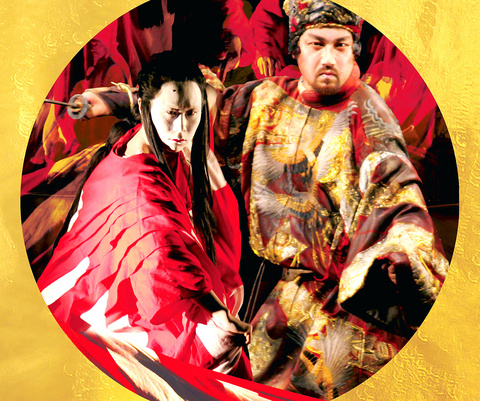
Suzuki chose Dionysus for his Taipei production as he feels the relationship between politics and religion is relevant to contemporary society.
Dionysus is based on Euripides' Bacchae. In the original play, Euripides has Dionysus, the god of wine, appear on stage and speak as a character. Suzuki alters the work by making a group of priests speak the lines of Dionysus, thus transforming the god into cult.
This cult of priests, with its communal need for unity and desire to spiritually influence the masses creates what Suzuki calls, a "story called Dionysus." For Suzuki, the conflict between Dionysus and the young King Pentheus is not a battle between god and man, but an altercation between a religious sect and a political authority.
Suzuki says the Bacchae speaks to our contemporary condition because of the conflict between two communal value systems that exist on the same plane.
By adapting Greek theater to the contemporary stage, Suzuki manages to raise questions about our current political and social situation and done in a way that challenges the audience to look beyond national borders. It gives us a focus on the changing conditions of our own lives, as well as the lives of the ancient Greeks and modern Japanese thus illustrating a universalism that is often lacking in contemporary theater. This is probably why tickets for all his Taipei performances sold out before he arrived in Taiwan.
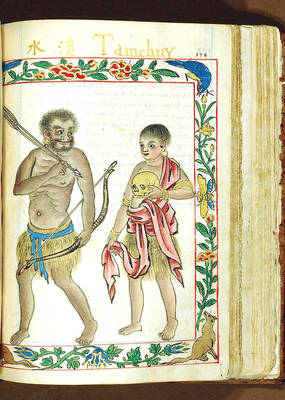
The Portuguese never established a presence on Taiwan, but they must have traded with the indigenous people because later traders reported that the locals referred to parts of deer using Portuguese words. What goods might the Portuguese have offered their indigenous trade partners? Among them must have been slaves, for the Portuguese dealt slaves across Asia. Though we often speak of “Portuguese” ships, imagining them as picturesque vessels manned by pointy-bearded Iberians, in Asia Portuguese shipping between local destinations was crewed by Asian seamen, with a handful of white or Eurasian officers. “Even the great carracks of 1,000-2,000 tons which plied

It’s only half the size of its more famous counterpart in Taipei, but the Botanical Garden of the National Museum of Nature Science (NMNS, 國立自然科學博物館植物園) is surely one of urban Taiwan’s most inviting green spaces. Covering 4.5 hectares immediately northeast of the government-run museum in Taichung’s North District (北區), the garden features more than 700 plant species, many of which are labeled in Chinese but not in English. Since its establishment in 1999, the site’s managers have done their best to replicate a number of native ecosystems, dividing the site into eight areas. The name of the Coral Atoll Zone might
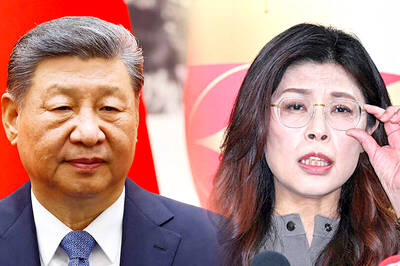
On Monday morning, in quick succession, the Chinese Communist Party (CCP) and the Chinese Nationalist Party (KMT) released statements announcing “that the Central Committee of the Communist Party of China and General Secretary Xi Jinping (習近平) have invited KMT Chairwoman Cheng Li-wun (鄭麗文) to lead a delegation on a visit to the mainland” as the KMT’s press release worded it. The KMT’s press release added “Chairwoman Cheng expressed her gratitude for the invitation and has gladly accepted it.” Beijing’s official Xinhua news release described Song Tao (宋濤), head of the Taiwan Work Office of the CCP Central Committee, as
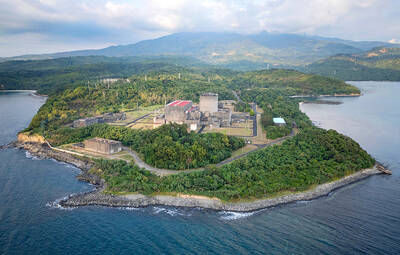
Nuclear power is getting a second look in Southeast Asia as countries prepare to meet surging energy demand as they vie for artificial intelligence-focused data centers. Several Southeast Asian nations are reviving mothballed nuclear plans and setting ambitious targets and nearly half of the region could, if they pursue those goals, have nuclear energy in the 2030s. Even countries without current plans have signaled their interest. Southeast Asia has never produced a single watt of nuclear energy, despite long-held atomic ambitions. But that may soon change as pressure mounts to reduce emissions that contribute to climate change, while meeting growing power needs. The


 RSS
RSS