


Weeds are conquering the gardens, and the last elderly residents of Sanchung's Air Force First Village (空軍三重一村) are moving out. As village chairman Wang Chih-hsin (王繼新) leads a tour of his childhood home, a now-vanished world comes to life in his mind.
He points to the concrete platform built for a Japanese anti-aircraft battery. Villagers gave it a tarp and added stone tables, wood chairs and electrical wiring to make it a central gathering space. He wanders through the empty lanes where children played games and rode bicycles. He cracks open a creaky gate to a lonely house covered by an overgrown banana tree.
"Because I grew up here, there is some kind of bond. I feel for every person and all the buildings and plants, the trees and the flowers," Wang says, choking back tears as he shuts the gate. "It's sad to see the whole thing disappear … for all the people to go away and disperse."
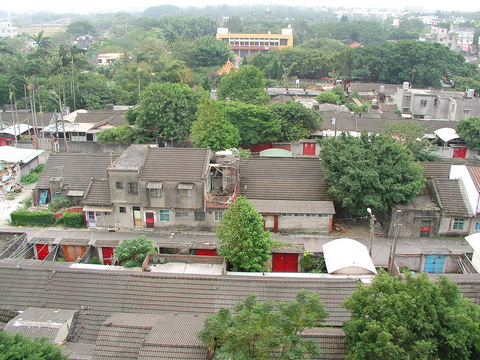
PHOTO: TAIPEI TIMES
Once a defining part of Taiwan's urban landscape, veterans' villages like this one are being abandoned, left to wild dogs and the derelict, awaiting transformation into parks, cultural institutions or commercial real estate. Built for the Chinese Nationalist Party (KMT) troops who fled China with Generalissimo Chiang Kai-shek (蔣介石) in the late 1940s, these were once proud islands of Mainlander culture, separated from the surrounding neighborhoods by walls and gates, dialects and customs. When the last juan cun (眷村), or military dependents' village, is torn down in 2009, a unique subculture will disappear — and a chapter of Taiwan's history will come to a close.
Unlike other symbols of the KMT's migration to Taiwan, veterans' villages have, for the most part, faded away peacefully — generally, the change has not been seen as a triumph of Taiwanese identity over Chinese traditionalism. Originally built from bamboo and straw as temporary barracks for troops preparing to retake China, the compounds were never intended to be permanent. After decades of unplanned-for expansion, they were blocking urban development and becoming dangerous places to live.
In 1982, there were roughly 880 veterans villages housing more than 100,000 families. Four fifths of these were in northern Taiwan, with the rest scattered across the country as far as Penghu and Matsu. Using stronger materials like bricks and tiles, residents had expanded their homes until in many cases only narrow alleys separated units, turning the villages into low-slung warrens of decaying, jerry-rigged architecture.
The government in 1996 passed the Statute Governing Reconstruction of Old Military Dependents' Villages (國軍老舊眷村改建條例), which budgeted money to demolish the villages and replace them with modern, high-rise housing. Though motivated in part by concerns for the residents' welfare, the decision was also political. The KMT under then-president Lee Tung-hui (李登輝) was pursuing a policy of localization, one that alienated many living in the veterans villages, which had been "storehouses of votes" for his party. Subsidizing the construction of new homes was seen as a ploy to prevent the veterans and their families from voting for the New Party, which had broken from the KMT over Lee's Taiwan-first agenda.
Inevitably, the ethnic angle was exploited. Alarmed by the pace of redevelopment — more than 700 villages have already been torn down — preservationists proposed an amendment to the Statute Governing Reconstruction of Old Military Dependents' Villages giving local governments incentives to preserve cultural and architectural aspects of the villages. The amendment enjoyed broad support, until earlier this year when KMT legislators Chu Fong-chi (朱鳳芝) and Lu Shiow-yen (盧秀燕) proposed additional amendments that would compensate veterans who never received housing in the villages. The move gave Democratic Progressive Party (DPP) legislators an opening to attack the preservation effort, calling it another example of government largess for veterans, one that used money that could more fairly be spent on subsidies for fishermen and farmers, groups that are predominately Taiwanese.
On Jan 10, DPP legislators William Lai (賴清德) and Sandy Yen (莊和子) held a press conference urging KMT lawmakers to withdraw the amendments, which they said would cover half a million veterans and cost the government NT$1.49 trillion.
Lai and Yen declined requests for interviews. Chu, who counts veterans and their dependants as a core constituency in her Taoyuan district, said in an interview at her office that her proposals would only cover a few thousand households. Preservationists, who credit Chu with helping sponsor their original amendment, say her add-ons gave DPP legislators room to spin the issue and exaggerate the money involved.
"It was a numbers game," said Chang Mao-kuei (張茂桂), president of the Association of Mainlander Taiwanese (外省臺灣人協會) and a sociologist at Academia Sinica, who helped push the original amendment. "They inflated the numbers to make whoever proposed the amendment look bad," while "the people who proposed [the additional amendments] could not" explain why they were needed or how much they would cost. "To my knowledge, some of those veterans may have already received housing subsidies for not living in juancun."
Mao noted that the original amendment enjoyed bi-partisan support. "Our intention was just to preserve the cultural memory," he said.
Sitting on a bench outside the central meeting area at Air Force First Village, a large Republic of China flag flapping in the breeze beside him, Wang says the spat over the amendments highlights the need for preservation. He acknowledges that villagers originally closed themselves off from the working-class Taiwanese neighborhood growing up around them, and DPP politicians did not dare until recently to enter the compound. But many veterans married Taiwanese women, as did their children and grandchildren. Lately, though residents may still lean pan-blue — cartoon figurines representing Lien Chan (連戰) and James Soong (宋楚瑜) stand on a nearby table — they worked with the local DPP legislator to preserve the village as a government-designated historical site.
"We want to be called Taiwanese, too," he says. "We simply want to preserve a culture that has existed for 60 years, because if we have a better understanding of each other, this will enhance mutual respect between ethnic groups."
Wang's village is ideal for such an effort. Built for Air Force officers, its houses and open spaces are much larger than those in veterans villages built for enlisted men and their families. He hopes to turn some of the houses into a museum, rent out others as bed-and-breakfasts, and use the revenue to fund preservation.
This summer, a Taipei County committee resolved to register his village's buildings as historic sites. A final decision is still pending, awaiting, preservationists say, the Legislature's decision on the amendments to the Statute Governing Reconstruction of Old Military Dependents' Villages.
Elsewhere, villages in Tainan, Taoyuan and Matsu counties have already been designated as historic sites. Hsinchu recently opened a Military Dependents' Village Museum (新竹市眷村數位博物館),
and the Taipei city government has renovated part of Xinyi District's 44 South Village (四 四南村) in Taipei, a row of one-story structures once deemed an eyesore and slated for demolition.
Though Wang and others worry how they will fund maintenance and attract visitors, such efforts seem to be immune from ethnic politicking. The same is not true for the welfare of the old veterans who have moved into the new communities. They may need additional government support in the form of social services, but calls for such support could meet with opposition from pan-green legislators.
"The old residential [communities] were very close-knit," Academia Sinica's Chang explained. "Now the situation has changed. The old folks are moving into these modern apartment complexes, while their children have moved on, often to different cities. The elderly have special needs but have been cut off from their traditional support networks. They are not necessarily poor, but they probably need assistance to be connected with the outside world, whether it's for medical or other reasons."
"Given the political situation today, you cannot ask for additional social services for veterans, even though their wives are Taiwanese and their children are half and half. They are still regarded as Mainlanders," Chang said.
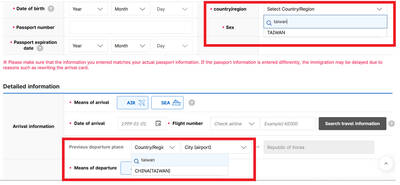
Jason Han says that the e-arrival card spat between South Korea and Taiwan shows that Seoul is signaling adherence to its “one-China” policy, while Taiwan’s response reflects a reciprocal approach. “Attempts to alter the diplomatic status quo often lead to tit-for-tat responses,” the analyst on international affairs tells the Taipei Times, adding that Taiwan may become more cautious in its dealings with South Korea going forward. Taipei has called on Seoul to correct its electronic entry system, which currently lists Taiwan as “China (Taiwan),” warning that reciprocal measures may follow if the wording is not changed before March 31. As of yesterday,
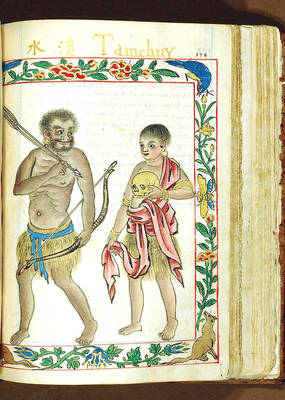
The Portuguese never established a presence on Taiwan, but they must have traded with the indigenous people because later traders reported that the locals referred to parts of deer using Portuguese words. What goods might the Portuguese have offered their indigenous trade partners? Among them must have been slaves, for the Portuguese dealt slaves across Asia. Though we often speak of “Portuguese” ships, imagining them as picturesque vessels manned by pointy-bearded Iberians, in Asia Portuguese shipping between local destinations was crewed by Asian seamen, with a handful of white or Eurasian officers. “Even the great carracks of 1,000-2,000 tons which plied
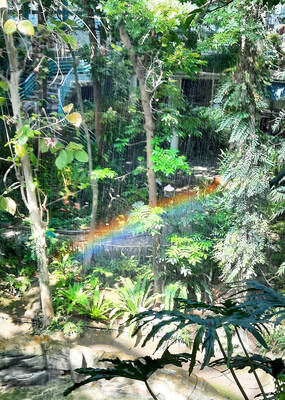
It’s only half the size of its more famous counterpart in Taipei, but the Botanical Garden of the National Museum of Nature Science (NMNS, 國立自然科學博物館植物園) is surely one of urban Taiwan’s most inviting green spaces. Covering 4.5 hectares immediately northeast of the government-run museum in Taichung’s North District (北區), the garden features more than 700 plant species, many of which are labeled in Chinese but not in English. Since its establishment in 1999, the site’s managers have done their best to replicate a number of native ecosystems, dividing the site into eight areas. The name of the Coral Atoll Zone might
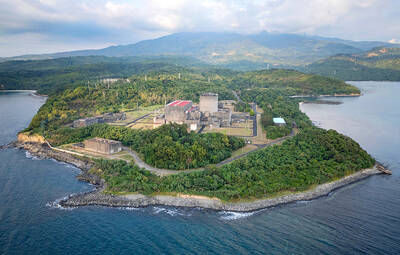
Nuclear power is getting a second look in Southeast Asia as countries prepare to meet surging energy demand as they vie for artificial intelligence-focused data centers. Several Southeast Asian nations are reviving mothballed nuclear plans and setting ambitious targets and nearly half of the region could, if they pursue those goals, have nuclear energy in the 2030s. Even countries without current plans have signaled their interest. Southeast Asia has never produced a single watt of nuclear energy, despite long-held atomic ambitions. But that may soon change as pressure mounts to reduce emissions that contribute to climate change, while meeting growing power needs. The


 RSS
RSS