


It is 14 years since Neil Jordan had an enormous success with The Crying Game, in which one character's ambiguous sexual identity put a sensational twist in the tale of terrorism, the British military and Northern Ireland. Now Jordan revives these tropes in this adaptation of Patrick McCabe's 1998 picaresque novel Breakfast On Pluto — in which transvestism is a defiant rejection of bigotry, labels, and borders.
Cillian Murphy plays Patrick "Kitten" Brady, a drag queen with attitude from a small town in the Irish Republic, close to the border. He is the secret son of the local priest, played by Liam Neeson, who got his housekeeper pregnant and arranged for the resulting baby to be farmed out to an uncaring foster mother. Growing up in the 1960s and 1970s, Kitten scandalizes everyone with his addiction to girls' clothes and precocious sense of glamour. But Kitten is obsessed with the idea of his mother — who is supposed to have made a new life in London — and, all but penniless, he heads off to the English capital with a romantic notion of tracking her down.
We are presumably supposed to be cheering for Kitten, as a lovably exuberant rebel who makes joyless priests, cruel Brits and stone-faced Provos look silly with his antics. Actually the character is bafflingly charmless: narcissistic and unsympathetic, and the shrill, twittering monotony of Murphy's performance becomes exasperating.
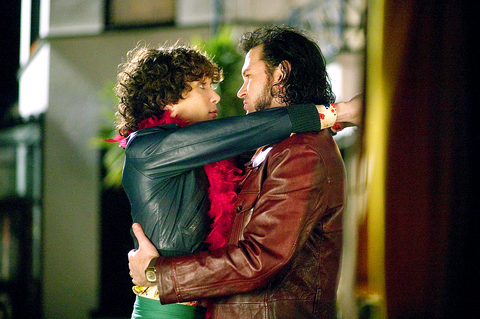
PHOTO COURTESY OF SWALLOW WINGS
His story begins with a couple of CGI robins swooping over the rooftops, commenting on the action and establishing the uncertain, sub-magic-realist sense that Kitten's self-narrated mythologizing is at some level unserious. Yet Kitten appears to get involved in deadly serious situations: he experiences first-hand the casual arrogance of the British border patrol and the icy ruthlessness of the IRA. Turning tricks in London, he is nearly murdered by a curb-crawler played by Bryan Ferry (a disconcerting piece of novelty casting) and even gets blown up in a pub bombing only then to be beaten up by the London police as a typical Paddy suspect. But all the time he airily waves away any suggestion that he should take any of this seriously: "Oh serious, serious, serious ... " But isn't it serious? Kitten actually flirts with a copper who just a few days previously had stood idly by while his colleague beat him up. His unending campness saves him from being half-killed on separate occasions by the Met and the Provos; it is miraculously disarming — the cross-dressing Christ in high-heels? — but it can only be disarming in this world tinged with black-comic fantasy.
Kitten's refusal to conform to sexual stereotypes is an apolitical plague-on-both-your-houses gesture, and certainly an effective way of showing how the warring sides have something in common: nauseating macho arrogance. But having detached himself from the political contest, where are Kitten's emotional commitments? His relationship with his mother, Eileen, has most power when it is yearning fantasy: when confronted with her in the flesh, Kitten becomes tongue-tied and it is all a bit of let-down — Eileen is played by Eva Birthistle, who recently gave such an excellent performance in Ken Loach's Ae Fond Kiss. Kitten's friendship with the pregnant Charlie (Ruth Negga) is also filtered through his incessant, brittle posturing.
Stephen Rea has a droll presence as a conjuror and hypnotist who becomes captivated with Kitten, using him as an assistant and mesmerizing him into thinking his mother is in the audience, for the benefit of a heartless, chortling crowd. Yet Kitten's hypnotized rapture doesn't seem that much different from the real thing. The only person in the film who really comes to life is Brendan Gleeson, playing John-Joe, an itinerant Irish actor who briefly gets Kitten a job in a horrific Wombles theme park. As Great Uncle Bulgaria, John-Joe has a certain authority that is displayed when, in full costume, he punches the haughty English manager for accusing him unjustly of breaking a mallet. Kitten's adventures rattle along divertingly enough, but it is difficult to make any emotional investment in a character who is interested chiefly in himself.

If one asks Taiwanese why house prices are so high or why the nation is so built up or why certain policies cannot be carried out, one common answer is that “Taiwan is too small.” This is actually true, though not in the way people think. The National Property Administration (NPA), responsible for tracking and managing the government’s real estate assets, maintains statistics on how much land the government owns. As of the end of last year, land for official use constituted 293,655 hectares, for public use 1,732,513 hectares, for non-public use 216,972 hectares and for state enterprises 34 hectares, yielding

The small platform at Duoliang Train Station in Taitung County’s Taimali Township (太麻里) served villagers from 1992 to 2006, but was eventually shut down due to lack of use. Just 10 years later, the abandoned train station had become widely known as the most beautiful station in Taiwan, and visitors were so frequent that the village had to start restricting traffic. Nowadays, Duoliang Village (多良) is known as a bit of a tourist trap, with a mandatory, albeit modest, admission fee of NT$10 giving access to a crowded lane of vendors with a mediocre view of the ocean and the trains

For many people, Bilingual Nation 2030 begins and ends in the classroom. Since the policy was launched in 2018, the debate has centered on students, teachers and the pressure placed on schools. Yet the policy was never solely about English education. The government’s official plan also calls for bilingualization in Taiwan’s government services, laws and regulations, and living environment. The goal is to make Taiwan more inclusive and accessible to international enterprises and talent and better prepared for global economic and trade conditions. After eight years, that grand vision is due for a pulse check. RULES THAT CAN BE READ For Harper Chen (陳虹宇), an adviser

Traditionally, indigenous people in Taiwan’s mountains practice swidden cultivation, or “slash and burn” agriculture, a practice common in human history. According to a 2016 research article in the International Journal of Environmental Sustainability, among the Atayal people, this began with a search for suitable forested slopeland. The trees are burnt for fertilizer and the land cleared of stones. The stones and wood are then piled up to make fences, while both dead and standing trees are retained on the plot. The fences are used to grow climbing crops like squash and beans. The plot itself supports farming for three years.


 RSS
RSS