


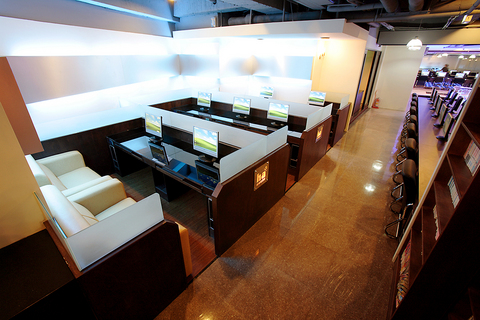
If you had asked someone six years ago what Taiwan's Internet cafe of today would look like, that person might have described something like Ha2 (哈哈活力站) in Shilin (士林), near Taipei's Jiantan MRT station (劍潭站). Located beneath a winding staircase on a street that's often crowded with high school students, H2 is as sleek as a nightclub and as comfortable as the lobby of a five-star hotel. Effortlessly filling its 920m2 spread are 180 high-powered computers, soft white sofas and a conference room straight out of a James Bond movie.
Where competitors smell like airport smoking lounges and serve ramen noodles and instant coffee, H2 has a state-of-the-art ventilation system, a walk-in cooler, and a menu that lists pizza and fried chicken. Customers here for relaxation can read comic books at four-person pods with flat-panel monitors that swivel on mechanical arms, or pair off in cubicles with adjustable, wood-finish desks. Those on business get projector screens and a conference table with a partition that raises via remote control to reveal personal workstations. Set well apart from these areas are rows and rows of brand-new dual-processor PCs, where scores of young men battle day and night with keyboard and mouse on the latest online games.
Among the hundreds of Internet cafes that existed in Taipei six years ago, Ha2 stands out — not so much for staying on the cutting edge of technology and comfort as for the fact that it's still around. Initial overinvestment in the industry, followed by government policies designed to address social problems linked to Internet cafes, have taken their toll. In 2002 there were 32 Internet cafes in Shilin alone, now there are nine, Ha2 manager Rich Kao (高盛興) said.
It's harder now than it was to find an Internet cafe in Taipei, but there are still more than 200 licensed ones in the city to choose from. Others have gone underground, unable to comply with city regulations mandating that they not operate within 200m of a school and limiting the hours when minors can visit. Many Internet cafes, unable to attract new investors, look like time capsules from the turn of the century, albeit with newer games and smoke-yellowed walls.
"Half of the social problems in Taiwan, the government — and the media — have blamed on Internet cafes," said Jacky Wu (吳振彰), founder of industry giant Aztec Technology (戰略高手), which once had nearly 90 franchises across Taiwan but now operates around three-dozen.
The trouble started with concerns that teenagers were spending too much time in Internet cafes, where they were exposed to excessive violence in computer games and could easily obtain access to pornographic Web sites or meet ill-intentioned strangers in online chat rooms. A survey supervised by a former justice minister found that around 400,000 young students were visiting Internet cafes at least once a week, spending an average of eight-and-a half-hours there. It was speculated that more than a quarter of young patrons were addicted to online games.
The Taipei City government responded in 2001 by passing a statute regulating "information-recreation service providers" (資訊休閒業), or Internet cafes. According to published accounts, 90 percent of the city's estimated 800 Internet cafes did not comply with some aspect of the statute, which in addition to restricting access by the young also mandated that such businesses only operate in commercial areas on streets 8m wide or larger, where rent was more expensive than the residential areas where most had set up shop. The national government responded with its own, less stringent regulations.
But the bad publicity continued. A few months after the regulations were approved, a young man was found paralyzed in an Internet cafe in Taipei County. He had been there for three days and had not left his seat except for occasional bathroom breaks. Earlier this year, an unemployed man who had become estranged from his wife died after spending three months in a Danshui (淡水) Internet cafe. According to published accounts, the cafe's owner said that over his lengthy stay, the man played video games, chewed betel nut, ate instant noodles and smoked.
Jacky Wu, a thin man with a gray crew cut who had the air of someone who'd seen too many reporters, estimates there are now between 200 and 300 Internet cafes in Taipei, with another 300 to 400 in Taipei County. Though he now owns only one, Skywalker Multimedia Entertainment Center (天行者), just off Songjiang Road (松江路), his is one of the most well-appointed.
At 1,300m², Skywalker is larger than Ha² but has fewer computers. There is a large area in the back with wood paneling and Chinese scrolls, where customers can rest on comfortable sofas while surfing the Web or flipping through magazines — 50 new titles each month — and comic books — Skywalker has 40,000. There are also workstations equipped with Microsoft Office software, printers, a photocopier and a fax machine. The hourly fee is NT$60, double the average price, but drinks are free. Like Ha2, Skywalker has a large conference room for business meetings, and a dedicated area for computer gamers.
Wu, who also founded the Solar System (太陽系) MTV chain and the King of Comics (漫畫王) franchise, believes that advances in home computing have not rendered Internet cafes obsolete. “You can sing karaoke at home, but people still go to KTVs. You can watch movies at home, but people still go to movie theaters,” he said. “There is room in Taiwan for the kind of cyber cafes they have in Tokyo, the ones with showers and beds and all kinds of media devices. But right now the local economic environment is so bad that no one wants to invest in something new. And if you do, the government will regulate you to death.”
Taipei's largest Internet cafe has found a way to turn the extra government attention to its advantage. Located across the street from a gas station south of Nanjing East Road (LHH Cyber Cafe (麗華行) has four floors jammed with 200 computers, which it replaces every two years. The new models are Dell workstations with Intel Core 2 Duo processors, NT$10,000 NVIDIA graphics cards and Web cams for use with Skype or instant messaging programs.
LHH has received the city education bureau's Outstanding Youth Recreational Venue (青少年健康休閒場所評鑑) award for each of the last four years, one of only seven Internet cafes and 40 youth hangouts, including playgrounds and museums, to have earned that distinction. It has received similar citations from the national government. “If a customer stays here too long, we'll tell him to go home, shower and take a rest,” said LHH manager Wu Shu-fang (吳淑芳), whose pink uniform shirt and curly hair made her look like a playground supervisor.
Both Wu Shu-fang and Ha²'s Kao believe their industry has consolidated its losses and could see a renewed phase of expansion once investors regain confidence in the local economy. “The Internet cafes that had problems have already closed,” said Kao, a former convenience store and restaurant manager who has stayed in the business because he loves computer games. “The ones that are still here will keep getting better.”
Jacky Wu said he will continue to upgrade Skywalker's technology, but sometimes it's hard to see a brighter future. “When the government looks at this business, they just see computer games. They don't see the real potential here,” he said.

The Portuguese never established a presence on Taiwan, but they must have traded with the indigenous people because later traders reported that the locals referred to parts of deer using Portuguese words. What goods might the Portuguese have offered their indigenous trade partners? Among them must have been slaves, for the Portuguese dealt slaves across Asia. Though we often speak of “Portuguese” ships, imagining them as picturesque vessels manned by pointy-bearded Iberians, in Asia Portuguese shipping between local destinations was crewed by Asian seamen, with a handful of white or Eurasian officers. “Even the great carracks of 1,000-2,000 tons which plied
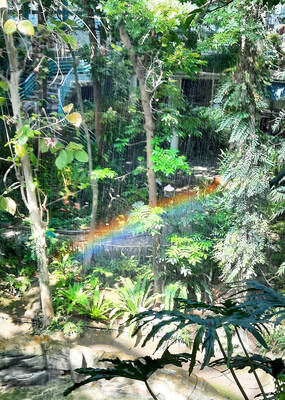
It’s only half the size of its more famous counterpart in Taipei, but the Botanical Garden of the National Museum of Nature Science (NMNS, 國立自然科學博物館植物園) is surely one of urban Taiwan’s most inviting green spaces. Covering 4.5 hectares immediately northeast of the government-run museum in Taichung’s North District (北區), the garden features more than 700 plant species, many of which are labeled in Chinese but not in English. Since its establishment in 1999, the site’s managers have done their best to replicate a number of native ecosystems, dividing the site into eight areas. The name of the Coral Atoll Zone might

On Monday morning, in quick succession, the Chinese Communist Party (CCP) and the Chinese Nationalist Party (KMT) released statements announcing “that the Central Committee of the Communist Party of China and General Secretary Xi Jinping (習近平) have invited KMT Chairwoman Cheng Li-wun (鄭麗文) to lead a delegation on a visit to the mainland” as the KMT’s press release worded it. The KMT’s press release added “Chairwoman Cheng expressed her gratitude for the invitation and has gladly accepted it.” Beijing’s official Xinhua news release described Song Tao (宋濤), head of the Taiwan Work Office of the CCP Central Committee, as
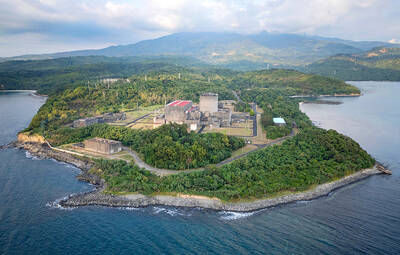
Nuclear power is getting a second look in Southeast Asia as countries prepare to meet surging energy demand as they vie for artificial intelligence-focused data centers. Several Southeast Asian nations are reviving mothballed nuclear plans and setting ambitious targets and nearly half of the region could, if they pursue those goals, have nuclear energy in the 2030s. Even countries without current plans have signaled their interest. Southeast Asia has never produced a single watt of nuclear energy, despite long-held atomic ambitions. But that may soon change as pressure mounts to reduce emissions that contribute to climate change, while meeting growing power needs. The


 RSS
RSS