


Amila Jeewantha, an artist from Sri Lanka, set up the Lion Foot Sri Lankan Cuisine restaurant just over a year ago. Last month, Jeewantha opened a second branch in Tianmu district, bringing the exotic aroma of Sri Lankan cuisine to this upscale neighborhood.
Like its predecessor, the spacious restaurant features authentic homemade Sri Lankan delicacies. Made with oodles of herbs and spices, many dishes include blends of 25 or more spices and are based on sophisticated culinary and nutritional principles that maximize the ingredients' healthful properties and flavor.
In addition to its broad range of beef, chicken, pork, seafood and vegetable options, the menu offers nine set meals that guide diners through Sri Lanka's ancient culinary culture.
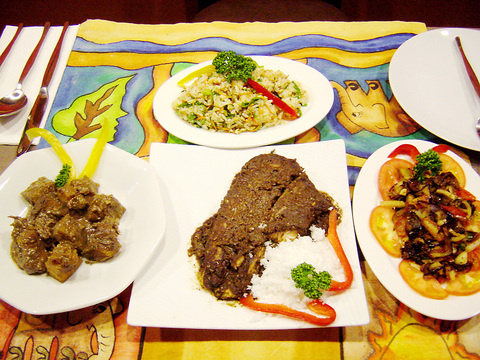
PHOTO: HO YI, TAIPEI TIMES
One of the highlighted main courses is fish ambul thiyal. Simmered over a low-flame in ambul sauce, made of spices and a tart fruit resembling dark plum, the fish fillets are impregnated with a heavenly flavor.
Beef smore is another popular dish that combines tender meat with a mix of spices to create a pungent and multi-layered taste sensation. Also recommended is black pumpkin curry, which is cooked with the restaurant's signature sauce made from 14 roasted spices. White curry, on the other hand, is a mild and smooth sauce made from un-roasted curry powder, mustard and coconut milk. Red curry is mixed with chilies and spices, and comes highly recommended on a cold winter's day as it warms up the whole body.
The traditional side dishes sambol and mallum are not to be missed. Hot and sweet eggplant sambol, chopped fresh vegetable mixed with coconut, mixed vegetable rice or coconut roti can be ordered to accompany the main dishes.
The best after-meal drink would be a cup of organic tea from Sri Lanka's world-acclaimed tea plantations in Nuwara Eliya, Dimbula and Uva.
Jeewantha believes cooking is a form of creative expression and hopes someday people will visit the restaurant for live performances as well as to fill up on top-quality and healthy food.
"All kinds of art are welcome here," said Jeewantha, who used his own art to put a unique stamp on the restaurant.

The Portuguese never established a presence on Taiwan, but they must have traded with the indigenous people because later traders reported that the locals referred to parts of deer using Portuguese words. What goods might the Portuguese have offered their indigenous trade partners? Among them must have been slaves, for the Portuguese dealt slaves across Asia. Though we often speak of “Portuguese” ships, imagining them as picturesque vessels manned by pointy-bearded Iberians, in Asia Portuguese shipping between local destinations was crewed by Asian seamen, with a handful of white or Eurasian officers. “Even the great carracks of 1,000-2,000 tons which plied
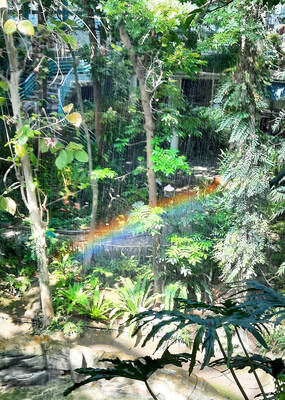
It’s only half the size of its more famous counterpart in Taipei, but the Botanical Garden of the National Museum of Nature Science (NMNS, 國立自然科學博物館植物園) is surely one of urban Taiwan’s most inviting green spaces. Covering 4.5 hectares immediately northeast of the government-run museum in Taichung’s North District (北區), the garden features more than 700 plant species, many of which are labeled in Chinese but not in English. Since its establishment in 1999, the site’s managers have done their best to replicate a number of native ecosystems, dividing the site into eight areas. The name of the Coral Atoll Zone might

On Monday morning, in quick succession, the Chinese Communist Party (CCP) and the Chinese Nationalist Party (KMT) released statements announcing “that the Central Committee of the Communist Party of China and General Secretary Xi Jinping (習近平) have invited KMT Chairwoman Cheng Li-wun (鄭麗文) to lead a delegation on a visit to the mainland” as the KMT’s press release worded it. The KMT’s press release added “Chairwoman Cheng expressed her gratitude for the invitation and has gladly accepted it.” Beijing’s official Xinhua news release described Song Tao (宋濤), head of the Taiwan Work Office of the CCP Central Committee, as
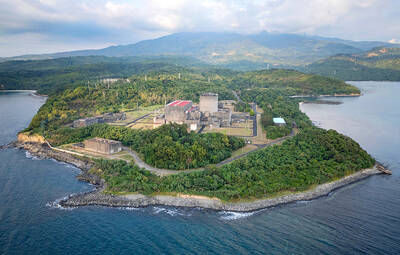
Nuclear power is getting a second look in Southeast Asia as countries prepare to meet surging energy demand as they vie for artificial intelligence-focused data centers. Several Southeast Asian nations are reviving mothballed nuclear plans and setting ambitious targets and nearly half of the region could, if they pursue those goals, have nuclear energy in the 2030s. Even countries without current plans have signaled their interest. Southeast Asia has never produced a single watt of nuclear energy, despite long-held atomic ambitions. But that may soon change as pressure mounts to reduce emissions that contribute to climate change, while meeting growing power needs. The


 RSS
RSS