


Andy has sprouted white whiskers, suffers from lower back pain and no longer bounds up the stairs like he used to.
Still, the 11-year-old Siberian husky isn't lying idle: every week he meets his personal trainer for a run on an underwater treadmill, does laps in a doggy pool to strengthen his hind legs and unwinds with a hot spa and massage session.
The boom in pet ownership in Japan has led to a new phenomenon: legions of elderly animals that doting masters pamper with fortified food and vitamins, aromatherapy and even acupuncture.

PHOTOS: EPA
"I want to do everything I can for Andy. He's part of the family," said Aya Ashiya, 50, of Tokyo as she ran around the swimming pool with a squeeze toy, cheering the husky on during a recent session at the dog aqua fitness gym El Pero.
"We've been together for so long, and we've really learned to communicate," Ashiya said. "I just want him to stay healthy for as long as possible."
Though figures are scarce, a study published last year showed that longevity for cats in Japan almost doubled between 1991 and 2003, from 5.1 years to 9.9 years. Dog longevity surged from 8.6 years to 11.9 years.
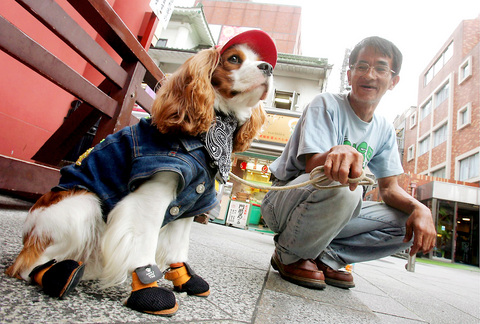
Researchers attribute the jump to better health care, more vaccinations, a more balanced diet and a new trend of pets being allowed to live in homes — once unthinkable in a country of tatami-mat houses.
But longer lives have led to ailments seldom seen before in pets in Japan, such as cancer, diabetes, heart disease and dementia, said Hideki Hayashidani, an assistant professor at the Tokyo University of Agriculture and Technology, who carried out the longevity study.
"Japanese attitudes toward pets have changed radically. Owners dote over them like children," Hayashidani said. "That means fewer pups and kittens die from infections, while cancer and heart disease cases have hit the roof ... And owners will pay anything to keep their pets alive longer."
Kyuta, an eight-year-old long-haired Chihuahua, started biweekly acupuncture sessions at the Kamakura Genki Animal Hospital after severe back pain struck last year.
At a recent session, the dog gave yelped as a veterinarian inserted 13 needles into his quivering back and hind legs, but soon settled down in his owner's arms.
"Kyuta loves coming here. His tail goes right up when he gets on the examination table," said Emi Matsuya, 43, a Tokyo hairdresser.
The pair travel two hours each way by train for the acupuncture sessions, which cost US$47, Matsuya said, and the Chihuahua eats homemade meals of meat and vegetables now he is getting older.
"Dogs crave attention — that's what makes them happy. And happy dogs live longer," said hospital director Takashi Ishino, who also offers massage and aromatherapy treatments.
Japan's aging dogs also benefit from specially designed care items such as doggie diapers, harnesses that support aging pooches on walks and pet strollers. Elderly cats have their own products, including climbing towers with extra padding.
And owners can take a break from their pets by getting a nursing care specialist. Keiko Himi, who runs the pet-sitting service "Nyan to Wonderful" northeast of Tokyo, says an increasing number of owners ask her to care for aging pets while they run errands or work.
"Caring for old pets is a big burden for the owner, physically and emotionally," Himi said. "In one case, I went to help a family every day through their dog's last days." Death doesn't end the pampering. A spate of companies offers everything from pet cemeteries, funerals and memorials to counseling for grieving owners. Tokyo's Japan Pet Ceremony Co. runs a 24-hour funeral hot line; the Machida Izumi Joen cemetery offers the ultimate in owner-pet companionship: a shared grave.
"It's all about giving dogs a certain quality of life," said Ashiya, the Siberian husky owner. "We're not going to give up just because Andy's old ... not as long as I have the energy, time, and money."

The Portuguese never established a presence on Taiwan, but they must have traded with the indigenous people because later traders reported that the locals referred to parts of deer using Portuguese words. What goods might the Portuguese have offered their indigenous trade partners? Among them must have been slaves, for the Portuguese dealt slaves across Asia. Though we often speak of “Portuguese” ships, imagining them as picturesque vessels manned by pointy-bearded Iberians, in Asia Portuguese shipping between local destinations was crewed by Asian seamen, with a handful of white or Eurasian officers. “Even the great carracks of 1,000-2,000 tons which plied

It’s only half the size of its more famous counterpart in Taipei, but the Botanical Garden of the National Museum of Nature Science (NMNS, 國立自然科學博物館植物園) is surely one of urban Taiwan’s most inviting green spaces. Covering 4.5 hectares immediately northeast of the government-run museum in Taichung’s North District (北區), the garden features more than 700 plant species, many of which are labeled in Chinese but not in English. Since its establishment in 1999, the site’s managers have done their best to replicate a number of native ecosystems, dividing the site into eight areas. The name of the Coral Atoll Zone might

On Monday morning, in quick succession, the Chinese Communist Party (CCP) and the Chinese Nationalist Party (KMT) released statements announcing “that the Central Committee of the Communist Party of China and General Secretary Xi Jinping (習近平) have invited KMT Chairwoman Cheng Li-wun (鄭麗文) to lead a delegation on a visit to the mainland” as the KMT’s press release worded it. The KMT’s press release added “Chairwoman Cheng expressed her gratitude for the invitation and has gladly accepted it.” Beijing’s official Xinhua news release described Song Tao (宋濤), head of the Taiwan Work Office of the CCP Central Committee, as
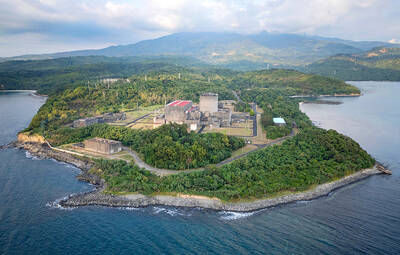
Nuclear power is getting a second look in Southeast Asia as countries prepare to meet surging energy demand as they vie for artificial intelligence-focused data centers. Several Southeast Asian nations are reviving mothballed nuclear plans and setting ambitious targets and nearly half of the region could, if they pursue those goals, have nuclear energy in the 2030s. Even countries without current plans have signaled their interest. Southeast Asia has never produced a single watt of nuclear energy, despite long-held atomic ambitions. But that may soon change as pressure mounts to reduce emissions that contribute to climate change, while meeting growing power needs. The


 RSS
RSS