


Staple foods are nourishment to the soul because they provide the kind of sustenance that is at once nostalgic and comforting. When Asians travel to the West they are often confounded by the lack of rice on menus. For Westerners coming to Taiwan, the dearth of potatoes can sometimes cause stress. And though this is a generalization, many will go to great lengths to find staple foods that alleviate the yearning for home. For this reviewer, it is bread. Like any culinary Columbus, I will travel far and wide to discover new places providing breads and desserts.
The recently opened Patisserie Boite de bijou, located in an alley directly behind National Taiwan Normal University (Shida), fills in the map. The brainchild of Lin Shu-chen (林淑真), the small European-style bakery serves up an excellent variety of breads, pastries and desserts. The fact that Lin was an interior designer is apparent in the layout of her store; the service is also excellent, as is the bread coming out of the oven.
Lin uses flour imported from France, and says that special emphasis is put on making the breads totally natural, with no chemical enhancements. From scratch, the process of making the bread takes on average between one to three days, "which enables the ingredients to blend together and the dough to rise naturally," she said.
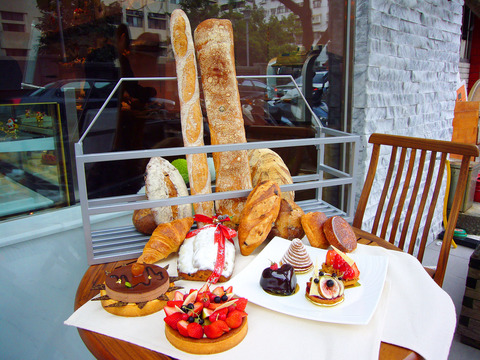
PHOTO: NOAH BUCHAN, TAIPEI TIMES
And though purchasing high quality breads and desserts means coughing up a little extra dough, the return on the investment is worth it. The foccacia (NT$40), French bread (NT$50), panini with black olives (NT$100) and baguette (NT$100) all provide a perfect accompaniment to any pasta dish while the rye bread with green peppercorns (NT$45) or French bread with cranberries (NT$75) are great foundations for any sandwich.
The variety of pastries and desserts on offer also receives the same care in experimentation that Lin and her team of chefs give to all their creations. Among the most popular are the mousse au chocolate et aux framboise (NT$85), gateau opera (NT$95) and the not too sweet mont blanc (NT$95), a light dessert that mellows out any bitter cup of coffee.
As it is the season to be jolly, Lin and her team of chefs have spent the last few weeks perfecting a Christmas stollen (NT$380) that would keep Santa coming back for more. In addition to the stollen there are also a variety of other cakes and breads perfect for any Christmas party or dinner.
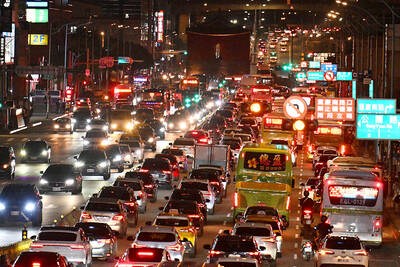
By global standards, the traffic congestion that afflicts Taiwan’s urban areas isn’t horrific. But nor is it something the country can be proud of. According to TomTom, a Dutch developer of location and navigation technologies, last year Taiwan was the sixth most congested country in Asia. Of the 492 towns and cities included in its rankings last year, Taipei was the 74th most congested. Taoyuan ranked 105th, while Hsinchu County (121st), Taichung (142nd), Tainan (173rd), New Taipei City (227th), Kaohsiung (241st) and Keelung (302nd) also featured on the list. Four Japanese cities have slower traffic than Taipei. (Seoul, which has some
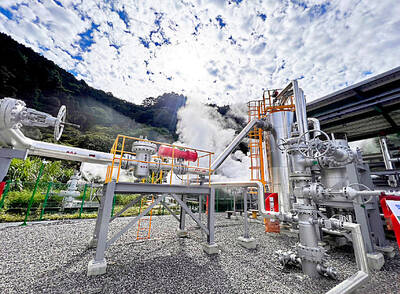
Taiwan’s semiconductor industry consumes electricity at rates that would strain most national grids. Taiwan Semiconductor Manufacturing Co (TSMC) alone accounted for more than 9 percent, or 2,590 megawatts (MW), of the nation’s power demand last year. The factories that produce chips for the world’s phones and servers run around the clock. They cannot tolerate blackouts. Yet Taiwan imports 97 percent of its energy, with liquefied natural gas reserves measured in days. Underground, Taiwan has options. Studies from National Taiwan University estimate recoverable geothermal resources at more than 33,000 MW. Current installed capacity stands below 10 MW. OBSTACLES Despite Taiwan’s significant geothermal potential, the

In our discussions of tourism in Taiwan we often criticize the government’s addiction to promoting food and shopping, while ignoring Taiwan’s underdeveloped trekking and adventure travel opportunities. This discussion, however, is decidedly land-focused. When was the last time a port entered into it? Last week I encountered journalist and travel writer Cameron Dueck, who had sailed to Taiwan in 2023-24, and was full of tales. Like everyone who visits, he and his partner Fiona Ching loved our island nation and had nothing but wonderful experiences on land. But he had little positive to say about the way Taiwan has organized its

The entire Li Zhenxiu (李貞秀) saga has been an ugly, complicated mess. Born in China’s Hunan Province, she moved to work in Shenzhen, where she met her future Taiwanese husband. Most accounts have her arriving in Taiwan and marrying somewhere between 1993 and 1999. She built a successful career in Taiwan in the tech industry before founding her own company. She also served in high-ranking positions on various environmentally-focused tech associations. She says she was inspired by the founding of the Taiwan People’s Party (TPP) in 2019 by Ko Wen-je (柯文哲), and began volunteering for the party soon after. Ko


 RSS
RSS