


Ping Lu (平路), the Taiwanese novelist, columnist and cultural critic is reputed for her feminist approach to many social issues. In her introduction to this new novel she calls it a difficult subject which took her "seven or eight years" to research, and was all the more demanding on account of her determination to be able to point to a historical record to support every detail offered in her story.
The book can't at present be published in China because of the authors' close-up picture of Sun Yat-sen (孫逸仙), revered as a hero there just as he is in Taiwan, even if a less crucial figure for Beijing than he is for the Taipei authorities. But Love and Revolution is scarcely politically correct here either, as Ping observes. But it has already been published in Chinese in Taipei, and in Japanese in Tokyo, and now arrives in an English translation by Fu-jen Catholic University's Nancy Du in Columbia's admirable Modern Chinese Literature from Taiwan series.
The novel begins in 1924, the year before Sun's death from liver cancer. He and his wife, Song Qingling (宋慶齡), are on a ship sailing from Kobe in Japan to Tianjin in China. Sun is 59 and Song 34.
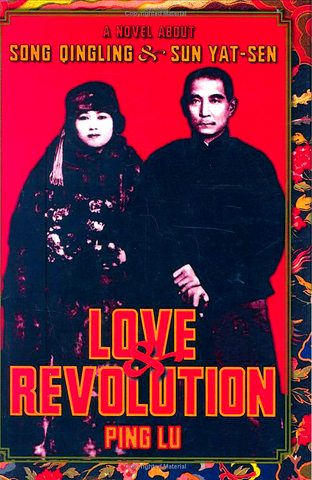
The book is structured as alternating authorial narratives, half about Sun and half about Song. A few extra chapters are narrated by one of Song's two daughters, born to another man after Sun's death. Each of the two main narratives ends with the death of its subject, Sun's in 1925, Song's in 1981.
It's already possible to foresee from the above information that both the book's organization and its dependence on massive historical investigation might lead to a certain formality of presentation. The time it took to write (most of it, you feel, spent on research) may have taken its toll. When you have a large amount of historical detail waiting to be incorporated, the flow and emotional evolution on which good novels depend both risk getting impeded.
It's not exactly that historical detail clutters up a story so much as that nuggets of information, once discovered, almost insist on finding a place somewhere in the text, so that the writer is drawing endlessly on card indexes or their computerized equivalents rather than letting the feelings of the characters take the tiller. And it's feeling-driven narratives rather than research-driven ones that hook readers and send sales rocketing. Tolstoy knew plenty about Napoleon's invasion of Russia when he sat down to write War and Peace, but he hid his knowledge and gave his characters primacy at all points in the story. That Dan Brown wears his knowledge on his sleeve is one of the weaknesses of The Da Vinci Code.
Ping's portrayal of Sun will shock the conventional. On his death he quickly became a hero of China's emerging nationalism, and heroes aren't supposed to have blemishes. When England's Oliver Cromwell told the man painting his portrait to show him "warts and all" he was being unusual — history's tendency, especially with revolutionary figures, is to idealize — or, if their ideology isn't approved of, then to denigrate wholesale, as in Jung Chang (張戎) and Jon Halliday's recent debunking book on Mao.
Ping portrays Sun as in many ways a rather inadequate figure. He's certainly shown close-up — we see him picking his nose, having liver-spotted hands and frostbite scars on his feet, with his skin clammy and his saliva giving off an unpleasant smell. Politics aged him fast. He thinks himself too mild-mannered for a revolutionary, is considered by others indecisive, and is told at one point that although he may be a significant figure historically, he was not one of the genuinely powerful men on the political scene.
Then there's his love-life. Heroes aren't supposed to have love-lives unless they're either exemplary or heroic ones. Sun is shown to have had many lovers before marrying Song (his second wife). Song's own love-life, too, is shown realistically — not very satisfactory with Sun, and certainly not buried along with her husband after his death.
Here and there the narrative hints that it might have been something rather different — the parallel lives of three women. Qingling was one of three sisters, and one of the others, Song Meiling (宋美齡), married Chiang Kai-shek (蔣介石) (it so happens Ping has written stories about both of them). The two come together on one page when Chiang's death in Taiwan is reported, and they're joined there by a reference to Mao's widow Jiang Qing (江青), arrested following Mao's death the following year.
The book sticks valiantly to the historical record, and because it presents Sun remembering his life prior to his death in 1925, and Song remembering the events she lived through right up to her death in 1981, the two narratives combined offer a vivid and personalized picture of political events in China through much of the 20th century.
Qingling's life as a widow is presented in part-detailed, part-hazy fashion, possibly as a result of the sparse information available. What is at one point described as her "secret second marriage" is alluded to mostly in the small number of chapters narrated by her daughter, whose father is guardedly referred to as "S". The American man this daughter is about to marry is named as Simpson.
Various Westerners friendly to China appear, from Irish dramatist George Bernard Shaw, who visited China in the 1930s, to the American journalist Edgar Snow, author of Red Star Over China, and his wife Helen. Taiwan only appears intermittently, most interestingly when the occupying Japanese authorities refuse permission for a specially-composed anthem to be sung at a memorial service organized to mark Sun's death. Praise for Sun had been widespread in the Japanese press, but it was presumably felt that anything that hinted of Chinese nationalism in Taiwan was too sensitive to be permitted. All this Lu has carefully researched.
It's beyond doubt that Love and Revolution offers a detailed picture of the lives of both its protagonists. For some readers it will be a touch too detailed. The progress of Sun's cancer, and his related medical treatments, are rather gruesomely described, while Song's anxiety about her later obesity, plus her sense of having been side-lined by the Chinese Communist Party, are prominent themes in the later chapters.
Even so, this novel has the outstanding virtue of offering two famous figures as credible individuals. At one point the author refers, in the persona of Song's daughter, to "the numerous Song Qingling biographies that have been written ... filled with archaic language" and leaving "no impression of the person at all." This book most certainly doesn't follow in the footsteps of these, and it is for this reason above all that it's to be recommended.
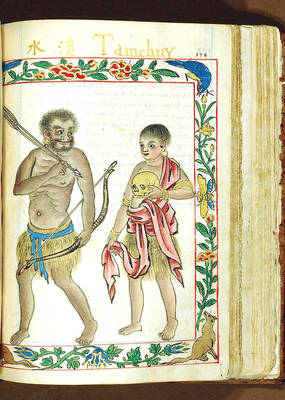
The Portuguese never established a presence on Taiwan, but they must have traded with the indigenous people because later traders reported that the locals referred to parts of deer using Portuguese words. What goods might the Portuguese have offered their indigenous trade partners? Among them must have been slaves, for the Portuguese dealt slaves across Asia. Though we often speak of “Portuguese” ships, imagining them as picturesque vessels manned by pointy-bearded Iberians, in Asia Portuguese shipping between local destinations was crewed by Asian seamen, with a handful of white or Eurasian officers. “Even the great carracks of 1,000-2,000 tons which plied

It’s only half the size of its more famous counterpart in Taipei, but the Botanical Garden of the National Museum of Nature Science (NMNS, 國立自然科學博物館植物園) is surely one of urban Taiwan’s most inviting green spaces. Covering 4.5 hectares immediately northeast of the government-run museum in Taichung’s North District (北區), the garden features more than 700 plant species, many of which are labeled in Chinese but not in English. Since its establishment in 1999, the site’s managers have done their best to replicate a number of native ecosystems, dividing the site into eight areas. The name of the Coral Atoll Zone might
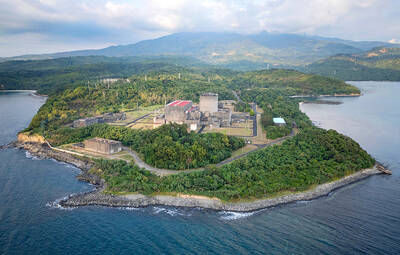
Nuclear power is getting a second look in Southeast Asia as countries prepare to meet surging energy demand as they vie for artificial intelligence-focused data centers. Several Southeast Asian nations are reviving mothballed nuclear plans and setting ambitious targets and nearly half of the region could, if they pursue those goals, have nuclear energy in the 2030s. Even countries without current plans have signaled their interest. Southeast Asia has never produced a single watt of nuclear energy, despite long-held atomic ambitions. But that may soon change as pressure mounts to reduce emissions that contribute to climate change, while meeting growing power needs. The

On Monday morning, in quick succession, the Chinese Communist Party (CCP) and the Chinese Nationalist Party (KMT) released statements announcing “that the Central Committee of the Communist Party of China and General Secretary Xi Jinping (習近平) have invited KMT Chairwoman Cheng Li-wun (鄭麗文) to lead a delegation on a visit to the mainland” as the KMT’s press release worded it. The KMT’s press release added “Chairwoman Cheng expressed her gratitude for the invitation and has gladly accepted it.” Beijing’s official Xinhua news release described Song Tao (宋濤), head of the Taiwan Work Office of the CCP Central Committee, as


 RSS
RSS