


After two years of preparation and two reconnaissance trips that covered only 20 percent of Kevin Lin’s (林義傑) daring route, the ultramarathon star is ready for a feat of ultimate endurance: he aims to be the first human to run across 6,500km of the Sahara desert, from coast to coast, in 80 days.
Scheduled to begin on Oct. 25, the unparalleled test of fitness and strength will see the ultra-marathon runner and two teammates, Charlie Engle and Ray Zahad, traverse six countries: Senegal, Mauritania, Mali, Niger, Libya and Egypt. The Saharan run poses the ultimate challenge to body and mind as the runners’ will face extreme temperatures, life-threatening stand storms, disease and the dangers of lawless regions.
“It will be my biggest dream come true, but also the most excruciating experience I will ever have to endure,” Lin said.
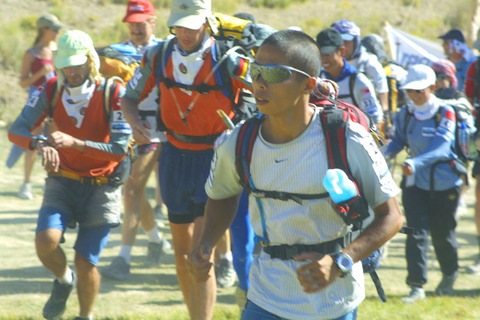
PHOTO COURTESY OF KEVIN LIN
Hollywood documentary filmmaker and Academy Award winner James Moll will direct a film chronicling the arduous journey, bringing the desert’s unique ecosystems, cultures and its peoples to the big screen. Matt Damon has been signed up to narrate the film.
Lin is placed first among the 15 people in the world to have completed the Four Deserts ultra-marathons, which were held in the Gobi, Chile’s Atacama, the Sahara in Egypt and Antarctica. His formidable reputation is one of invincible strength and willpower unlike any other.
In person, the 30-year-old athlete has a slight physique that hardly seems conducive to feats of derring-do and supreme stamina, or for maintaining a position at the top of a sport that requires participants to carry 10kg of water, food, gear and clothing on their backs while covering a grueling route across treacherous terrain in extreme weather conditions.
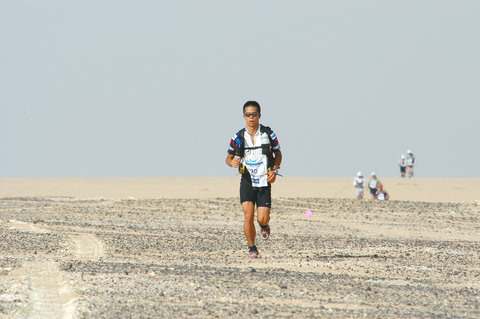
PHOTO COURTESY OF KEVIN LIN
“Westerners are amazed how a petite Asian like me can do it… . I guess I have my own advantages. A health examination done in the US indicates that I have 82 percent VO2 max [the highest volume of oxygen a person can use per minute of exercise], a high figure that is rarely seen, and my body can also hold lots of water so I don’t dehydrate easily,” Lin said.
Years of training and the right genes may have enabled Lin to become an outstanding sportsman, but it is his extraordinary determination that has carried him to the apex of ultramarathon running. Aged 10, Lin knew his future lay on the running field. Despite opposition from his family, Lin entered Hsihu Vocational and Business School (西湖商工), famed for its track and field teams. At first the coach refused to accept him because of his slight stature, but was later moved by Lin’s stubborn resolve and relented.
In college, Lin worked odd jobs to fund his studies, sleeping three hours a day while maintaining a rigorous training routine and racing in national and international contests.
After graduating, Lin took a job as a junior high school physical education teacher, but soon quit.
“I just wanted to see and experience more of the world,” Lin said.
In 2002, he borrowed the US$2,600 registration fee to enter the 17th Sahara competition and finished 12th. Government funding followed but it hardly covered transport costs. Financial difficulties didn’t stop Lin, neither did encountering life-threatening situations in hazardous environments or severe leg pain (he broke his right leg in a car accident in 2003).
Running in temperatures of over 50oC across inhospitable terrain where trails are few and far between, the endurance runner’s worst nightmare is to get lost and run out of water. Dehydration can quickly set in; death soon follows. Sudden sandstorms cause disorientation.
“When sandstorms hit, the sky is blackened by whirlwinds of sand that cover your eyes, nose and ears. You can hardly stand still but you have to keep on running,” said Lin.
Running at high altitudes also challenges runners’ physical limits. “Most people would develop acute altitude sickness at 2,500m; I sometimes have to run at over 4,000m,” Lin said.
The star marathon runner usually trains at sandy fields and mountains at high altitude abroad, running from 250km to 280km per week before races. Lin believes mental training is as important as physical preparation since runners need to stay calm and clear-minded.
“Before each race, I practice a tactic called image-training, that is, I imagine the worst case scenario and the excruciating pain I will have to endure so when it does happen, I am prepared for it,” Lin said.
Currently working towards a masters degree in sports psychology at National Chung Cheng University and writing a thesis on mental toughness, Lin believes that mental strength is derived from the least expected emotion — love.
“To me, love is more important than health. It is because of love for those close to you that people can accomplish their goal, even while experiencing great agony,” Lin said.
Several near-death experiences while undertaking ultra-marathon races have made Lin realize that the most important thing in life is to live it to the full. “I want to pursue a colorful life and grasp every chance that comes my way. If you give up trying, life will become insipid, even if you can live 100 years,” he said.
As for his future plans, the athlete intends to quit adventure runs and apply his personal experiences in the pursuit of a doctorate in sports psychology in the US. “For once, I would like to be a focused student living in an ivory tower and contribute my study and experiences to clinical psychology,” he said.
Dividing his hectic schedule between competing, training, studying, giving speeches and making public service and commercial endorsements, Lin also wants to set up an alternative model for fostering local athletic talent.
“I want to show that being coaches or physical education teachers is not our only way. We have lots of options,” he said.
A young man full of inspiration, Lin has been using the profits earned from his book and the sale of souvenirs from races to sponsor young athletes to enter international competitions.
“I have great respect for Taiwan’s eminent athletes because they achieved their accomplishments all by themselves. Many talented athletes are neglected by the system, and we should give them more support and resources,” the idealistic sportsman said.
Lin will depart for Senegal this week where the Running the Sahara expedition begins. A charitable campaign has also been set up to fund clean water programs in Africa. For more information on the ultimate test of human endurance or to make a donation for the campaign, visit www.runningthesahara.com.

Taiwan’s English education system is being pulled apart by three opposing forces. Bilingual Nation 2030 pulls students toward English and global communication. Artificial Intelligence (AI) readiness pulls them toward digital judgment, verification and AI-mediated work. But Taiwan’s old exam culture pulls them back toward memorization, grammar drills, timed reading and correct answers. If the education system keeps using old exams to define success, it risks producing graduates who are neither genuinely bilingual nor genuinely AI-ready, but trained for tasks machines can already perform. The first force is Bilingual Nation 2030. Launched in 2018, the policy aimed to “help Taiwan’s workforce connect

It seems every few days one bumps into one of those “real man” comments in which Taiwan is urged to “face reality” or similar, and “make a deal,” with the speaker implying that soon it will be too late. “Deal” advocates always present themselves as having a superior grip on reality, and the manly ability to make the “hard choice.” Their testosterone-laden language often echoes that of Taiwan sellout advocates. Note that such commentary always specifies a process (“make a deal, work with, make progress”), never the end state of what occupation by a violent authoritarian colonialist state will entail. In

“Taiwan’s Opposition Leader Comes to US With a Message Straight Out of Beijing” read a May 31 headline in the Wall Street Journal. Top US administration officials and members of Congress almost certainly read the WSJ, and if there was a bullet point takeaway that people in Washington should absorb ahead of Chinese Nationalist Party (KMT) Chair Cheng Li-wun’s (鄭麗文) arrival in DC on June 9, that headline is it. The last few columns have discussed this very topic, and the timing is not coincidental. While those top officials likely do not read the Taipei Times, judging by the number
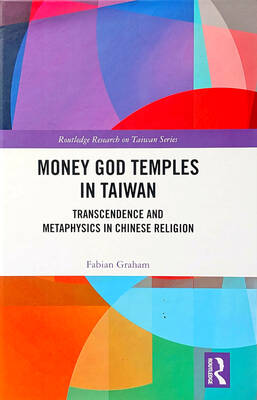
As someone who normally steers clear of books with “transcendence” or “metaphysics” in their subtitles, this reviewer — a casual observer of local belief systems since the 1990s — found Fabian Graham’s Money God Temples in Taiwan a challenging read. Those who’ve only dipped their toes into temple culture will likely need to parse several sections with special care if they’re to keep up with the author, a British ethnographic researcher whose previous books have investigated religious practices among ethnic Chinese in Southeast Asia. This scholarly volume examines a facet of Taiwan’s religious landscape that didn’t exist a century ago, and


 RSS
RSS