


Zhang Ziyi (章子怡) wowed Western audiences with her feisty fighting moves in Crouching Tiger, Hidden Dragon (臥虎藏龍). Gong Li (鞏俐) starred in Memoirs of a Geisha and seduced Colin Farrell in Miami Heat.
Chinese actresses are making their mark on the world stage as Hollywood turns to Asia for fresh faces. The tide likely won't stop with Zhang and Gong.
Two more Chinese stars worth watching are Zhou Xun (周迅) and Zhang Jingchu (張靜初).

Zhou dominated the Hong Kong movie awards circuit this year on the strength of her performance in director Peter Chan's (陳可辛) musical Perhaps Love (如果愛). Her portrayal of a movie star caught between past and present romances earned best actress honors from the Hong Kong Film Awards and the Hong Kong Film Critics Society.
Zhang Jingchu emerged after starring in Peacock, which won a Silver Bear at the Berlin Film Festival in 2005. She followed up with a solid delivery in Tsui Hark's (徐克) kung fu epic Seven Swords (七劍).
Zhou, who studied dance, not acting, is known for her versatility and an instinctive approach to acting. A pair of soulful eyes, carrying a tinge of sadness, enhance the allure of the slender actress.
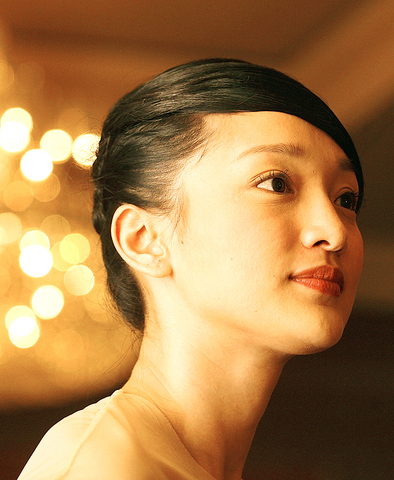
“She doesn't act with technique. She acts from the heart, so she can be very sincere. Many formally trained actors can complete their jobs perfunctorily, but their flaw is that they're not sincere,” director Feng Xiaogang (馮小剛) said.
If Zhou lacks academic training in drama, it doesn't show. In Perhaps Love, she skillfully handles her character's transformation from a desperate, struggling dancer and aspiring actress to a cold, callous star. She's a playful cafe owner who consults an imaginary friend about her love life in A West Lake Moment.
In Hollywood Hong Kong, she brings to life a worldly prostitute who effortlessly manipulates and seduces those around her.
In person, Zhou is a quiet, soothing presence, speaking slowly in a deep voice.
By contrast, Zhang Jingchu is bubbly and bursting with energy, a quality even evident in her writing.
Describing her nerves while preparing to audition for Peacock in a diary entry posted on her blog, she wrote, “I'm nervous and emotional. It's like I've been cursed by Peacock and can't go to sleep.”
Later at the actual audition, the sharp-faced, big-eyed Zhang pans her own performance, telling herself, “Do you think you're making a commercial? Do you think you can always flash your signature smile?”
Zhang, who studied directing at the Central Academy of Drama, also Zhang Ziyi's alma mater, is more dynamic than Zhou, but her strong presence sometimes leads to overacting. Her portrayal of a shocked villager, waving a sword in the air aimlessly after surviving an attack, is over-the-top.
But her well-defined screen personality comes in handy in Peacock, in which she plays a petulant, conniving homebound daughter.
Zhou and Zhang Jingchu have different outlooks on possible careers in the West.
“Whether or not it's Hollywood, the most important thing is the quality of the script,” Zhou said. She said she has been approached by foreign filmmakers but the right role hasn't come along.
Zhang Jingchu appeared lukewarm about Hollywood.
She declined a request to be interviewed and said in brief written responses to questions, “I don't plan to go to the US and I haven't signed with an American talent agency.”
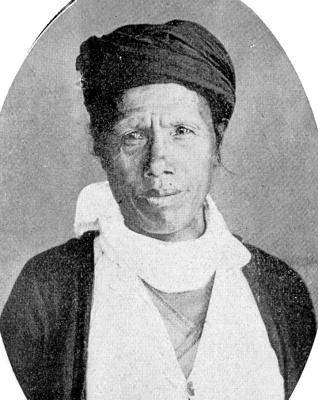
May 11 to May 17 Traversing the southern slopes of the Yushan Range in 1931, Japanese naturalist Tadao Kano knew he was approaching the last swath of Taiwan still beyond colonial control. The “vast, unknown territory,” protected by the “fierce” Bunun headman Dahu Ali, was “filled with an utterly endless jungle that choked the mountains and valleys,” Kano wrote. He noted how the group had “refused to submit to the measures of our authorities and entrenched themselves deep in these mountains … living a free existence spent chasing deer in the morning and seeking serow in the evening,” even describing them as

As a different column was being written, the big news dropped that Chinese Nationalist Party (KMT) caucus whip Fu Kun-chi (傅?萁) announced that negotiations within his caucus, with legislative speaker Han Kuo-yu (韓國瑜) of the KMT, party Chair Cheng Li-wun (鄭麗文), Taichung Mayor Lu Shiow-yen (盧秀燕) and Taiwan People’s Party (TPP) Chair Huang Kuo-chang (黃國昌) had produced a compromise special military budget proposal. On Thursday morning, prior to meeting with Cheng over a lunch of beef noodles, Lu reiterated her support for a budget of NT$800 or NT$900 billion — but refused to comment after the meeting. Right after Fu’s

Yesterday, the Democratic Progressive Party (DPP) nominated legislator Puma Shen (沈伯洋) as their Taipei mayoral candidate, the Chinese Nationalist Party (KMT) put their stamp of approval on Wei Ping-cheng (魏平政) as their candidate for Changhua County commissioner and former legislator Tsai Pi-ru (蔡壁如) of the Taiwan People’s Party (TPP) has begun the process to also run in Changhua, though she has not yet been formally nominated. All three news items are bizarre. The DPP has struggled with settling on a Taipei nominee. The only candidate who declared interest was Enoch Wu (吳怡農), but the party seemed determined to nominate anyone
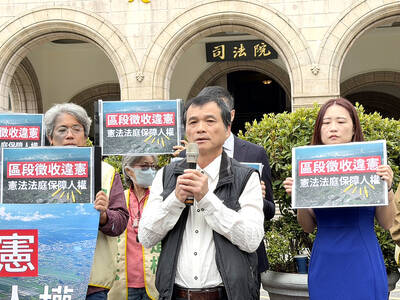
What government project has expropriated the most land in Taiwan? According to local media reports, it is the Taoyuan Aerotropolis, eating 2,500 hectares of land in its first phase, with more to come. Forty thousand people are expected to be displaced by the project. Naturally that enormous land grab is generating powerful pushback. Last week Chen Chien-ho (陳健和), a local resident of Jhuwei Borough (竹圍) in Taoyuan City’s Dayuan District (大園) filed a petition for constitutional review of the project after losing his case at the Taipei Administrative Court. The Administrative Court found in favor of nine other local landowners, but


 RSS
RSS