


It was far from the flash, cash and speed of topflight racing at the Rosso go-kart track in Taichung, but there was a competitive thrill when the Taipei Times challenged the country’s fastest driver to a race.
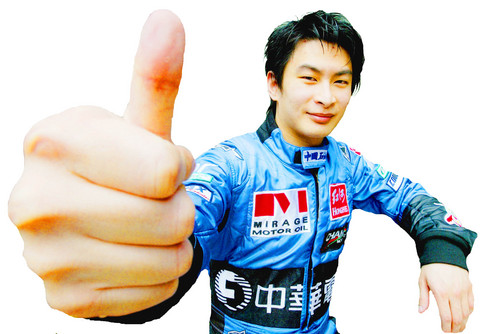
Born and raised in Taichung County (台中縣), you could tell Formula V6 driver Hanss Lin (林帛亨) was feeling at home by the permanent smile beneath the sunglasses. He was among friends and fans, who all wanted camera-phone snaps with their hero. There were just wisps of cloud in a clear, light blue sky. Perfect driving conditions.
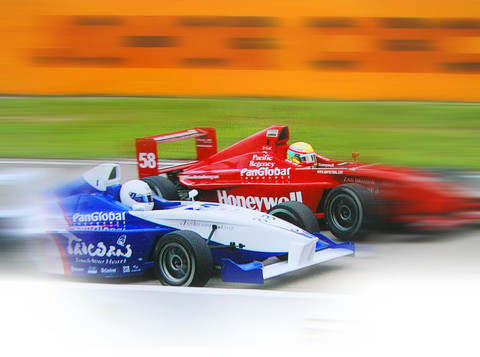
The 26-year-old earned his spurs driving for the world's most powerful car manufacturers on top international racetracks, and is now a tantalizing step away from Formula 1 (F1). His fellow drivers are the elite.
PHOTOS: LIN BO-HEN, TAIPEI TIMES
Your reporter, on the other hand, is middle-aged, doesn't get tickets any more unless it's for illegal parking and was last seen racing go-karts as a kid. He remembered his mother's advice: Go fast as you can, break before the curve, accelerate out of it. How hard could it be?
Local wannabe racers had been jostling for the right to challenge Lin by competing in qualification races all morning. They were locals who knew the cars and track, or go-kart enthusiasts from around the country. They were raring to go.
And then we were off!
I started at the back of the grid with Lin and was already trailing after the warm-up. A couple of circuits later, after managing to find a few racing lines, the pack unexpectedly roared past and I was lapped once more before the checkered flag went down.
On a more optimistic note I had unwittingly slowed the lead drivers enough for Lin to take the advantage with his superior passing skills and win the race. Congratulations all round. There was a podium-and-fizzy-drink celebration.
“Everyone here wants to do what I do,” Lin said, waving a hand at the racetrack, “It really is a dream job.” He was accompanied at our interview last weekend by his friend and racing manager Barry Chen (陳璞申). Both men spoke good English, Lin with a Canadian accent.
His father Lin Chen-ting (林振廷) owns an art auction house and has strong connections in business and politics. He has indisputably been the driving force behind his son up to now. He bought the five-year-old his first go-kart and entered him in his first race at seven.
Lin's father also bankrolled him with a reported US$1 million so he could pursue his dream, aged 15, of being champion in “the most popular sport in the world after soccer.”
Lin was sent to study in Vancouver, Canada, and graduated from Simon Fraser University and Bridgestone Racing Academy. He attended the prestigious La Filiere Federation Francaise du Sport Automobile Racing School, in France, and won a scholarship of US$128,000. In 2003 he invested this money by joining Emeritus Racing Team, as a driver in Formula BMW Asia.
Since then his career has taken off and he convincingly won the Formula Renault 2000 Asia championship last year, winning 10 of 13 races. He's now starting to find his feet in the more challenging Formula V6 Asia.
According to ex-F1 driver Alex Yoong, quoted in a recent on-line Asian MotorsSports article, “The make-up of the [V6] car is quite similar to the ones in F1 with the semi-auto gear boxes and digital display ... . This is certainly the missing link [in Asia] for drivers who are looking to step up to F1.”
“This year the power is about double,” Lin said. “The cars are bigger and they’re very high tech, there's about 100 to 120 sensors for every moving part. The car shifts with hydraulics, so there are problems getting used to new things.”
“The driving style is completely different, Hanss has to get in the corner earlier and break lighter and it's been difficult to change the car to our style. But the car is really quick, it goes from nothing to 200kph in 5.6 seconds,” manager Barry Chen said.
“You need a lot more strength to drive the car and the drivers are the best from each country. There's also the other variables, like choosing a team, a car and dealing with the new regulations,” Chen added.
Lin was sixth in the Formula V6 Asia standings after three races but was optimistic of a breakthrough today and tomorrow in Zhuhai, China, where he's racing. It's tough, as Lin is only as good as his last race in this competitive environment. The pressure is always on to keep changing and get an edge.
Lin has joined forces with South Korea's E-Rain team this year, but he must soon decide where to race at the end of the season and with whom. It is the drivers who pay the team, which includes an engineer, mechanics, team bosses, managers and support staff.
“Everything is about winning and money. If there's no podium there’s no money. If we don't have enough money then there's a problem. It’s all about our budget and what we want. Last year I was a driving champion but I must move on just to keep up,” Lin said.
“In motor sports, unlike any other sport, everything is about the money,” Chen said. “We always say money's a dirty word, but it's a necessary one. A set of running tires costs US$1,000 and four sets are needed for practicing, qualifying and the race. You need a budget of about NT$30 million. The cars cost NT$3 million.”
One of Lin's biggest dilemmas — familiar to sports stars who are winning — is choosing a sponsor. In the case of motor racing it has to be corporate because of the costs involved. Lin is currently backed by Chinese Petroleum Corporation and the Taiwan Tourist Bureau.
Lin was offered sponsorship by a major company in China but balked at the requirements, which were to give up his Taiwanese nationality and live in Beijing or Shanghai.
“I am Taiwanese-Chinese. This should not be a problem. In Taiwan there are native Taiwanese, Han and Hakka, all under one concept. It was really hard to say no to the deal with China,” Lin said.
“But I have been disappointed with the lack of support for motor sports here for some time and politics always seems to mess it up. Politics should help, but it doesn’t seem to do that.”
“There was supposed to be a racing track in Taiwan and if they could do it then it would be good, but otherwise [auto racing] will never become a popular sport here. People have talked to me about this so I still have some confidence. Otherwise it’s just talk.”
But one thing Lin cannot do is wait while others take their time. He's in his prime. If he cannot get support here he will look elsewhere to keep his dreams alive. And, if China comes up with a “reasonable offer,” perhaps he will take it.
“I will be near my best next year and another option is to take part in Japan’s Super GT sports car races.” Lin said. “It's a huge investment to get into F1. It's not going to happen, especially for a Taiwanese driver. Nationality is very important. Even for Chinese racers it's not likely to happen in the next 10 years. It took 50 years for Japan to get a driver on the podium.”
In the daytime Lin is busy preparing to race, racing, keeping fit and meeting with sponsors. He travels a lot and — in stereotypical fashion for jet-set drivers — said he liked clubbing when it came to the nighttime.
“It's about just enjoying and forgetting the pressure,” Lin said. “When I exercise I'm just in the present and thinking about what needs to be done. The pressure doesn't go away. Actually, I have to deal with it.
“But the most important thing is fighting spirit. My grandfather was a champion runner. Competition is in our family. I was born with fighting spirit and cars.
“Motor sports is my life and though everything changes so quickly I believe it's what I will be doing in the future. There's a lot of business related to motor sports, as we know, and many teams are controlled by former racers, so who knows? It's up to my financial status. You have to follow the money.”

Taiwan’s English education system is being pulled apart by three opposing forces. Bilingual Nation 2030 pulls students toward English and global communication. Artificial Intelligence (AI) readiness pulls them toward digital judgment, verification and AI-mediated work. But Taiwan’s old exam culture pulls them back toward memorization, grammar drills, timed reading and correct answers. If the education system keeps using old exams to define success, it risks producing graduates who are neither genuinely bilingual nor genuinely AI-ready, but trained for tasks machines can already perform. The first force is Bilingual Nation 2030. Launched in 2018, the policy aimed to “help Taiwan’s workforce connect

“Taiwan’s Opposition Leader Comes to US With a Message Straight Out of Beijing” read a May 31 headline in the Wall Street Journal. Top US administration officials and members of Congress almost certainly read the WSJ, and if there was a bullet point takeaway that people in Washington should absorb ahead of Chinese Nationalist Party (KMT) Chair Cheng Li-wun’s (鄭麗文) arrival in DC on June 9, that headline is it. The last few columns have discussed this very topic, and the timing is not coincidental. While those top officials likely do not read the Taipei Times, judging by the number
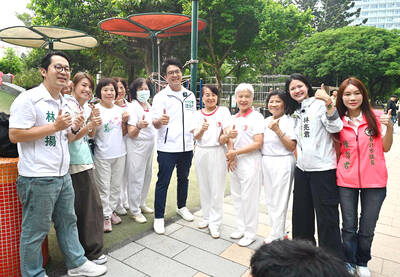
With weighty, anxiety-inducing geopolitical topics dominating the headlines, checking in on the wild and weird state of local politics can take some of the edge off. This November’s elections will determine who will be in charge of fixing potholes in your neighborhood, not the potholes in Taiwan’s complicated geopolitical space. Recently, after an online interview with a Taipei-based journalist, I commented that Taipei journalists never go further than the MRT can take them. He laughed and agreed. Naturally, the Taipei mayoral race is eating up much of the press attention. TAIPEI CITY Democratic Progressive Party (DPP) candidate Puma Shen (沈伯洋) has
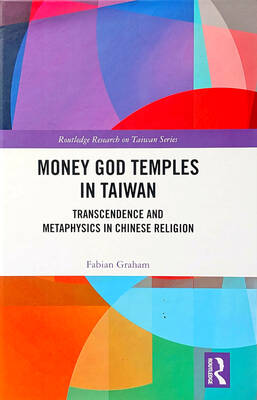
As someone who normally steers clear of books with “transcendence” or “metaphysics” in their subtitles, this reviewer — a casual observer of local belief systems since the 1990s — found Fabian Graham’s Money God Temples in Taiwan a challenging read. Those who’ve only dipped their toes into temple culture will likely need to parse several sections with special care if they’re to keep up with the author, a British ethnographic researcher whose previous books have investigated religious practices among ethnic Chinese in Southeast Asia. This scholarly volume examines a facet of Taiwan’s religious landscape that didn’t exist a century ago, and


 RSS
RSS