


The mass of Taipei's steakhouses can leave carnivores with feelings of quiet desperation.
Most smother their rib eye and T-bone in unappetizing choices of black pepper or mushroom sauces. This is a travesty, but ask to hold the sauce and you'll find that the meat tastes equally unpalatable. True, places like Noble Family steakhouse offer a free trip to the salad bar. But you'd get a better result if you spent the money they charge per meal on a good cut of meat and cooked it yourself.
Fortunately for steak lovers who don't have time to cook and can't afford Ruth's Chris, Bull-Demon-King offers tasty meals for very reasonable prices at two locations off Shida Road.
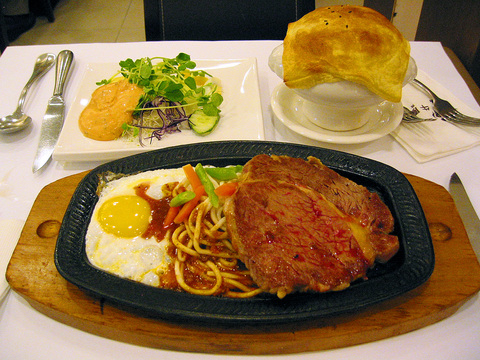
PHOTO: RON BROWNLOW, TAIPEI TIMES
Both are owned by Huang Jong-hsiang (黃榮祥), 50, who opened the first, a stall on Longquan Street in the Shida night market, more than 20 years ago. Even in hot weather, the stall is always packed at dinnertime, with customers jostling elbow-to-elbow at small folding tables as they wait for sizzling meals.
The night market location has become so popular that Huang opened a fancier sit-in Bull-Demon-King four years ago off Shida Road on Alley 49. There's air-conditioning here and the menu is more extensive, with side dishes like salad and puff pastry soups, along with additional main courses like a shrimp platter (蝦排, NT$240). The restaurant pulls in between 200 and 300 customers per day.
Huang chooses his cuts of beef himself, removes the tendons and bones, and marinates them for six hours, leaving the steaks tender and juicy. When a customer orders a meal, the steak is fried until nearly well-done, then dropped on a sizzling iron plate along with spaghetti and a raw egg, which cooks in seconds. Hold a napkin in front of the skillet because the meal will still be cooking when it comes to your table.
But the real difference is in the marinade, said Huang, when asked why his night market stall and restaurant are so popular. He studied Western cuisine in chef's school and invented his brew — an orange concoction containing chicken bones, onions, carrots, pepper, garlic and bacon — after much trial and error.
Because most of Bull-Demon-King's customers are students, prices are very reasonable. The generously portioned fried chicken cutlet costs NT$120 at the night market and NT$140 at the restaurant. A filet mignon (菲力牛排) meal will set you back NT$220 at the night market, or NT$280 at the restaurant. Each comes with sides like soup and tea at the outside location, or soup and salad in the restaurant.
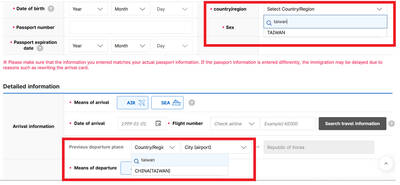
Jason Han says that the e-arrival card spat between South Korea and Taiwan shows that Seoul is signaling adherence to its “one-China” policy, while Taiwan’s response reflects a reciprocal approach. “Attempts to alter the diplomatic status quo often lead to tit-for-tat responses,” the analyst on international affairs tells the Taipei Times, adding that Taiwan may become more cautious in its dealings with South Korea going forward. Taipei has called on Seoul to correct its electronic entry system, which currently lists Taiwan as “China (Taiwan),” warning that reciprocal measures may follow if the wording is not changed before March 31. As of yesterday,

The Portuguese never established a presence on Taiwan, but they must have traded with the indigenous people because later traders reported that the locals referred to parts of deer using Portuguese words. What goods might the Portuguese have offered their indigenous trade partners? Among them must have been slaves, for the Portuguese dealt slaves across Asia. Though we often speak of “Portuguese” ships, imagining them as picturesque vessels manned by pointy-bearded Iberians, in Asia Portuguese shipping between local destinations was crewed by Asian seamen, with a handful of white or Eurasian officers. “Even the great carracks of 1,000-2,000 tons which plied
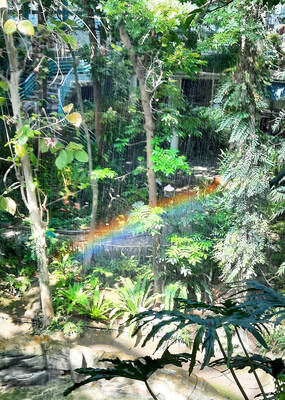
It’s only half the size of its more famous counterpart in Taipei, but the Botanical Garden of the National Museum of Nature Science (NMNS, 國立自然科學博物館植物園) is surely one of urban Taiwan’s most inviting green spaces. Covering 4.5 hectares immediately northeast of the government-run museum in Taichung’s North District (北區), the garden features more than 700 plant species, many of which are labeled in Chinese but not in English. Since its establishment in 1999, the site’s managers have done their best to replicate a number of native ecosystems, dividing the site into eight areas. The name of the Coral Atoll Zone might
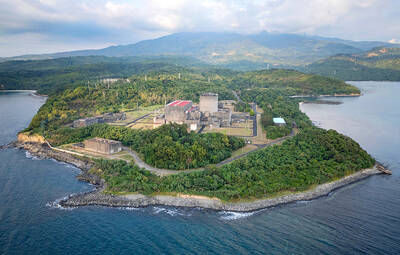
Nuclear power is getting a second look in Southeast Asia as countries prepare to meet surging energy demand as they vie for artificial intelligence-focused data centers. Several Southeast Asian nations are reviving mothballed nuclear plans and setting ambitious targets and nearly half of the region could, if they pursue those goals, have nuclear energy in the 2030s. Even countries without current plans have signaled their interest. Southeast Asia has never produced a single watt of nuclear energy, despite long-held atomic ambitions. But that may soon change as pressure mounts to reduce emissions that contribute to climate change, while meeting growing power needs. The


 RSS
RSS