


The subject matter was untested, the actors almost naked and the whole movie was to be made in a language spoken by only a tiny group of people -- but to film executive Brian Rosen, funding Australia's latest international film success, Ten Canoes, was a "no-brainer."
Even the fact that there was no conventional script, the cast were untrained and the set was a mosquito and crocodile-infested swamp in tropical northern Australia did not stop the ground-breaking movie from going ahead.
Filmed on location in the remote Arafura Swamp in northeastern Australia's Arnhem Land, the US$1.76 million-budget feature is the first to depict life in an Aboriginal community in the days before European invasion.
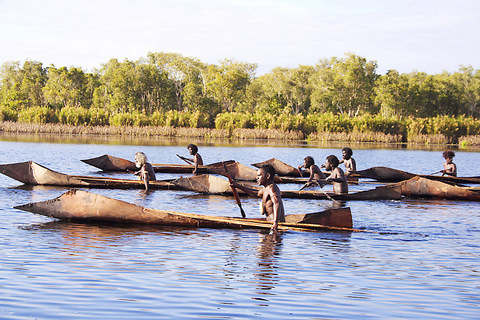
PHOTO: AFP
It switches between depictions of traditional life before contact with white people to more than a thousand years earlier during mythical times when the Aboriginal legends were formed.
"The one thing we felt when the project came in -- yes, it was directed by a white person -- but it was a very special story about indigenous mythology," Rosen, chief executive of the Australian Film Finance Corporation, said.
"On the one hand you could say that's pretty obscure, but on the other you could see it as a very important film."
Ten Canoes is the first Australian film to be shot entirely in indigenous language and its untrained cast come mainly from the remote post of Ramingining where one of the native tongues is Ganalbingu, which is spoken by fewer than 4,000 people.
The movie revolves around the story of a young man, Dayindi, who has taken a fancy to an older man's wife. The older man, aware of Dayindi's feelings, decides to tell him an ancient legend on the same theme.
While previous movies about Aboriginal communities have portrayed some aspect of their interaction with the white Europeans who began arriving here more than 200 years ago, this is the first to delve into their stories before colonization.
"We are going back to what it was like to live in Australia 1,000 years ago. The magical part of this film is that it's about their mythology," Rosen said.
"For the first time ever you are seeing their mythology on film. This is one that's a no-brainer. It's something about Australia that no one has seen before."
The film's reception has proven Rosen right. Ten Canoes won a special jury prize at the Cannes International Film Festival and has been picked up for distribution in the US and Europe.
Back home, the film has been welcomed by the local Aboriginal community in which it has awakened hopes of a revival of traditional indigenous culture.
Film-maker Rolf de Heer said he could not have made Ten Canoes without the assistance of the Ramingining community, which crafted the canoes, spears and housing needed for the movie and helped direct the narrative.
"It's unlike the normal way I would do a film because it's more I was a means by which I could make their story. I was, in a sense, their servant, in the best possible way I could be," he said.
"It was really me using the elements and parameters they gave me and fashioning that into something that would work for them and their community ... and the western world so their culture could be recognized."
For inspiration, the crew drew on the photographs of anthro-pologist Donald Thomson who lived in the area in the 1930s.
Included in his photographs are portrayals of traditional practices, such as magpie egg hunting, which have long since died out. The snapshots were instrumental in allowing the community to relearn how to make canoes and other artefacts.
De Heer said besides reviving these skills, the filming also unearthed traditional songs and provided the impetus for young people in the area to receive training in movie-making and for others to hold art exhibitions.
"Going up there a number of times, I thought I didn't want to do the thing that always happens, that you go in and you make a film and nothing gets left behind," he said.

Taiwan’s English education system is being pulled apart by three opposing forces. Bilingual Nation 2030 pulls students toward English and global communication. Artificial Intelligence (AI) readiness pulls them toward digital judgment, verification and AI-mediated work. But Taiwan’s old exam culture pulls them back toward memorization, grammar drills, timed reading and correct answers. If the education system keeps using old exams to define success, it risks producing graduates who are neither genuinely bilingual nor genuinely AI-ready, but trained for tasks machines can already perform. The first force is Bilingual Nation 2030. Launched in 2018, the policy aimed to “help Taiwan’s workforce connect

It seems every few days one bumps into one of those “real man” comments in which Taiwan is urged to “face reality” or similar, and “make a deal,” with the speaker implying that soon it will be too late. “Deal” advocates always present themselves as having a superior grip on reality, and the manly ability to make the “hard choice.” Their testosterone-laden language often echoes that of Taiwan sellout advocates. Note that such commentary always specifies a process (“make a deal, work with, make progress”), never the end state of what occupation by a violent authoritarian colonialist state will entail. In

“Taiwan’s Opposition Leader Comes to US With a Message Straight Out of Beijing” read a May 31 headline in the Wall Street Journal. Top US administration officials and members of Congress almost certainly read the WSJ, and if there was a bullet point takeaway that people in Washington should absorb ahead of Chinese Nationalist Party (KMT) Chair Cheng Li-wun’s (鄭麗文) arrival in DC on June 9, that headline is it. The last few columns have discussed this very topic, and the timing is not coincidental. While those top officials likely do not read the Taipei Times, judging by the number
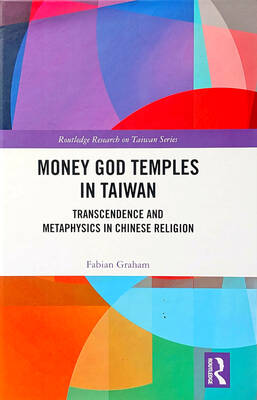
As someone who normally steers clear of books with “transcendence” or “metaphysics” in their subtitles, this reviewer — a casual observer of local belief systems since the 1990s — found Fabian Graham’s Money God Temples in Taiwan a challenging read. Those who’ve only dipped their toes into temple culture will likely need to parse several sections with special care if they’re to keep up with the author, a British ethnographic researcher whose previous books have investigated religious practices among ethnic Chinese in Southeast Asia. This scholarly volume examines a facet of Taiwan’s religious landscape that didn’t exist a century ago, and


 RSS
RSS