


Someone in Taipei has obviously been doing a lot of bye-byes to Terpsichore (the Greek muse of dance) because 2006 has definitely turned into the "Year of Dance."
In the past three months alone there has been an astonishing variety of performances from dance companies big and small, local and international, first-timers and favorite friends, providing a feast both for the eyes and mind, although a bit hard on the wallet.
Next up on the calendar is the return of the Bejart Ballet Lausanne to the National Theater next week, for what will be its third visit in six years.
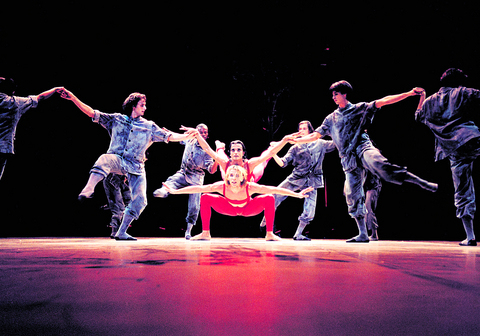
PHOTO COURTESY OF BEJART BALLET LAUSANNE
The company's program for its three-night, one matinee run will show audiences why 79-year old French choreographer Maurice Bejart has been such a vital part of the European Dance Theater movement for decades,
influencing an entire generation of choreographers such as Pina Bausch, Boris Eifman and Matthew Bourne.
The three pieces -- L'Amour, la Danse (also known as "The Best of Bejart"), L'Oiseau de feu and Elton-Berg -- demonstrate the three main reasons for Bejart's enduring popularity with audiences (although not always with critics).
Reason number one is Bejart's sexed-up takes on classical ballet with dances that celebrate male beauty and eroticism (such as Bolero), not to mention his flair for theatrical spectacles.
L'Amour, la Danse would certainly qualify as a spectacle in anyone's book. It was created last year as a way of celebrating Bejart's more than half a century as a choreographer by providing extracts from some of his more famous pieces. This anthology for 20 dancers includes solos, pas de deux and ensemble pieces from Romeo et Juliet, Le Presbytere, Brel and Barbara and The Seven Greek Dances -- and lots of good-looking men.
The second reason for his popularity has been his interest in exploring the political and social forces confronting society as well as injecting old themes into modern contexts.
In his 1970 production L'Oiseau de feu, Bejart gives a revolutionary twist to the Igor Stravinsky score for the Ballet Russe's 1910 The Firebird. Bejart completely revitalizes the Stravinsky music by portraying the firebird as the leader of a group of revolutionaries.
The third reason Bejart is so popular is his ability to make ballet or modern dance approachable to almost anyone. This has been helped by his enthusiastic embrace of non-traditional music, including rock (Queen), pop (U2) or "contemporary" (Jacques Brel).
In Elton-Berg Bejart uses one piece of choreography, set to two very different pieces of music, a song by Elton John and a composition by Alban Berg.
Bejart's muses are still going strong, and audiences in Taipei and elsewhere are the richer for it.
PERFORMANCE INFORMATION:
WHAT: Bejart Ballet Lausanne
WHERE: National Theater of the CKS Memorial Hall
WHEN: July 6-8 at 7:30pm and July 9 at 2:30pm
TICKETS: NT$800, NT$1,000,NT$1,500, NT$2,000, NT$2,500, NT$3,000,NT$3,500 and NT$4,000

The small platform at Duoliang Train Station in Taitung County’s Taimali Township (太麻里) served villagers from 1992 to 2006, but was eventually shut down due to lack of use. Just 10 years later, the abandoned train station had become widely known as the most beautiful station in Taiwan, and visitors were so frequent that the village had to start restricting traffic. Nowadays, Duoliang Village (多良) is known as a bit of a tourist trap, with a mandatory, albeit modest, admission fee of NT$10 giving access to a crowded lane of vendors with a mediocre view of the ocean and the trains

For many people, Bilingual Nation 2030 begins and ends in the classroom. Since the policy was launched in 2018, the debate has centered on students, teachers and the pressure placed on schools. Yet the policy was never solely about English education. The government’s official plan also calls for bilingualization in Taiwan’s government services, laws and regulations, and living environment. The goal is to make Taiwan more inclusive and accessible to international enterprises and talent and better prepared for global economic and trade conditions. After eight years, that grand vision is due for a pulse check. RULES THAT CAN BE READ For Harper Chen (陳虹宇), an adviser

Traditionally, indigenous people in Taiwan’s mountains practice swidden cultivation, or “slash and burn” agriculture, a practice common in human history. According to a 2016 research article in the International Journal of Environmental Sustainability, among the Atayal people, this began with a search for suitable forested slopeland. The trees are burnt for fertilizer and the land cleared of stones. The stones and wood are then piled up to make fences, while both dead and standing trees are retained on the plot. The fences are used to grow climbing crops like squash and beans. The plot itself supports farming for three years.

President William Lai (賴清德) on Nov. 25 last year announced in a Washington Post op-ed that “my government will introduce a historic US$40 billion supplementary defense budget, an investment that underscores our commitment to defending Taiwan’s democracy.” Lai promised “significant new arms acquisitions from the United States” and to “invest in cutting-edge technologies and expand Taiwan’s defense industrial base,” to “bolster deterrence by inserting greater costs and uncertainties into Beijing’s decision-making on the use of force.” Announcing it in the Washington Post was a strategic gamble, both geopolitically and domestically, with Taiwan’s international credibility at stake. But Lai’s message was exactly


 RSS
RSS