


If movies reflect the concerns of their time and the Cannes film festival accurately reflects what is on the minds of the world's film makers, then the world is now concerned with immigration, social injustice and political oppression.
Of the 20 films selected to compete for the Palme d'Or for best film at the 2006 Cannes International Film Festival, only four were not concerned to any extent with these issues.
More serious, perhaps, was the fact that comedy was used as an important device in only three of the 20 films, and one of them concerned murder and sexual abuse (Pedro Almodovar's Volver), one had as a main character a despicably unscrupulous loan shark (A Friend of the Family, by Paolo Sorrentino) and the third was about the end of the world (Richard Kelly's Southland Tales).

PHOTOS: EPA
No fewer than five of the movies in competition for this year's Palme d'Or used the issue of immigration, with Sorrentino making perhaps the most unexpected take on the theme.
A bold and very black comedy about the sleaziest, most cynical of usurers, A Friend of the Family opens with the arrival of a young, impoverished Romanian woman in the Italian city where the story takes place, and ends with her leaving the country bedecked in jewels and wrapped in an expensive fur coat.
As her bus pulls out of the station, she waves gaily to three Asian immigrants huddling forlornly on a bench. The implication of the closing image was clear: the world makes whores and usurers of us all and if you want to succeed you must lose all your scruples.

The issue of immigration takes a far more central place in Paolo Costa's Colossal Youth, which deals with Cape Verdean immigrants living in a rundown housing project in a suburb of the Portuguese capital Lisbon.
Rachid Bouchareb's Indigenes (Days of Glory) would win the prize for the most topical movie of the festival, if one were given, since its subject -- the 130,000 African volunteers who left their homelands to help liberate France from Nazi occupation in World War II -- touches directly or indirectly on the most sensitive issues in today's France: illegal immigration, racism and discrimination.
Immigration is also an issue in Mexican director Alejandro Gonzalez Inarritu's Babel, starring Brad Pitt, where it serves as a metaphor for the borders people erect in their heads.
Political oppression of the past, present and future informs at least five of the movies that vied for the Palme d'Or: Pan's Labyrinth by Mexico's Guillermo del Toro, Israel's Adrian Caetano's Buenos Aires 1977, Ken Loach's The Wind that Shakes the Barley, Lou Ye's Summer Palace, and Richard Kelly's Southland Tales.
The importance of the issue was underscored by Loach's being awarded the Palme d'Or for best film.
One is tempted to include Sofia Coppola's Marie Antoinette in this group, since its subject is the self-indulgent queen of France whose extravagant lifestyle (which the film suggests was the result of sexual frustration, insecurity and boredom) and indifference contributed to her subjects' inhumane living condition.
And one might also include Nanni Moretti's The Caiman, which wrapped a fierce critique of former Italian prime minister Silvio Berlusconi's alleged abuse of power around a touching domestic drama.
This year's festival-goers also managed to witness a bit of modern political harassment in the controversy surrounding Summer Palace, which was screened at Cannes without the requisite approval by Chinese government censors.
With its graphic sex scenes and use of the June 1989 bloody repression by Chinese soldiers of a pro-democracy protest at Tiananmen Square, Summer Palace was nearly not screened in Cannes at all.
Lou now faces a five-year ban on working if Beijing decides to make a high-profile example of him for defying the government's film bureau.
Social injustice was also the centerpiece theme of British director Andrea Arnold's stark first feature film Red Road.
Injustice is only hinted at in Marie Antoinette, but it is heavily present in Indigenes, The Wind that Shakes the Barley, Belgian director Lucas Belvaux's The Reasoning of the Weakest, Richard Linklater's Fast Food Nation, and Finnish director Aki Kaurismaki's Lights in the Dusk.
The third of Kaurismaki's trilogy about Finnish losers, Lights in the Dusk concerns the solitude of a man living near the bottom of the country's food chain.
It was certainly not a very uplifting programme this year. But perhaps in 2007, for its sixtieth film festival, Cannes will again be in the mood for love.
CANNES, France - British director Ken Loach's The Wind That Shakes the Barley won the top prize, the Palme d'Or, at the Cannes film festival on Sunday.
The following is a list of the winners of the main prizes and what they said:
PALME D'OR - The Wind That Shakes the Barley (Britain)
Director Ken Loach: "The wars that we have seen, the occupations that we see throughout the world -- people finally cannot turn away from that. And the fact that this is reflected in cinema is very important for the health of cinema. It's very exciting to be able to deal with this in films, and not just be a complement to the popcorn. I think the trend is very exciting. It puts cinema at the center of our lives really. I think that's brillant."
GRAND PRIX - Flanders (France)
French director Bruno Dumont: "I'm very touched. More than that, I'm very honored. It's an encouragement to those who think sincerely about making cinema without copying the mainstream."
BEST DIRECTOR - Babel (Mexico)
Mexican director Alejandro Gonzalez Inarritu: "It's a dream for me. A dream I can't believe has happened."
BEST ACTOR - Days of Glory (Algeria)
The prize went to the male cast, including Jamel Debbouze, Samy Naceri, Sami Bouajila, Roschdy Zem and Bernard Blancan.
Debbouze: "We don't hope to change things. But it's important to tell [the story]."
BEST ACTRESS - Volver (Spain)
The prize went to the female cast, including Penelope Cruz, Carmen Maura and Lola Duenas.
Cruz: "This prize really belongs to [director] Pedro [Almodovar]. You are the greatest, the bravest. You put so much magic into our lives. Thanks for what you do for women. I've always dreamt of becoming one of these women. Thank you. I love you with all my heart."
CAMERA D'OR (Golden Camera) - 12.08 East of Bucharest (Romania)
Director Corneliu Porumboiu: "I think there are good young directors [in Romania]. I think there is a new wave of young directors."
BEST SCREENPLAY - Volver
Almodovar: "[In making this film] I was accompanied by my sisters who helped me to remember everything about my childhood in La Mancha that I had forgotten."
JURY PRIZE - Red Road (Britain)
Director Andrea Arnold: "I'm overwhelmed again. I'm like a rabbit in the headlights."
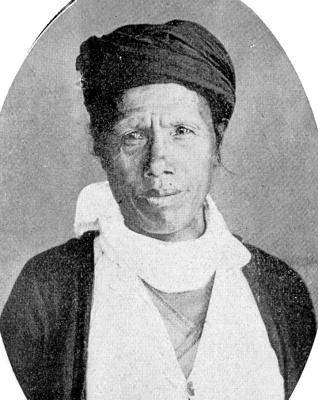
May 11 to May 17 Traversing the southern slopes of the Yushan Range in 1931, Japanese naturalist Tadao Kano knew he was approaching the last swath of Taiwan still beyond colonial control. The “vast, unknown territory,” protected by the “fierce” Bunun headman Dahu Ali, was “filled with an utterly endless jungle that choked the mountains and valleys,” Kano wrote. He noted how the group had “refused to submit to the measures of our authorities and entrenched themselves deep in these mountains … living a free existence spent chasing deer in the morning and seeking serow in the evening,” even describing them as

As a different column was being written, the big news dropped that Chinese Nationalist Party (KMT) caucus whip Fu Kun-chi (傅?萁) announced that negotiations within his caucus, with legislative speaker Han Kuo-yu (韓國瑜) of the KMT, party Chair Cheng Li-wun (鄭麗文), Taichung Mayor Lu Shiow-yen (盧秀燕) and Taiwan People’s Party (TPP) Chair Huang Kuo-chang (黃國昌) had produced a compromise special military budget proposal. On Thursday morning, prior to meeting with Cheng over a lunch of beef noodles, Lu reiterated her support for a budget of NT$800 or NT$900 billion — but refused to comment after the meeting. Right after Fu’s

Yesterday, the Democratic Progressive Party (DPP) nominated legislator Puma Shen (沈伯洋) as their Taipei mayoral candidate, the Chinese Nationalist Party (KMT) put their stamp of approval on Wei Ping-cheng (魏平政) as their candidate for Changhua County commissioner and former legislator Tsai Pi-ru (蔡壁如) of the Taiwan People’s Party (TPP) has begun the process to also run in Changhua, though she has not yet been formally nominated. All three news items are bizarre. The DPP has struggled with settling on a Taipei nominee. The only candidate who declared interest was Enoch Wu (吳怡農), but the party seemed determined to nominate anyone
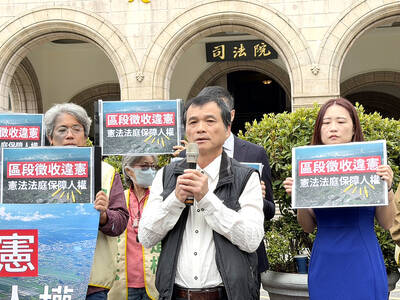
What government project has expropriated the most land in Taiwan? According to local media reports, it is the Taoyuan Aerotropolis, eating 2,500 hectares of land in its first phase, with more to come. Forty thousand people are expected to be displaced by the project. Naturally that enormous land grab is generating powerful pushback. Last week Chen Chien-ho (陳健和), a local resident of Jhuwei Borough (竹圍) in Taoyuan City’s Dayuan District (大園) filed a petition for constitutional review of the project after losing his case at the Taipei Administrative Court. The Administrative Court found in favor of nine other local landowners, but


 RSS
RSS