


In the English-speaking world -- especially the world of theater -- most people know that Anton Chekhov wrote The Cherry Orchard. Canada's Theatre Smith-Gilmour first produced that play in 1998.
Sitting in a dull hallway in the National Theater (
"We felt a frustration that we wanted to accomplish something that we couldn't do with the actors we were working with," he said. "[They] had preconceived notions of how to play Chekhov .... No matter what we did, they went back to that."
And so, one year after tackling The Cherry Orchard, Theatre Smith-Gilmour began work on Chekhov's Shorts. The play will be performed as part of Taipei's biennial International Theater Festival. Tickets for the show, however, sold out before it opened.
Theatre Smith-Gilmour's take on Chekhov's fiction is a stark departure from orthodox interpretations of the Russian dramatist's work.
"I feel like we learn more about the theater from his fiction," Gilmour said. "In Chekhov, there's an essential and invisible story underneath the text."
In the play, a group of Russians travel On the Train to a place called Run-For-Your-Life. They pass the time by swapping stories, which are theatrical adaptations of Man in a Shell, Kashtanka, Sleepyhead, and Rothschild's Fiddle.
The entire production is performed by a cast of four which plays many roles, and aims to reveal "an intuitive response to the material" by escaping the context of 19th-century theater.
"What we set out to do was start with no decor and no props, and ... focus on the actors and what the actors could do," Gilmour said.
In fact, they didn't even start with a script. Over the course of a year, the four actors honed initial improvisations into an obsessively controlled choreography. There is dialogue, but there is also a reliance on the clown, mime, and melodramatic techniques of the School of Jacques Lecoq, where Gilmour and Smith met as students.
Many of the objects in the play -- playing cards, opera glasses, etc. -- exist only through mime. The main props are four suitcases, which are used extensively to represent chairs, walls, and an accordion. Everything else is created through the actors' movements.
Both Smith and Gilmour insist that this freedom from the text is what allows them access to the "tragicomic" stories "underneath the text."
"We ? find ways of telling the story, and it's not about reducing the story to a play," said Smith (when the two of them are together, Gilmour does most of the talking).
The bodily aspect of the play is both theatrically effective and visually intriguing. In the scene based on The Man in the Shell, Smith plays Belikov, a socially stunted and terminally self-conscious bureaucrat whose hands have the ability to retract expressively into the sleeves of his coat.
As Belikov shuffles slowly across the stage, the other three actors hold their suitcases vertically to create a wall behind him. The wall "follows" Smith as its component actors spin from the back to the front, taking time to recite a few lines of neighborhood gossip in between rotations.
As prosaic as that sounds, it's a kick to watch on stage -- which is the point.

Taiwan’s English education system is being pulled apart by three opposing forces. Bilingual Nation 2030 pulls students toward English and global communication. Artificial Intelligence (AI) readiness pulls them toward digital judgment, verification and AI-mediated work. But Taiwan’s old exam culture pulls them back toward memorization, grammar drills, timed reading and correct answers. If the education system keeps using old exams to define success, it risks producing graduates who are neither genuinely bilingual nor genuinely AI-ready, but trained for tasks machines can already perform. The first force is Bilingual Nation 2030. Launched in 2018, the policy aimed to “help Taiwan’s workforce connect
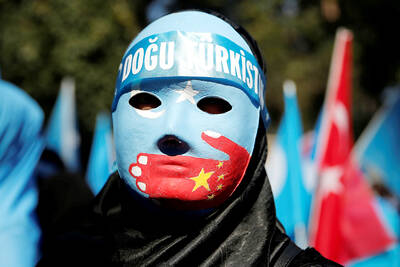
It seems every few days one bumps into one of those “real man” comments in which Taiwan is urged to “face reality” or similar, and “make a deal,” with the speaker implying that soon it will be too late. “Deal” advocates always present themselves as having a superior grip on reality, and the manly ability to make the “hard choice.” Their testosterone-laden language often echoes that of Taiwan sellout advocates. Note that such commentary always specifies a process (“make a deal, work with, make progress”), never the end state of what occupation by a violent authoritarian colonialist state will entail. In

“Taiwan’s Opposition Leader Comes to US With a Message Straight Out of Beijing” read a May 31 headline in the Wall Street Journal. Top US administration officials and members of Congress almost certainly read the WSJ, and if there was a bullet point takeaway that people in Washington should absorb ahead of Chinese Nationalist Party (KMT) Chair Cheng Li-wun’s (鄭麗文) arrival in DC on June 9, that headline is it. The last few columns have discussed this very topic, and the timing is not coincidental. While those top officials likely do not read the Taipei Times, judging by the number
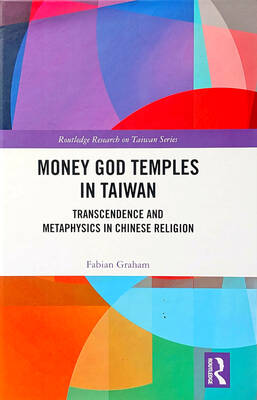
As someone who normally steers clear of books with “transcendence” or “metaphysics” in their subtitles, this reviewer — a casual observer of local belief systems since the 1990s — found Fabian Graham’s Money God Temples in Taiwan a challenging read. Those who’ve only dipped their toes into temple culture will likely need to parse several sections with special care if they’re to keep up with the author, a British ethnographic researcher whose previous books have investigated religious practices among ethnic Chinese in Southeast Asia. This scholarly volume examines a facet of Taiwan’s religious landscape that didn’t exist a century ago, and


 RSS
RSS