


The Last Witchfinder is a novel with two different authors, only one of whose names appears on the cover. He is James Morrow, a writer whose reputation has not caught up with his accomplishments. Morrow is a very odd bird, a novelist of intellect, bravado and wildly phantasmagorical imagination. In the eight works of fiction that precede this one and have sometimes fused satire, philosophy and science fiction, he has, among other things, envisioned a literal Godhead the size of Delaware.
Now to the other author who takes credit for The Last Witchfinder: This one isn't a person. It is a scientific treatise written in Latin, Sir Isaac Newton's Philosophiae Naturalis Principia Mathematica. As the book wryly acknowledges, "I must confess that much of what lies between my covers is as opaque to me as to anyone else." Yet the Principia claims to be such an esteemed classic that it is often found "right next to the Bible, perhaps, or rubbing covers with Homer."
Morrow lets the Principia begin narrating The Last Witchfinder by revealing that books secretly write other books (albeit with human help) and that they sometimes do it for sport. For instance: "After Waiting for Godot acquired a taste for writing Windows software documentation, there was no stopping it."
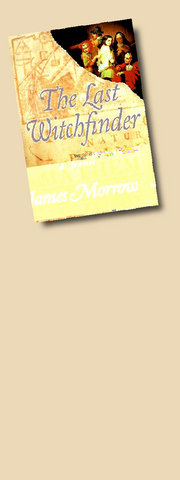
This is fancy footwork, and it is a showy, convoluted way to begin what is essentially a historical novel, a picaresque tale steeped in philosophical debate. The author, like John Barth (whose Sot-Weed Factor this book recalls), does not wear his erudition lightly. But he wears it audaciously well.
The heroine of The Last Witchfinder is Jennet Stearne, whose last name must be a nod to the author of the similarly roundabout Tristram Shandy, and whose mission throughout this novel is unwavering. Jennet seeks to repudiate the idea of witchcraft on a scientific basis, and she hopes to do this with the help of the great Newton himself. "Isn't Newton the sage who wrote that book neither he or anyone else understands?" one scholar asks during the course of the story.
Newton has also been an inspiration to Jennet's Aunt Isobel, who teaches her niece the tenets of cutting-edge science. (The year is 1688, when Jennet is a preado-lescent girl.) But their experiments with dissection, the use of Anton van Leeuwenhoek's microscope and the principle of uniform acceleration postulated by Galileo come at an unfortunate time in the history of women and ideas. Aunt Isobel is deemed a witch and is condemned by her own brother-in-law, Walter Stearne, the self-important would-be Witchfinder Royal of England.
Jennet mistakenly enlists one of Newton's worst enemies, Robert Hooke, to testify on Aunt Isobel's behalf. In a comic episode rendered with sublime mischief by Morrow, Hooke pretends to be an obscenity-spouting Newton. He does his best to behave scandalously and winds up sealing Isobel's fate. Jennet then vows to avenge her aunt and escape her father in ways that the Principia finds immensely admirable. The Principia itself is engaged in "an Armageddon of ideas" with another book, the Malleus Maleficarum, the set of rules that is relied upon by witch-hunters to justify their endeavors.
Since he has been ill advised to persecute a woman as wealthy and prominent as Aunt Isobel, Walter is banished to the Massachusetts Bay Colony with Jennet in tow. The Last Witchfinder is the kind of rich, rollicking, episodic book in which many such changes of scenery will follow. Next, "Jennet, whose attitude toward these
wilting Puritans fell far short of affection," winds up being abducted by Nimacook Indians (Morrow's fictionalized version of the Abenaki, who use the Algonquin language) and winds up married to one of them. She spends several years being known as Waewowesheckmishquashim, and being made to realize that the noblest of scientific principles aren't much use in weaving reed mats or catching salmon.
In another show of narrative brio, Jennet is snatched away from the Indians by a lovestruck postman named Tobias, through whose efforts she winds up in Boston. "Do you perchance enjoy access to the library at Harvard College?" she asks Tobias, while deciding whether to stay with him. Again, she marries. But eventually Jennet realizes that "whilst she would hesitate to call Tobias a man for whom ignorance was bliss, it seemed likely that in matters of bliss this man would always be ignorant."
Now Jennet resumes her dedication to scientific debate. "All flowings and fallings, all flappings and snappings, all swingings and springings, all splittings and fittings know naught of goblins, but only of goodness," she writes in witchcraft-debunking mode. In the interests of having her manifesto published, she winds up in Philadelphia, where Jennet -- now middle-aged -- encounters the 19-year-old printer Benjamin Franklin. Another of the novel's feats of comic audacity has these two setting off sparks, and not the kind obtained by flying a kite. "A dozen articles of clothing tumbled to the floor at uniform Galilean velocities," Morrow writes, describing Jennet and Franklin's first meeting of the minds. The Principia claims that Jennet is the mother of William Franklin, Benjamin's son, but says that Franklin's "Poor Richard's Almanack" has implored the Principia to be discreet about the boy's parentage.
The above synopsis barely scratches the surface of The Last Witchfinder. It is a book to which Morrow devoted seven years, according to its jacket copy. And that prodigious dedication pays off. Here are storytelling, showmanship and provocative book-club bait (try finding another recent novel that rivals this one for erudite talking points), all rolled into one inventive feat.

Taiwan’s English education system is being pulled apart by three opposing forces. Bilingual Nation 2030 pulls students toward English and global communication. Artificial Intelligence (AI) readiness pulls them toward digital judgment, verification and AI-mediated work. But Taiwan’s old exam culture pulls them back toward memorization, grammar drills, timed reading and correct answers. If the education system keeps using old exams to define success, it risks producing graduates who are neither genuinely bilingual nor genuinely AI-ready, but trained for tasks machines can already perform. The first force is Bilingual Nation 2030. Launched in 2018, the policy aimed to “help Taiwan’s workforce connect

It seems every few days one bumps into one of those “real man” comments in which Taiwan is urged to “face reality” or similar, and “make a deal,” with the speaker implying that soon it will be too late. “Deal” advocates always present themselves as having a superior grip on reality, and the manly ability to make the “hard choice.” Their testosterone-laden language often echoes that of Taiwan sellout advocates. Note that such commentary always specifies a process (“make a deal, work with, make progress”), never the end state of what occupation by a violent authoritarian colonialist state will entail. In

“Taiwan’s Opposition Leader Comes to US With a Message Straight Out of Beijing” read a May 31 headline in the Wall Street Journal. Top US administration officials and members of Congress almost certainly read the WSJ, and if there was a bullet point takeaway that people in Washington should absorb ahead of Chinese Nationalist Party (KMT) Chair Cheng Li-wun’s (鄭麗文) arrival in DC on June 9, that headline is it. The last few columns have discussed this very topic, and the timing is not coincidental. While those top officials likely do not read the Taipei Times, judging by the number
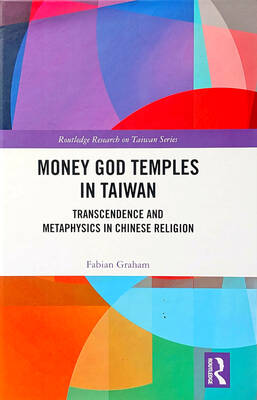
As someone who normally steers clear of books with “transcendence” or “metaphysics” in their subtitles, this reviewer — a casual observer of local belief systems since the 1990s — found Fabian Graham’s Money God Temples in Taiwan a challenging read. Those who’ve only dipped their toes into temple culture will likely need to parse several sections with special care if they’re to keep up with the author, a British ethnographic researcher whose previous books have investigated religious practices among ethnic Chinese in Southeast Asia. This scholarly volume examines a facet of Taiwan’s religious landscape that didn’t exist a century ago, and


 RSS
RSS