


If you are looking for a good dose of outrage at a theater near you, you won't find a better bargain than Enron: The Smartest Guys in the Room, a new documentary directed by Alex Gibney. Documentaries have recently been making up for a shortfall in genuine movie heroes -- those plucky child orthographers Spellbound and the gritty wheelchair jocks of Murderball come to mind -- and Gibney's film is the latest evidence that nonfiction cinema can supply worthy, hissable villains as well.
Anyone who might be in the jury pool for the coming trials of Kenneth Lay and Jeffrey Skilling, the top Enron executives who have yet to face justice, should probably stay away, since the movie makes the case against them with prosecutorial vigor. Based on the best-selling book by the Fortune magazine reporters Bethany McLean and Peter Elkind, Enron is a tight, fascinating chronicle of arrogance and greed. Interweaving Peter Coyote's sober, ever-so-slightly sarcastic voice-over narration with interviews and video clips (as well as one ill-advised and unnecessary re-enactment) and accompanied by an anthology of well-chosen pop songs, it manages to be both informative and entertaining.
Much of the entertainment value comes from the undeniable pleasure of feeling morally superior to many of the people on screen, a nice antidote to the envy they might have inspired when they were riding high. Gibney uses video from Congressional hearings and financial chat-show appearances to damning effect; in the era before CSPAN and CNBC, the case against Enron might have been much harder to make.
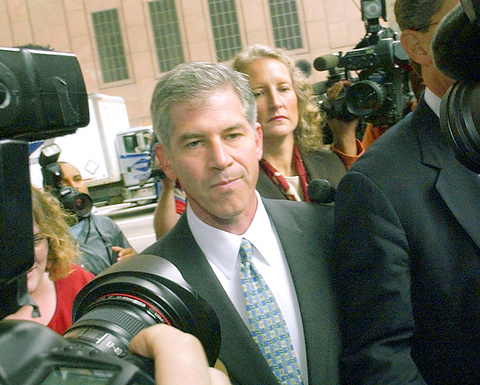
PHOTO COURTESY OF JOINT ENTERTAINMENT
He has also obtained in-house video from company meetings, in which Skilling and Lay, in their very different styles, strut and brag through the company's boom years. Lay is a bit like a classic Texas football coach -- gruff, tough but also possessing a measure of courtly charm. Skilling is more tightly wound, supremely confident of his intellect and abilities, with a chillier demeanor than his boss. When their enterprise starts to collapse, Skilling, expressing no remorse and accepting no responsibility, abruptly quits. Lay, rallying his troops, indulges in one of the most dismaying appropriations of the Sept. 11 attacks ever recorded, declaring to employees in the autumn of 2001 that, just like the US, Enron is under attack.
Among its tormentors were members of Congress from both parties, and also Elkind and McLean, who had the temerity, in the spring of 2001, to write a gently skeptical article called "Is Enron Overvalued?" What eventually became clear was that the company had been concocting value out of thin air, thanks not to the trading strategies it promoted as visionary but to financial games that turned a once-solid natural-gas distributor into the most notorious debacle in the era of corporate scandals. At times, the movie's explanation of Enron's business practices is hard to follow -- and the practices themselves seem to have been deliberately made complex to the point of opacity -- but the gist is clear enough.
When boilerplate fails, many of the film's interview subjects resort to metaphor. The Titanic comes up more than once. Jonestown, the Lusitania and earthquakes are also mentioned. A Houston minister whose congre-gation includes many former Enron employees likens the company to "a house of cards built over a pool of gasoline." Appropriately enough, Gibney's quick, fluid editing gives his film the suspenseful, queasy fasci-nation of a disaster flick, even -- or perhaps especially -- because you know exactly where it's headed. As the story moves forward, keep your eye on the bottom of the screen, where the stock price is periodically shown. Watch it soar, and then watch it plummet.
Of course, the consequences of Enron's foray into funny money were quite serious, and Enron: The Smartest Guys in the Room does not forget the real costs of this catastrophe. While it notes the friendship between Lay and the Bush family, and details Enron's role in the California energy crisis and the political destruction of Gray Davis, the film is for the most part too journa-listically scrupulous to indulge in anything that might smack of conspiracy theorizing.
Which is not to say that its scope is narrow or the implications of its story confined to one reckless Texas company. While the audience's contempt for Lay and Skilling feels good and is duly earned, Gibney does not encourage undue smugness. Without spelling too much out, Enron suggests a widespread moral deficit underlying Enron's eventual bankruptcy. Accountants held no one to account, governments abandoned their regulatory functions, the media turned cheaters into stars and a culture of self-righteous mendacity was allowed to flourish as long as the stock prices were high.
The smart guys at Enron were clever -- and amoral -- enough to profit from those circumstances. In all likelihood, they regard themselves as scapegoats, even as the public views them as villains. It's not impossible that they are, to some extent, both.

The Portuguese never established a presence on Taiwan, but they must have traded with the indigenous people because later traders reported that the locals referred to parts of deer using Portuguese words. What goods might the Portuguese have offered their indigenous trade partners? Among them must have been slaves, for the Portuguese dealt slaves across Asia. Though we often speak of “Portuguese” ships, imagining them as picturesque vessels manned by pointy-bearded Iberians, in Asia Portuguese shipping between local destinations was crewed by Asian seamen, with a handful of white or Eurasian officers. “Even the great carracks of 1,000-2,000 tons which plied

It’s only half the size of its more famous counterpart in Taipei, but the Botanical Garden of the National Museum of Nature Science (NMNS, 國立自然科學博物館植物園) is surely one of urban Taiwan’s most inviting green spaces. Covering 4.5 hectares immediately northeast of the government-run museum in Taichung’s North District (北區), the garden features more than 700 plant species, many of which are labeled in Chinese but not in English. Since its establishment in 1999, the site’s managers have done their best to replicate a number of native ecosystems, dividing the site into eight areas. The name of the Coral Atoll Zone might
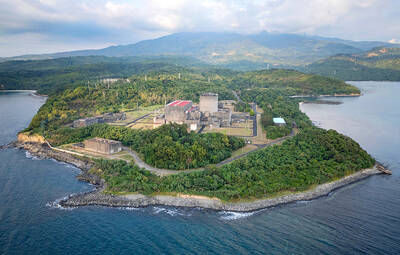
Nuclear power is getting a second look in Southeast Asia as countries prepare to meet surging energy demand as they vie for artificial intelligence-focused data centers. Several Southeast Asian nations are reviving mothballed nuclear plans and setting ambitious targets and nearly half of the region could, if they pursue those goals, have nuclear energy in the 2030s. Even countries without current plans have signaled their interest. Southeast Asia has never produced a single watt of nuclear energy, despite long-held atomic ambitions. But that may soon change as pressure mounts to reduce emissions that contribute to climate change, while meeting growing power needs. The

On Monday morning, in quick succession, the Chinese Communist Party (CCP) and the Chinese Nationalist Party (KMT) released statements announcing “that the Central Committee of the Communist Party of China and General Secretary Xi Jinping (習近平) have invited KMT Chairwoman Cheng Li-wun (鄭麗文) to lead a delegation on a visit to the mainland” as the KMT’s press release worded it. The KMT’s press release added “Chairwoman Cheng expressed her gratitude for the invitation and has gladly accepted it.” Beijing’s official Xinhua news release described Song Tao (宋濤), head of the Taiwan Work Office of the CCP Central Committee, as


 RSS
RSS