


Haxen Gaststatte has been open 10 years, so it must be doing something right, although within 10 minutes of entering this German restaurant several grumbles presented themselves: the proprietor was a little cold and the lighting was garish with florescent lights running along the edge of the ceiling.
The decoration sticks to the safety of beige and cream. The walls are filled with tourist paraphernalia, several framed sets of playing cards that show photographs of German landmarks and a large picture of a nondescript mountain scene hangs on the back wall.
The one window table affords patrons a vista of Fuxing North Road.
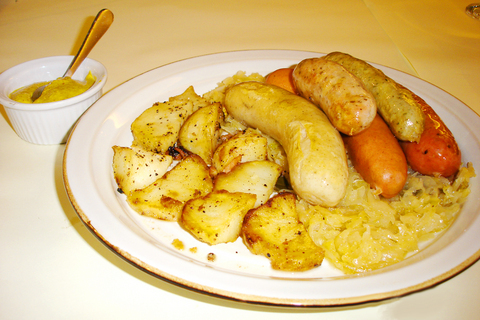
PHOTO: STEVE PRICE, TAIPEI TIMES
A reviewer on the American Chamber of Commerce Web site described the place as a "nicely decorated venue." Inoffensive would be more to the point.
Many German restaurants in Taipei include the usual variations on the theme of sausages, pork knuckle, spatzle and black forest gateau: Haxen Gaststatte is no exception.
But as more German restaurants open their doors the bar gets higher.
A set menu is available 11:30am until 2:30pm from Tuesday through Friday. Choices include sausages with bread, smoked pork loin, vegetable spatzle and beef stew, all of which come with salad, soup and tea or coffee.
For appetizers the a la carte menu includes mushroom gratin, deep fried camembert, potato pancake and swiss hashbrown. Main course choices include veal sausages, pork sausages, pepper sausages, Nurnberger sausages, spatzle with tomato sauce, gnocci in pesto cream sauce and boiled pork knuckle. For an extra NT$190 dishes come with soup, salad, dessert and coffee or tea.
So what does this place do well?
After a small bowl of highly seasoned mushroom soup and a plate of salad that consisted of grated carrot, red cabbage and potato salad topped off with two slices of lightly smoked ham the waitress brought over the main course -- mixed sausage platter. Five sausages of various shades of brown and pink were presented on a generous bed of sauerkraut, accompanied by pan-fried potatoes and a pot of honey mustard.
The tart sauerkraut was a good counterpoint to the meat fest and potatoes. The mustard was mild with a sweet edge. All in all a satisfying combination of flavors and textures.
If one asks Taiwanese why house prices are so high or why the nation is so built up or why certain policies cannot be carried out, one common answer is that “Taiwan is too small.” This is actually true, though not in the way people think. The National Property Administration (NPA), responsible for tracking and managing the government’s real estate assets, maintains statistics on how much land the government owns. As of the end of last year, land for official use constituted 293,655 hectares, for public use 1,732,513 hectares, for non-public use 216,972 hectares and for state enterprises 34 hectares, yielding
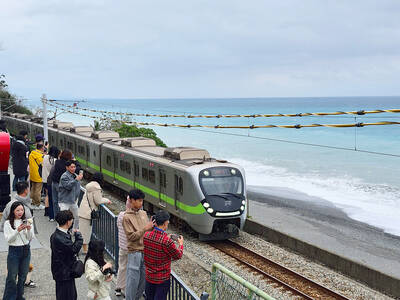
The small platform at Duoliang Train Station in Taitung County’s Taimali Township (太麻里) served villagers from 1992 to 2006, but was eventually shut down due to lack of use. Just 10 years later, the abandoned train station had become widely known as the most beautiful station in Taiwan, and visitors were so frequent that the village had to start restricting traffic. Nowadays, Duoliang Village (多良) is known as a bit of a tourist trap, with a mandatory, albeit modest, admission fee of NT$10 giving access to a crowded lane of vendors with a mediocre view of the ocean and the trains

The March/April volume of Foreign Affairs, long a purveyor of pro-China pablum, offered up another irksome Beijing-speak on the issues and solutions for the problems vexing the People’s Republic of China (PRC) and the US: “America and China at the Edge of Ruin: A Last Chance to Step Back From the Brink” rang the provocative title, by David M. Lampton and Wang Jisi (王緝思). If one ever wants to describe what went wrong with US-PRC relations, the career of Wang Jisi is a good place to start. Wang has extensive experience in the US and the West. He was a visiting
One of the challenges with the sheer availability of food in today’s world is that lots of us end up spending many of our waking hours eating. Whether it’s full meals, snacks or desserts, scientists have found that it’s not uncommon for us to be mindlessly grazing at some point during all of our 16 or so waking hours. The problem? As soon as this food hits the bloodstream in the form of glucose, it initiates the release of the hormone insulin. This in turn activates a switch present in every one of our cells, which is responsible for driving cell


 RSS
RSS