


Recently, the Taipei Fine Arts Museum has started exhibiting part of its collection in thematic exhibitions -- a great way to learn about Taiwan's modern history as told through art. Figurative painting in Taiwan is divided into five areas and these take the viewer through the story of Taiwan's diverse painting history and features 120 works by 70 artists.
The first theme is "Naturalism-Objectivity," which mainly consists of landscape painting. This inclusion seems strange, as in Western art history classes it is taught that figurative painting is the depiction of the human form. For local painters, however, there did not seem to be separate categories as the body and the landscape were interchangeable subjects for them.
The impressionist school of pain-ting began to influence Taiwanese painters in the 1950s. It also coincided with the New Art Movement of the Japanese colonial period (1895 to 1945) when artists depicted material objects in naturalistic ways. Even though the techniques may have come from outside influences, the subject matter was unique to Taiwan and included images of farmers, village life, and the water buffalo -- which soon came to symbolize Formosan life.
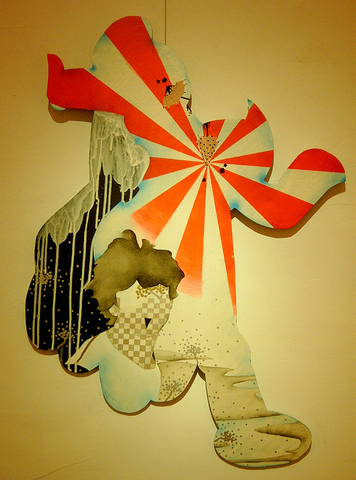
PHOTO COURTESY OF TFAM
Yen Shui-long's (
Under the theme "Altered Forms-Simplification," more lyrical and fanciful paintings appear. Wu Hao's (
As nativist literature began to influence the local visual arts during the 1970s, painters began to use Western painting techniques such as photorealism to portray Taiwan's grassroots culture. "Native Consciousness-Photorealism" is a grouping of paintings that depict Taiwan's unique local flavor.
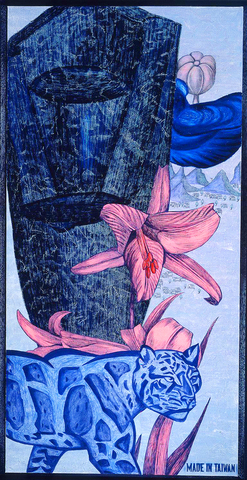
PHOTO COURTESY OF TFAM
As neo-expressionist painting swept Europe and North America in the early 1980s, the passionate forms of expressive brushwork had a major influence on Taiwanese painters. However, these artists had strong ideas about Taiwanese identity and were concerned with the contemporary political and social issues, as martial law was beginning to lose its grip. Under the theme "Historical Subjects-Neo-Expressionism" many of the works by these critical painters refer to the local history of coloni-zation and the struggle in the search for a native identity.
Yang Mao-lin's (
The last theme of the exhibition is "Virtual Realities-New Figurative Forms" and highlights the pluralist nature of the local art scene in the 1990s. As more artists studied or traveled abroad, they brought back diverse cultural influences. Wu Yung-chieh's (
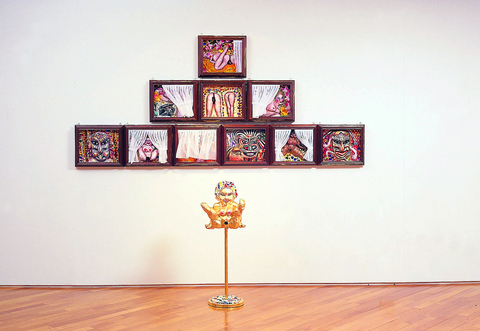
PHOTO COURTESY OF TFAM

Taiwan’s English education system is being pulled apart by three opposing forces. Bilingual Nation 2030 pulls students toward English and global communication. Artificial Intelligence (AI) readiness pulls them toward digital judgment, verification and AI-mediated work. But Taiwan’s old exam culture pulls them back toward memorization, grammar drills, timed reading and correct answers. If the education system keeps using old exams to define success, it risks producing graduates who are neither genuinely bilingual nor genuinely AI-ready, but trained for tasks machines can already perform. The first force is Bilingual Nation 2030. Launched in 2018, the policy aimed to “help Taiwan’s workforce connect

It seems every few days one bumps into one of those “real man” comments in which Taiwan is urged to “face reality” or similar, and “make a deal,” with the speaker implying that soon it will be too late. “Deal” advocates always present themselves as having a superior grip on reality, and the manly ability to make the “hard choice.” Their testosterone-laden language often echoes that of Taiwan sellout advocates. Note that such commentary always specifies a process (“make a deal, work with, make progress”), never the end state of what occupation by a violent authoritarian colonialist state will entail. In

“Taiwan’s Opposition Leader Comes to US With a Message Straight Out of Beijing” read a May 31 headline in the Wall Street Journal. Top US administration officials and members of Congress almost certainly read the WSJ, and if there was a bullet point takeaway that people in Washington should absorb ahead of Chinese Nationalist Party (KMT) Chair Cheng Li-wun’s (鄭麗文) arrival in DC on June 9, that headline is it. The last few columns have discussed this very topic, and the timing is not coincidental. While those top officials likely do not read the Taipei Times, judging by the number
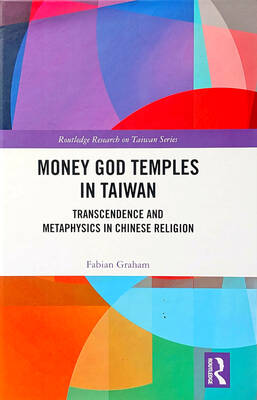
As someone who normally steers clear of books with “transcendence” or “metaphysics” in their subtitles, this reviewer — a casual observer of local belief systems since the 1990s — found Fabian Graham’s Money God Temples in Taiwan a challenging read. Those who’ve only dipped their toes into temple culture will likely need to parse several sections with special care if they’re to keep up with the author, a British ethnographic researcher whose previous books have investigated religious practices among ethnic Chinese in Southeast Asia. This scholarly volume examines a facet of Taiwan’s religious landscape that didn’t exist a century ago, and


 RSS
RSS